



Volkswagen is doubling down on gas-powered SUVs for the US.
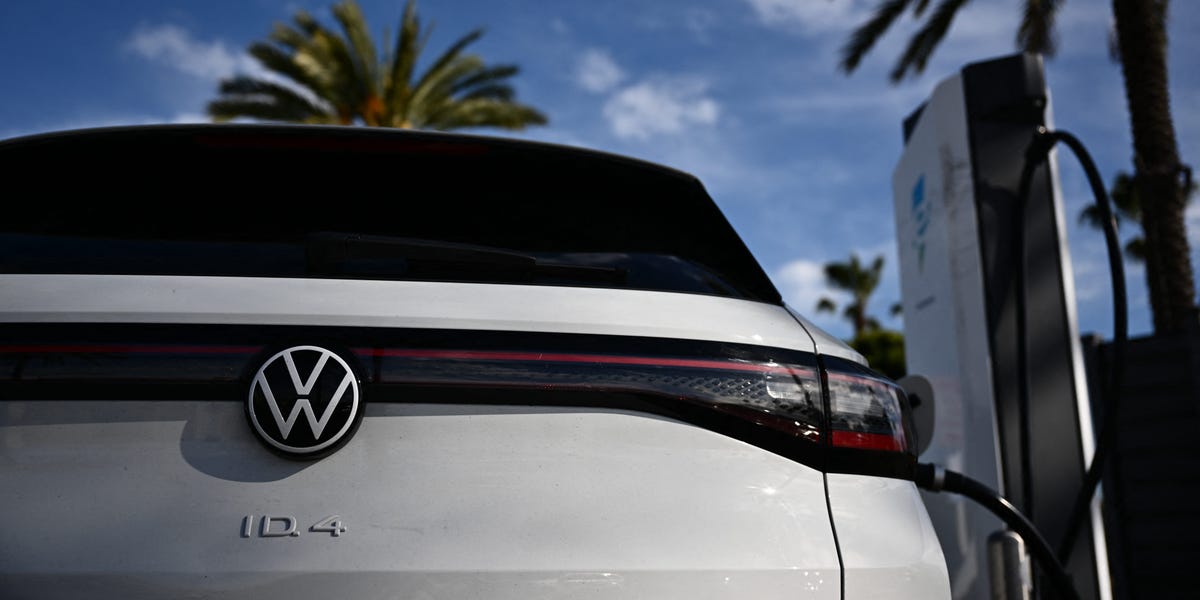
On Thursday, the German automaker said it would end assembly of the electric ID.4 crossover SUV at its Chattanooga, Tennessee, plant by mid-April.
The move means Volkswagen’s US EV sales will rely entirely on existing inventory. A spokesperson confirmed that the company does not import any ID.4s into the US.
“The EV market continues to challenge the industry, requiring measured decisions throughout the last few years to navigate this unpredictability,” VW said in the press release.
Instead, VW said the Tennessee plant will focus on building “higher-volume” models like the redesigned 2027 Atlas SUV, which the automaker unveiled ahead of last week’s New York Auto Show. The updated SUV is set to begin production this summer and arrive in dealerships this fall.
The factory switch-up also underscores a broader pullback in Volkswagen’s US EV strategy.
The ID.4 was once central to Volkswagen’s electric ambitions. When it launched globally in 2020, the automaker positioned it as a key step in expanding beyond its traditional gas-powered lineup. It also had targets to bring additional EVs, including the ID.7 sedan, to the US. The sedan’s US launch was later scrapped.
While the Tennessee factory will stop building the ID.4, the company said 2026 crossover EV will remain available “through current inventory,” which it expects will last into 2027.
It’s a similar approach to one the automaker outlined in December, when it said it would not bring the 2026 ID. Buzz EV to the US, citing weaker-than-expected demand. Instead, it said existing supply would cover sales until a refreshed version arrives next year.
Both models are expected to come back to US dealerships in 2027 with fresh updates.
Volkswagen has found more success with EVs in Europe, where it became the best-selling electric vehicle brand in 2025, surpassing Tesla.
In the US, however, EVs have yet to become a major growth driver. The ID.4 sold 22,373 units in 2025, up 31.4% year over year — the only continued SUV model in Volkswagen’s lineup to post a gain. Still, sales ranked fifth among the company’s six SUVs.
Volkswagen isn’t alone in recalibrating.
In the past year, automakers — including VW — have written down more than $55 billion amid shifts in their EV plans.
The industry has been scaling back or delaying EV plans amid inconsistent demand, while shifting its focus to next-generation models designed to be cheaper and more competitive.
For example, Ford, Toyota, Slate, and Rivian are now betting on more affordable EVs to reignite growth.
There are small glimmers of renewed consumer interest, particularly as gas prices increase. Car rental platform Turo told Business Insider it saw a 47% spike in EV bookings as fuel prices pushed past $4 a gallon, while Cars.com saw a 25% increase in searches for new and used EVs through March. Rivian, Toyota, and Tesla have all announced increases in EV sales to start the new year.
But that hasn’t yet translated into sustained, industry-wide EV sales, where demand has plummeted since the end of the $7,500 federal tax credit in September.
Read the full article here