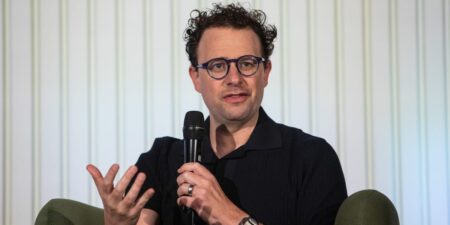





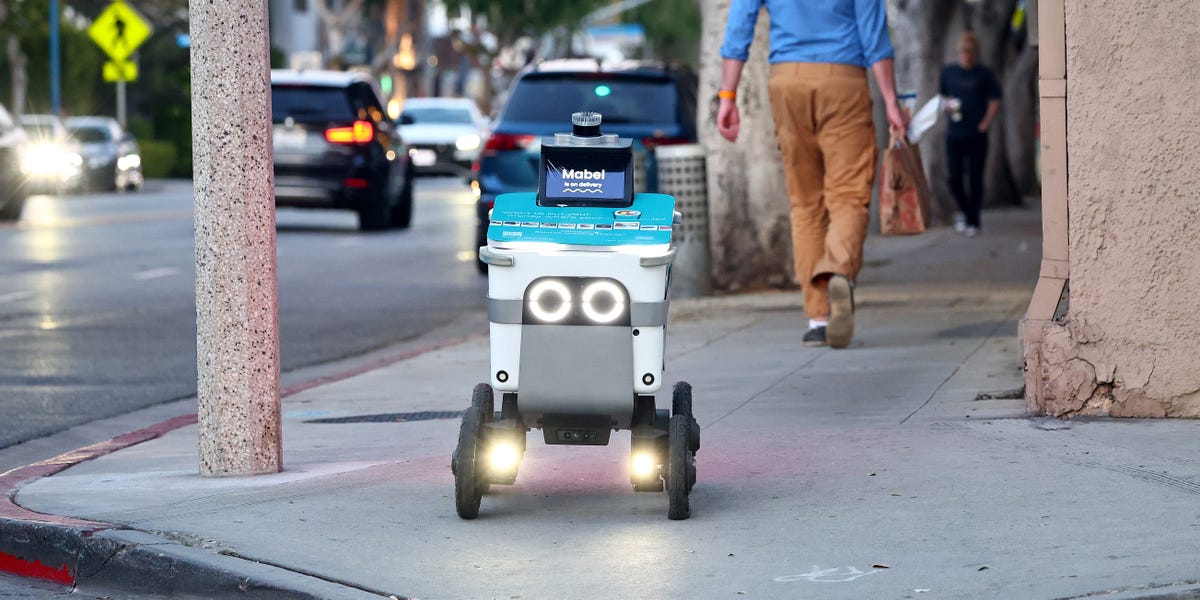
When William Gude isn’t grilling police officers or politicians for his tens of thousands of followers on social media, he’s profanely berating delivery robots that get in his way.
Gude, a Los Angeles resident for 25 years, told Business Insider that the robots are everywhere in his Hollywood neighborhood. So much so that he’s created an account, “Film The Robots LA,” to document the screw-ups of the trundling four-wheeled machines. On TikTok, the account has nearly half a million followers.
Gude doesn’t need to hunt for content: “I had an argument with one of them this morning,” he said.
Warning: The video below contains expletives.
Several thousand delivery robots have been deployed in dense urban environments and on college campuses in the US. Scroll through Gude’s channel, and viewers might think the machines are having a hard time sharing sidewalks with the rest of the world.
The companies behind them share a different story.
The CEOs of Serve Robotics, Starship Technologies, and Coco Robotics — three of the largest delivery robot companies — told Business Insider that human meddling and mischief are minimal.
Surprisingly, as broader fears around job displacement from AI and humanoid robots take shape, a different attitude has emerged around delivery robots: people want to help and, sometimes, fiercely defend them.
“I have been seriously threatened so many times, quite honestly,” Gude said of viewers reacting to his videos.
Humans are nicer than we’d think
One of the biggest fears Zach Rash and his cofounder, Brad Squicciarini, had in the early days of Coco Robotics was whether people could peacefully coexist with robots or take advantage of them.
Both were students at the University of California, Los Angeles. Around 2019, Bird, an electric scooter company, was wildly popular around campus for all the wrong reasons.
“We were front and center of scooters getting absolutely destroyed, especially in a college town, but across LA broadly,” Rash said. “In Westwood, people would just go kick them over, or they’d throw them into the trees.”
The vandalism turned into social media fodder. Rash recalled one popular Instagram account: “Bird Graveyard.”
“That was the core problem with the unit economics of scooters — was that they’d evaporate in a week,” Rash said. “So that was our big question: Well, if we’re going to make a robot that’s going to be a lot more expensive than the scooter, we couldn’t tolerate anything near that.”
Rash’s fears didn’t materialize. At least not fully.
All three CEOs told Business Insider that robot abuse exists, but the instances are rare.
Ali Kashani, CEO and cofounder of Serve Robotics, said that out of a recent dataset of 10,000 deliveries, 11 were incomplete — a 0.11% failure rate. The figure included failures caused by a robot falling, infrastructure issues, and human interference with the robot.
“I think it became clear very quickly that we as a species have a lower opinion of ourselves,” Kashani said. “We think we are worse than we actually are.”
Starship CEO Ahti Heinla said that after more than nine million deliveries, not a single robot has been stolen. He said human interference happens so rarely that Starship doesn’t track it as a major metric.
Rash said Coco Robotics also hasn’t had a single theft and that issues of abuse or vandalism have been “immaterial to the business.”
“That was the big worry,” Rash said. “Is this going to make it impossible to run the business? And the answer is, ‘No.'”
R2-D2, not C-3PO
It may help that the robots are cute.
Kashani said Serve Robotics learned early on that the design could shape how people responded to the machines. A product manager put googly eyes on an early robot, and soon people were pulling over in their cars to ask if they could buy one, he said.
Rash said Coco had a similar instinct.
“It’s like R2-D2 instead of C-3PO,” Rash said, referencing the “Star Wars” droids. “C-3PO is a little annoying and gets stuck all the time. No one really knows what R2-D2 is supposed to do, but it is constantly fixing all the problems and being super useful and enjoyable.”
Naomi Fitter, a robotics professor at Oregon State University who studies human-robot interaction, said anthropomorphic design choices can improve how people perceive robots. However, the more humanlike or socially apt a robot seems, she said, the more likely people are to overestimate what it can actually do.
In her research on delivery robots, Fitter found generally positive attitudes but also concerns around safety, accessibility, and privacy. She added that those attitudes could sour over time with more exposure, especially if robots start blocking curb cuts or getting in pedestrians’ way.
People lend robots a helping hand
Blundering delivery robots are easy viral targets, but another genre of robots-in-the-real-world videos is emerging: People being kind to them.
Kashani said Serve added a feature less than a year ago that allows its robots to ask nearby pedestrians to press crosswalk buttons. He said it could help speed up delivery times.
“Peak Los Angeles status is me helping the food delivery robot cross the road,” a caption on one TikTok video said.
Rash said he sees a similar reaction: “If the robot’s stuck somewhere, it looks sad and people run over and help it.”
Gude said he’s seen the full spectrum. In response to his videos, some viewers share his annoyance. Others urge him to be nicer to the “baby.” Some get angrier.
“I’ll get these messages telling me that I’m a punk for going after a robot, challenging me to fight, or that they’re going to kick my a— and they’re dead serious,” he said.
For Gude, “Film the Robots LA” is mostly in good fun. He doesn’t truly wake up every morning with a visceral hatred toward delivery robots. In some videos, he can be seen flipping them upright — not because he feels sorry for them, but more out of a sense of “public service,” like moving a shopping cart out of the road for other pedestrians.
Warning: The video below also contains expletives.
Gude said he does feel he’s channeling a real frustration some people have with robots, especially around automation and job displacement.
The CEOs dispute the idea that delivery robots will simply erase jobs.
Kashani said technology has historically changed the labor market more than destroyed it. Rash said cheaper delivery by robots could expand demand while also creating new jobs. Fitter also said, that in some cases, robots can extend human labor rather than replace it.
The bigger, guiding question for creating any kind of new technology, Fitter said, should be whether it “enhances the experience of humanity.”
“I believe there are some cases where new technologies don’t necessarily do that,” Fitter said.
For now, delivery robots have claimed their place on America’s sidewalks: A mild annoyance to some, ignored by most, and, in some cases, helped by others.
Read the full article here