




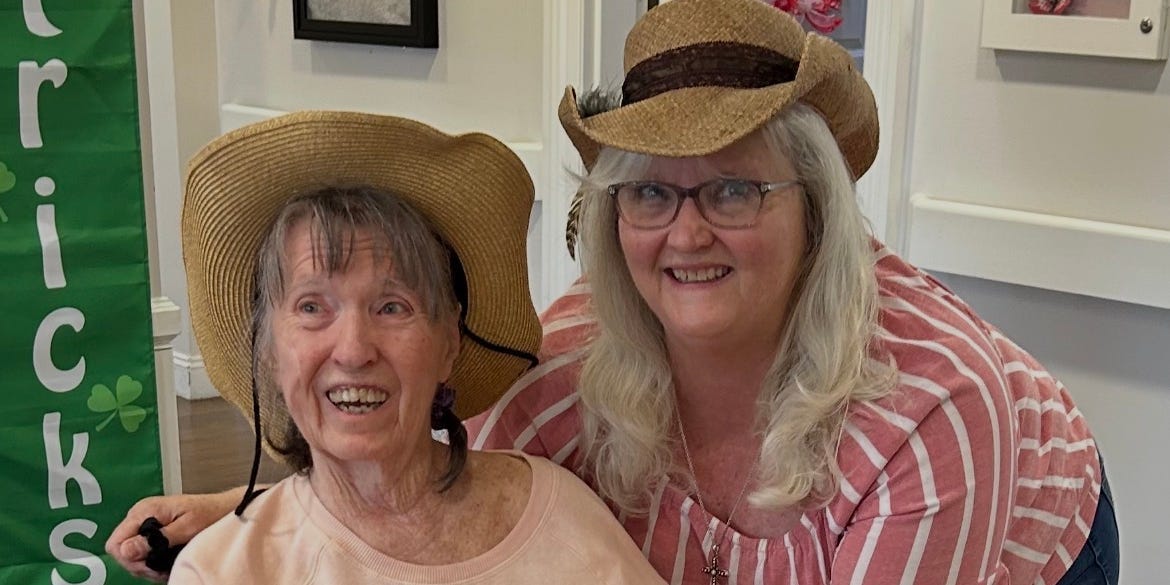
This interview is based on a conversation with CherylAnn Haley, 58, of Tampa, Florida, a private aide and certified dementia educator. It has been edited for length and clarity.
We didn’t recognize it at the time, but Mom’s dementia began around the age of 70 with her forgetting things and getting lost while driving.
She was a real estate agent and took clients to see properties in her car.
Often, on the way to a house, she couldn’t remember where she was going. She’d often have to call the office to ask them which place they were supposed to see.
Ripping paper is therapeutic for Mom
Neverthless she loved her job. I’ll always remember her sitting at the kitchen table, sorting through the paperwork after a successful transaction, thrilled.
She’d file whatever was important, but put the remainder, such as her MapQuest printouts and listing materials, into a big pile. Then she would rip it all up and throw it out.
“It’s cathartic,” she’d say. Even now, if you give her a few pieces of paper, she’ll methodically rip them up. “That feels good,” she’ll say. It calms her down.
Mom’s dementia accelerated quickly. In 2016, she showed up at my apartment complex unannounced. She lived two hours away, and we hadn’t made any plans to meet.
She said she was staying the weekend but hadn’t brought any clothes. When I asked her why, she said, “It doesn’t matter. We can buy new ones.”
After that, she continued getting lost and going missing for hours. I’d ask where she had gone and why, and she’d say, “Don’t you have anything better to do?”
My grandmother had dementia, too
It took a few years to get her to agree to see a doctor. The doctor requested an MRI and other tests, which indicated dementia.
In 2017, a neurologist found out that her primary dementia was not Alzheimer’s Disease. It was vascular dementia from a series of mini strokes.
My grandmother had dementia, and Mom looked after her at home. At the time, I remember Mom saying, “If something happens to me like that, there’s no need for me to move in with you. I want you to live your life.”
Still, in 2020, I knew that things had gone too far. She went missing for over five hours. She had clearly gotten very confused, but came back and behaved as if nothing had happened.
I knew we were going to have to make some hard decisions. One day that fall, I rang Mom’s doorbell, and she answered with her little coffee mug full of ice cream and her nightshirt.
And I said, “Mom, I know you said you didn’t want to live in my house, but it’s time. You need to go into your room and get your things.” She came out with just a pillow. It broke my heart.
Mom started hospice
She stayed with me in Tampa until we found her a place in assisted living soon after. At first, she thought she was staying in a nice hotel.
The next step was memory care. She went after the sheriff’s deputy discovered her outside the assisted living at 2:30 a.m. Then, a month ago, she started hospice.
I serve as her private aide. Right now, I’m probably working through the hardest thing I’ve ever walked through in my life.
When I get into the car and drive away, the tears will come. I don’t have my mom to call and ask about what to do.
Still, I get a lot of support from the Dementia Society of America, an important resource for people with dementia and their carers. It helps to know you’re not alone in this journey. We swap stories and support each other.
I tell other carers that nobody knows and understands their loved one better than they do. I recently told a nurse that if somebody asks her Mom a “yes” or “no” question she doesn’t understand, she’ll often say “no” because it’s the simpler option. You have to explore a little deeper.
I tell Mom’s carers about her needs and wants
Every now and again, someone won’t get the thing about her shredding paper or other habits that make her feel more relaxed. They’ll say, “Sandy, don’t do that!” when she’s just doing it for comfort.
I’m there to explain why she behaves the way she does. I call myself a “dementia translator.” A person once asked me whether that was a genuine job description with a special qualification.
It’s not, of course, but you could say that I’ve become my mom’s eyes, ears, and her voice.
Read the full article here