


Western militaries are investing heavily in drone warfare after seeing their impact in Ukraine’s fight against Russia’s invasion. And while it isn’t necessary to absorb every lesson, current and former military officials say one major operation is worth studying closely.
Maj. Rachel Martin, director of the US Army’s Unmanned Advanced Lethality Course designed to accelerate training on small drone warfare, told Business Insider that the 2025 Operation Spiderweb is “the one event that I teach to the students.”
Offensive potential
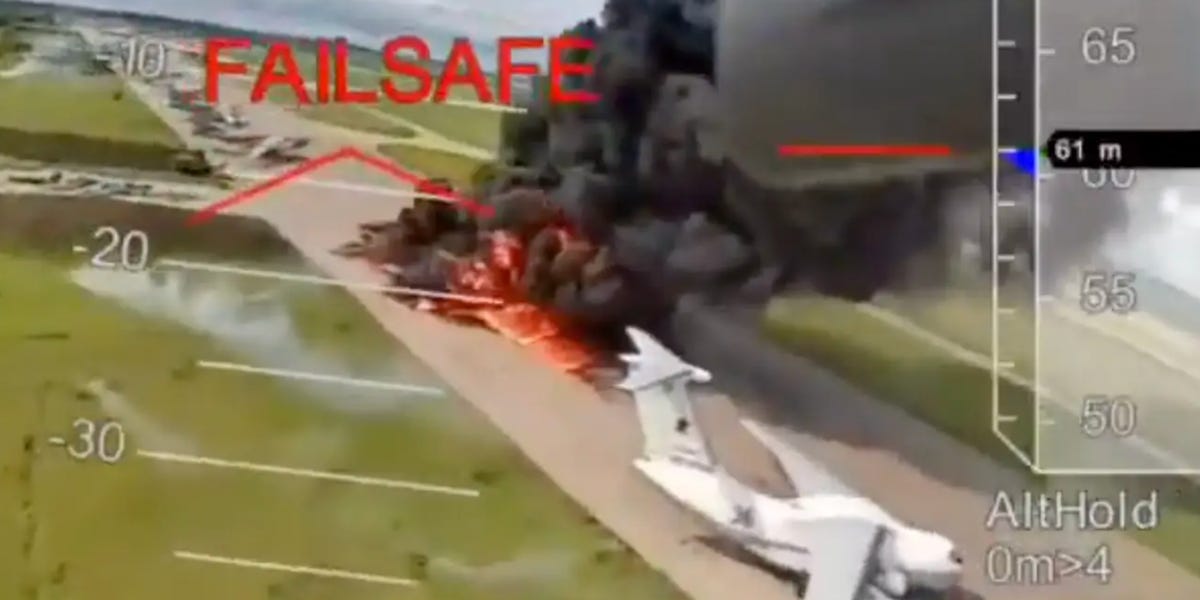
In the operation, Ukraine smuggled drones into Russia, drove them to positions close to Russian airfields, and launched them at strategically valuable aircraft. The Ukrainian drones hit 41 Russian warplanes and caused an estimated $7 billion in damage.
The strikes showed how arsenals of small, cheap drones can destroy high-value military assets far from the front — and how difficult they are to defend against.
The operation was complex and took roughly a year and a half of planning, but, Martin said, it showed “that a small amount of money could be spent to destroy something at the strategic level,” in this case, bombers and other high-dollar aircraft.
It cost Russia billions of dollars when it “is already hurting financially from being in a prolonged war.”
Seeing that kind of low-cost attack destroying assets that could take years to replace, she said, “was a big eye-opening experience for the world.” It highlighted not only what was possible with attack drones on offense, but also critical vulnerabilities.
Defensive realizations
The Ukrainian operation sparked a realization in the West about the need for significantly more protection at air bases, especially those hosting essential mission tools, such as nuclear deterrence elements.
Lt. Gen. Andrew Gebara, the deputy chief of staff for strategic deterrence and nuclear integration for the US Air Force, said of the operation last year that “disruptive” technologies like the drones seen in the Ukraine war “will have big implications not just for our bomber force or our nuclear force but really any critical infrastructure.”
“We have counter-drone capabilities at these bases. Do we need to continue to modernize? Do we need to accelerate?” he said. “Yeah, absolutely, all that.”
The majority of the most strategic US air assets are based inside the continental US. American airpower also depends heavily on warplanes stationed at air bases around the world. Defending against drones has proven challenging at both home and abroad, as the Tower 22 disaster and a number of domestic incidents have highlighted.
European air bases have likewise grappled with the challenge of drones, making the lessons of Operation Spiderweb particularly poignant.
Retired Air Marshal Greg Bagwell, who spent 36 years in the British Royal Air Force and served as its director of joint warfare, said last month that Operation Spiderweb holds key lessons that NATO allies need to learn.
When it comes to modern drone warfare, the West has more to learn from operations like Spiderweb than from day-to-day front-line drone fighting, he said at the UK think tank Chatham House. The West doesn’t necessarily need to engage in heavy quadcopter warfare at the front when it has artillery and substantial airpower.
“The lessons that we need to learn are more from Operation Spiderweb, where Ukraine employed these drones in a much more sophisticated way and really did start to take out some significant targets,” Bagwell said. That operation had a high-level strategic effect on a stronger adversary for a comparatively lower cost. It’s asymmetric warfare that the West can’t ignore.
Picking up lessons from the war
The US is using drone warfare in ways beyond what Spiderweb demonstrated, drawing on other lessons from the war. In its war with Iran that started last month, it has used drones to attack Iranian targets, including the new one-way attack LUCAS drones.
It’s also still employing traditional drone tactics, using platforms like the uncrewed strike and reconnaissance drone MQ-9 Reaper.
The Army’s new drone course is just one of the many ways that it is advancing its drone warfare capabilities, along with other moves like plans to buy at least a million drones in the next two or so years. Allies across NATO are taking similar steps.
Martin said their power is undeniable, and the course itself was created because the Army could see that it was behind in small drone warfare and needed to fix that. But the US is not in the same existential fight that Ukraine is, nor is it facing the same weapons shortages.
Drones have kept Ukraine in the fight against Russia even as other weapons ran out. They haven’t been decisive, though, indicating that deep stocks of traditional and advanced weaponry still matter.
The US Army course teaches soldiers that drones aren’t always the right weapon.
Bagwell also cautioned against leaning too heavily on drones. He said that drones have been “hugely useful” for Ukraine, but “these have not won the war for either side.”
He said that Ukraine has “had to adapt and fight the way they can only fight, and I applaud them for what they have done. But there is a question for us in the West as to whether that is the way we want to fight.”
Read the full article here