


Lucid Motors is making a big swing toward autonomy, pursuing self-driving in personal cars and a two-seater robotaxi that would rival Tesla’s Cybercab.
During the company’s investor day in New York City on Thursday, interim CEO Marc Winterhoff said Lucid Motors’ investment in robotaxis and autonomy will play a key role in bringing the company to profitability.
“L4 is our north star — to get there as fast as possible,” he said, “and in the end, be a profitable company and cash-flow positive.”
Lucid Motors executives laid out the road map for its robotaxi, which includes a “business-to-business” strategy partnering with companies like Uber, and a timeline for deploying self-driving technology for consumer vehicles by 2029.
With its current portfolio of luxury EV sedans and newly announced investments in midsize SUVs and autonomous driving, Lucid said in its presentation that it expects to target a market that will grow to more than $700 billion by 2035.
Here are the five biggest announcements the EV maker made on autonomy.
Uber partnership deepens
Lucid’s robotaxi partnership with Uber may go beyond the Gravity SUVs that the ride-hailing company has agreed to use for its self-driving fleet.
Lucid said it’s entering the midsize EV market, directly competing with the Tesla Model Y, with two new cars called Lucid Cosmos and Lucid Earth. Starting prices for the EVs will be under $50,000, the company said.
With those midsize SUVs, Lucid said it’s in “advanced discussions” with Uber to scale the ride-hailing company’s robotaxi vehicle platform.
Lucid announced last year that it committed 20,000 Gravity units for Uber’s robotaxis, while the ride-hailing giant has invested $300 million into the EV maker.
Lucid robotaxis set for 2026 launch
The company reaffirmed on Thursday that the commercial launch of Uber’s robotaxi service, through a partnership with Nuro and Lucid, is “on track” for late 2026.
Lucid’s VP of autonomy and advanced driver assistance systems, Kai Stepper, said on Thursday that Uber has been given 80 Gravity SUVs within the past half year for data collection and testing in the San Francisco Bay Area.
Lucid will take on Tesla’s Cybercab
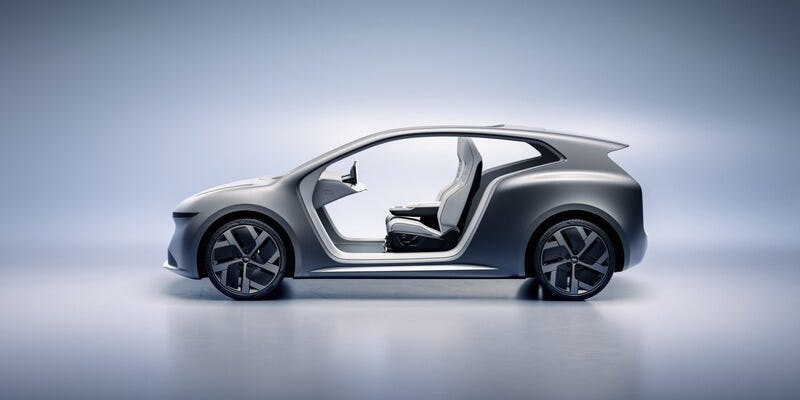
Lucid unveiled a concept for its two-seater robotaxi called “Lunar.”
The car is purpose-built, much like Tesla’s Cybercab or Zoox’s robotaxi, which means the vehicle has no pedals or steering wheel. The concept car that was shown during the presentation included a large console screen that stretched across the dashboard.
Winterhoff said the Lunar will be based on the same platform as the new midsize EVs, allowing for quick ramp-up of production.
The executive said the company expects operating costs to be 40% lower than the robotaxis in the current market; although he did not specify an operator.
Lucid did not explicitly say whether Lunar would be deployed through its partnership with Uber, but Winterhoff revealed the concept car during his conversation with Andrew Macdonald, Uber’s chief operating officer.
“First of all, I feel like I’m sitting in a personal theater with a comfy chair and lots of leg room and the media center in front of me,” Macdonald said. “Second of all, I think our customers are going to love it.”
‘Full Self-Driving’ tech comes to Lucid
Lucid is also betting on self-driving in personally owned cars, outlining a timeline for fully autonomous driving, or Level 4 autonomy, during its investor day.
The company said it expects to deploy hands-free highway driving in the second quarter of 2026; hands-free highway and city driving by 2027; Level 3 autonomy, which allows for eyes-off driving, in 2028; and Level 4 autonomy, or the autonomous driving seen in Waymo’s robotaxi, in 2029.
Winterhoff said during the presentation that the software will be comparable to FSD, or Tesla’s Full Self-Driving, “or better.”
The company did not indicate whether this will enable Lucid to pursue its own robotaxi service. Stepper said Lucid is pursuing a business-to-business strategy for autonomous ride-hailing programs.
Subscription will be a key revenue driver
Lucid is joining a slew of automakers hoping to increase revenue through subscriptions to its self-driving technology.
The company revealed a tiered subscription service for its ADAS, called DreamDrive Pro, that ranges from $69 per month to $199 a month.
The specific features for each tier were not detailed, but the service will range from Level 2+ driving to Level 4 driving.
“Autonomy subscriptions are the single biggest software monetization opportunity,” the company said in its slide deck.
Read the full article here