





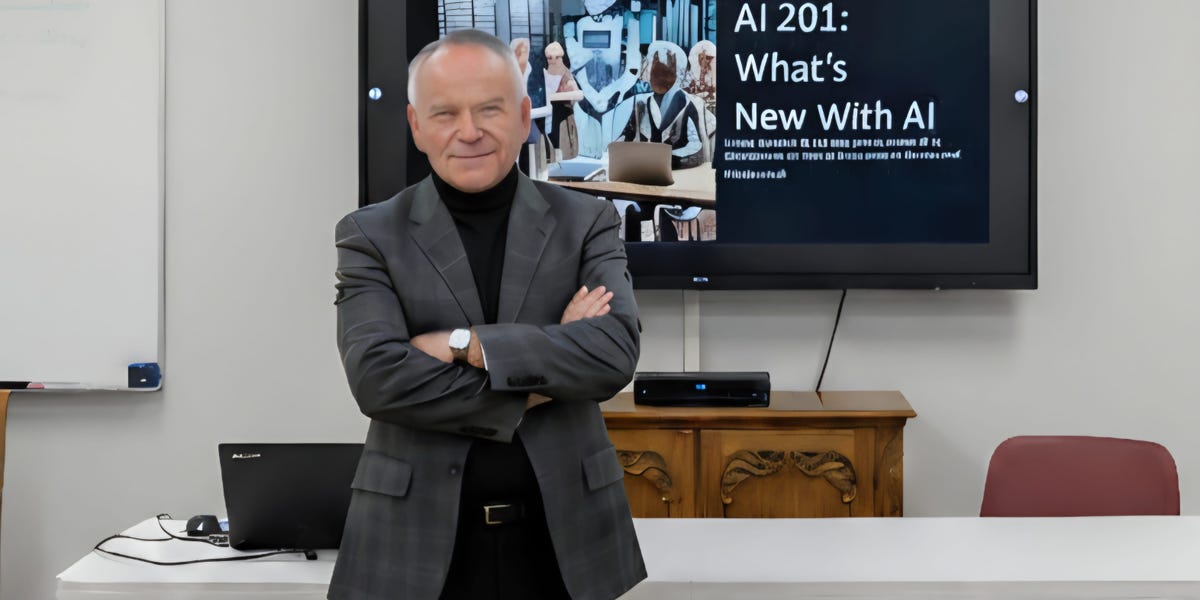
This as-told-to essay is based on a conversation with Lewis Dickson, a 78-year-old retiree and technology consultant. It’s been edited for length and clarity.
I’ve been in technology for a long time. I worked for IBM in the late 1970s. I did technology consulting for a Fortune 500 company in Atlanta from 2015 to 2024. I’ve taught many engineers and customers over the years.
I’m in semi-retirement mode now. Technology isn’t work to me — it’s fun.
When ChatGPT came out, I jumped on it. About six or eight months ago, when vibe coding became hot, I said, “Well, I need to try this out.”
I researched and found Emergent. What I liked is that they had the full stack. I didn’t have to connect anything or get my developers on the line to handle the back-end. I could just get on there and start.
I began with a couple of simple things. Now I’ve probably done a dozen or more vibe-coded apps.
The last two were for this AED company. They wanted the ability to access their existing camera provider’s website and extract their data. So I vibe-coded an app that would do that — pull that data in.
I also vibe-coded an AI voice app for them. It’s a web app, so you go to it on your phone, hit a button, and ask, “What’s our AED status?” It checks the database, then returns the information.
When I first showed the CEO a demo, he lit up. He thought it was the coolest thing he’d ever seen.
Older people can move fast
Most people think an old guy like me would have a flip phone.
When I started as a ham radio operator at 13, I was using Morse code on tubes, transmitters, and receivers. To go from that to what we’ve gone through with phones and cellphones, and then to watch that transition over the years into AI and be closely involved, I just love the technology — both the hardware and the software.
A lot of young kids today are into software but don’t know much about the hardware piece. Having a wide background comes in handy.
There’s often an assumption that gray hair means outdated technology skills. I understand where that perception comes from, but it’s not always accurate.
Many of us have moved just as quickly with the rise of AI as younger professionals. The advantage we bring is perspective: decades of experience that allow us to apply AI strategically, not just technically.
Some people would say older people retire and lose purpose. I’ve never had that problem because I’ve always had a passion for doing technical things.
I’m constantly on my laptop and phone, doing something related to AI and learning. You’ve got to watch a lot of YouTube and social media, learn what’s coming and what’s new.
How seniors can use AI for everyday life
I’m teaching AI to seniors now. In my class back in November, we were talking about data centers, what’s behind AI.
There’s a lady named Sue who’s 100 years old. Near the end of the class, Sue came up and asked, “What’s a semiconductor?”
I have a hardware background, so I answered her question at a very high level. She listened intently and wrote down a few notes.
After that class, I thought, “I need to do more for her.” So I used AI to create a video that went through the evolution of tubes in the 20s and 30s — things they could relate to — and old radios and TVs. Then we went to transistors in the late 40s and 50s, and what that meant.
The seniors I taught have now learned enough to take over their internal resident newsletter and use AI to help write it. They also created images for the newsletter with AI.
They are using AI to shop, check for bargains, and research their items.
I’ve shown them how to recognize different plants and birds with AI. They’ll walk through their garden area, take a picture, and ask ChatGPT or Gemini.
Do you have a story to share about vibe coding? Contact this reporter at [email protected].
Read the full article here