






I didn’t set out to follow a political diet, or any diet at all, really. But it was January, the new food pyramid was out, and according to the people in charge, it was healthy and easy to do on the cheap. Plus, I like a challenge.
At the start of the year, Health and Human Services Secretary Robert F. Kennedy, Jr. announced the federal government’s new dietary guidelines for how Americans should aspire to eat. The gist: meat, full fats, and whole foods are in; sugars, processed foods, and excess carbs are out. After complaints that the recommendations leaned toward pricier food categories, the Secretary of Agriculture said you could follow the new protocol for as little as $3 a meal. I had my doubts, given grocery prices and inflation. Apparently she (or her staff) did, too, because Rollins later amended her indications to $15.64 a day.
Despite my reservations, I decided to try it myself. For seven days, I would follow what I came to think of as the “RFK diet” on a $15-a-day budget to see just how realistic this whole thing was. Would I have regrets? Of course. Would I learn something? Honestly, yes — among other things, that spices are my friend, that I don’t like apples that much, and that food is more political and emotional than we realize. Our identities, beliefs, and social statuses are wound up in every single decision we make, including what’s for breakfast, lunch, and dinner.
The Shopping Trip
I am not used to making a weekly grocery haul. One of the blessings of living in New York City is that there’s usually a store close enough that it’s fine to make multiple trips a week. This makes up for one of the curses of NYC, which is that most people don’t have a car, so whatever you buy, you carry. So I enlist AI’s help to ensure I don’t miss anything and to make my spending calculations easier. I input the new guidance, explain my financial constraints, and the machine spits out a shopping list. As I scribble it down, I decide that a line from ChatGPT will be my shopping philosophy: “This is not maximal pleasure. This is maximal compliance + realism.”
Once I’ve hit the aisles, I adopt a second shopping philosophy: undershoot the budget. I can spend up to $105, but I wind up paying $70.31, leaving myself a $34.69 emergency fund in case things go awry. I’m actually pretty close to that initial $3-a-meal estimate, which would have left me with a $63 weekly budget.
Since, besides the federal government, I am the one making the rules here, I decide on some adjustments. I’ll use the olive oil, butter, salt, pepper, and spices already in my apartment because part of thrift is utilizing the resources you already have. The same goes for my already-owned instant coffee that will serve as a vehicle for whole milk. Moderate alcohol consumption is not an official budget consideration, but it seems fine since Dr. Oz says it’s allowed and Dry January is passé. Price, quality, and availability are a delicate balance — I buy the cheapest peanut butter and ignore the ingredients list, which is surely not RFK Jr.-approved.
After making some tough calls, this is my haul:
- 1 bag potatoes
- 1 bag onions
- 1 can chickpeas
- 1 loaf whole grain bread, or the closest the store had to it
- 1 head cabbage
- 1 jar peanut butter
- 1 bag apples
- 1 block sharp cheddar cheese
- ½ gallon whole milk
- 2 dozen eggs
- 1 bag baby carrots
- 1 bag lentils
- 1 bag brown rice
- 1 bag frozen mixed vegetables
- 1 bag frozen peas
- 1.5 lbs ground beef
- 3 lb 8-piece cut chicken that I don’t think I understood what it was
Day 1: Tuesday
It would have made more sense to start this on a Monday morning, but there was a big snowstorm over the weekend, so Tuesday night kickoff it is. I start with some manageable basics, meaning I boil six eggs and rice and put them in the fridge, and I pick an easy recipe. Spoiler alert: I’m a terrible cook, so this is going to be a journey.
I’ve never been much of a food prepper (or life prepper), so I’m pretty impressed with myself for what I’d imagine others might consider a pathetic performance. My dinner is decent. ChatGPT has armed me with a plan for my leftovers. I have not yet over-potatoed, nor am I aware that sentiment is on the horizon.
Dinner: Roasted chicken breast with potatoes and carrots
The vibe: Cautiously optimistic, until I remember this plan does not allow for dessert.
Day 2: Wednesday
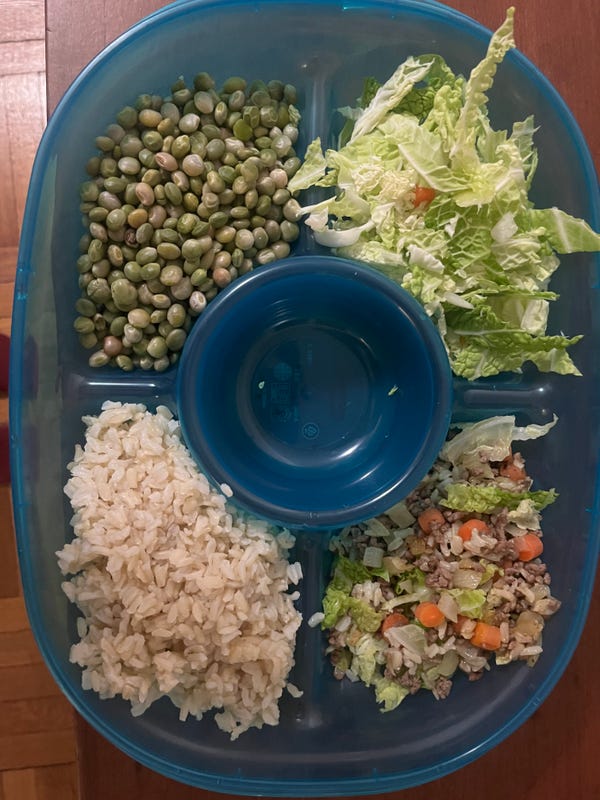
My AI-assisted meal plans tell me I have a variety of breakfast options. My heart tells me I have only one — bread with peanut butter — which I fear may be the culinary highlight of my week. A midday trip to the dentist and the accompanying novocaine make me nervous about the lunch situation, but luckily, my meal is basically mush — chicken, rice, and peas. I make a different combination of ingredients into what appears to be a largely identical plate of mush for dinner, and set aside the leftovers from my lunchtime mush for the office tomorrow.
At some point during all of this, I realize that I have the ingredients for an actual good mush: mashed potatoes. This is very exciting. Post-dinner, I notice a coworker’s Instagram story of his New York Times-inspired creamy lasagna soup creation, which fits neither my diet nor my budget. My excitement fades.
Breakfast: 1 piece of toast with peanut butter, coffee with milk
Lunch: Chicken breast, rice, and peas
Snack: 1 apple, 2 slices cheddar cheese
Dinner: Ground beef skillet with onion, carrot, cabbage, and rice
The vibe: This is a lot like how I ate when I was broke in my 20s. I remember why I’m not a big fan of peas. Thank God for cheese.
Breakfast.
Emily Stewart/Business Insider
Food prep.
Emily Stewart/Business Insider
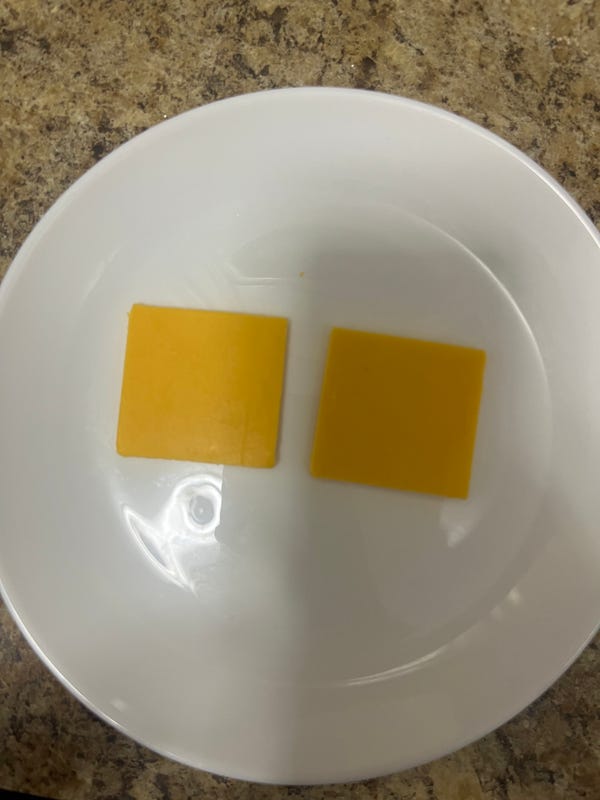
The cheese <3.
Emily Stewart/Business Insider
Day 3: Thursday
I’ve reached the “bargaining” stage of this endeavor quicker than I thought. I catch myself looking at the new and improved food pyramid multiple times throughout the day to see if there’s something affordable but delicious that I’m missing. Broccoli? An avocado? The official guidelines list kimchi, which seems like the coastal political elite seeping through. Also, it’s $10 in the grocery store, so no.
ChatGPT assures me the free seltzer water in my office is allowed, which is a treat. When someone in the office announces there are free Girl Scout cookies on her desk, I don’t bother asking the robot if that’s OK, because I already know the answer. I meet a friend for drinks after work and, somewhat ashamedly, explain that I can’t stay for dinner because I pitched what I have now definitely decided was a very stupid idea. I will probably cheat sooner rather than later, but not yet.
Breakfast: 2 hard-boiled eggs, coffee with milk
Lunch: Chicken, rice, and peas
Snack: 1 apple that I spent $1 on because I did not plan and forgot to bring one from home
Dinner: Ground beef skillet with onion, carrot, cabbage, and rice
Vibe: I have to find a way to mix this up tomorrow.
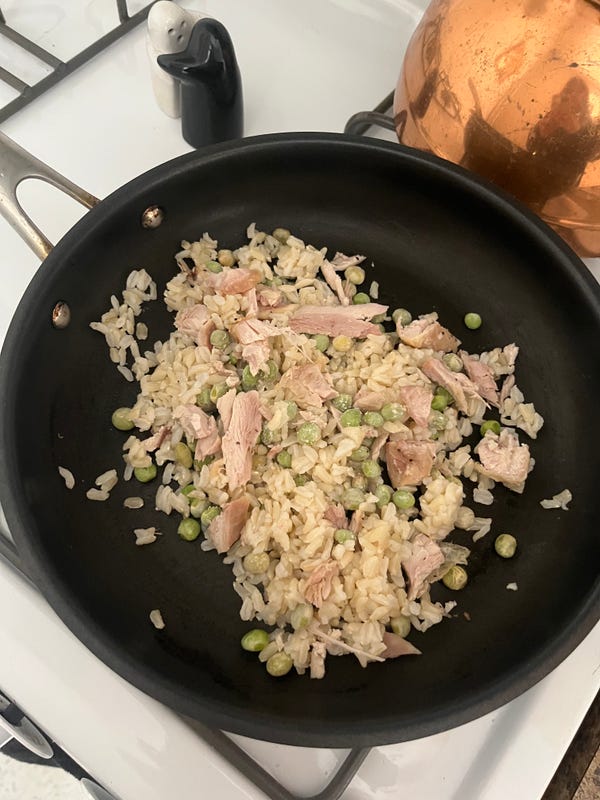
Mush 1.
Emily Stewart/Business Insider
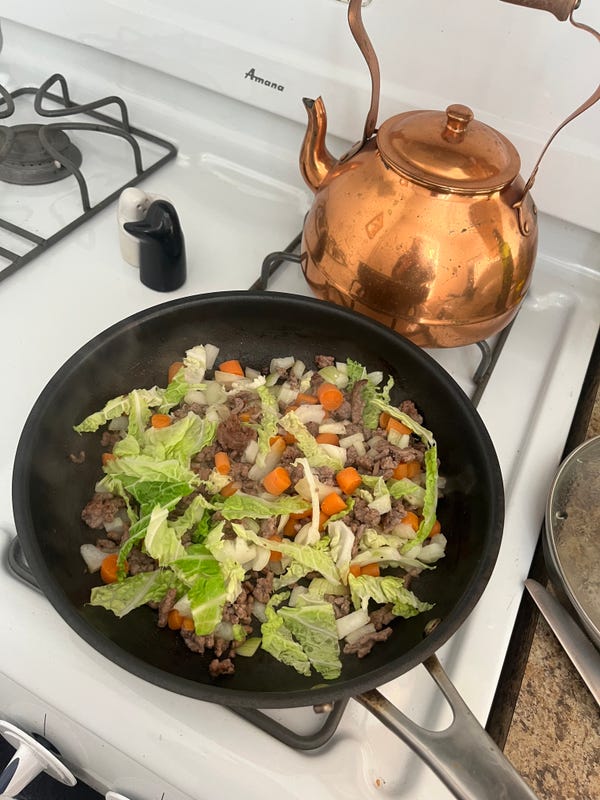
Mush 2. You can see the problem.
Emily Stewart/Business Insider
Day 4: Friday
The point of food isn’t just nourishment — it’s pleasure. This is a sensation that this diet is severely lacking.
In the midst of my desperation, I text Morgan Dickison, a registered dietitian at Weill Cornell Medicine, to ask for advice. The first thing she asks after I show her my food diary is whether I’m hungry, which I’m not — I’m having some pretty big portions, and the food isn’t exactly triggering additional cravings. She suggests seeking out some herbs, spices, and flavored oils, budget permitting. This prompts me to take a harder look at the spices in my cabinet to see what I might be able to incorporate. Her most specific recommendation: Rao’s tomato sauce — it’s not ultra-processed, and there’s no added sugar. (This is not the case, unfortunately, with Rao’s pesto.) She also low-key recommends I cool it on so much red meat. I wonder what RFK would say.
I head to the grocery store to buy Rao’s, but over the course of my five-minute walk, I forget why I’m there. I leave with chicken, an avocado, broccoli, two tomatoes, and corn tortillas, totaling $12.62. I have $22.07 left. Plus the $1 apple, so $21.07. Despite blanking on the sauce, the Morgan consultation/pep talk inspires what has been my best meal yet. Things may be looking up.
Breakfast: 1 piece of toast with peanut butter, coffee with milk
Lunch: Beef skillet with onion, carrot, and lentils
Snack: Hard-boiled egg, 2 slices cheddar cheese
Dinner: Grilled chicken breast with mashed potatoes
Vibe: Real live dietitian >>>>> AI.
Day 5: Saturday
I am pretty committed to this bit, but I also don’t want to be a freak. After a glass of wine at the Westminster dog show agility preliminaries (which is awesome), I realize I have to eat something, lest I be too buzzed to enjoy the amateur canine obstacle courses. I get an $8 chicken empanada, which almost certainly breaks the rules. I decide the day has no more rules and go out for dinner.
Breakfast: 1 corn tortilla with 2 slices of cheddar cheese, in a quesadilla-type situation
Lunch: 1 chicken empanada
Dinner: Don’t worry about it
Vibe: Between the very agile dogs and my cheat meal, I have had a great day.
Day 6: Sunday
I wake feeling more confident about this experiment, thanks to my Friday dinner semi-success and probably the glow of Saturday’s rule-breaking. I make an actually good brunch-type situation, and by “I make” I mean I generally start some things and then my boyfriend, a much better cook, takes over.
For dinner, it’s too cold to go to the store, so I manage to scrounge up the ingredients from my boyfriend’s brothers’ apartment to make pasta and homemade pasta sauce. I use it to concoct the chicken Parmesan I’ve been thinking about since my failed Friday Rao’s trip. I’m not sure if this is completely allowed, with the pasta (which is organic!) and also chicken breading, but I’m following along in spirit.
Brunch: Mashed potato hashbrowns, scrambled eggs, 1 corn tortilla, ¼ avocado
Snack: 2 slices cheddar cheese
Dinner: Chicken Parmesan
Vibe: There is light at the end of the tunnel.
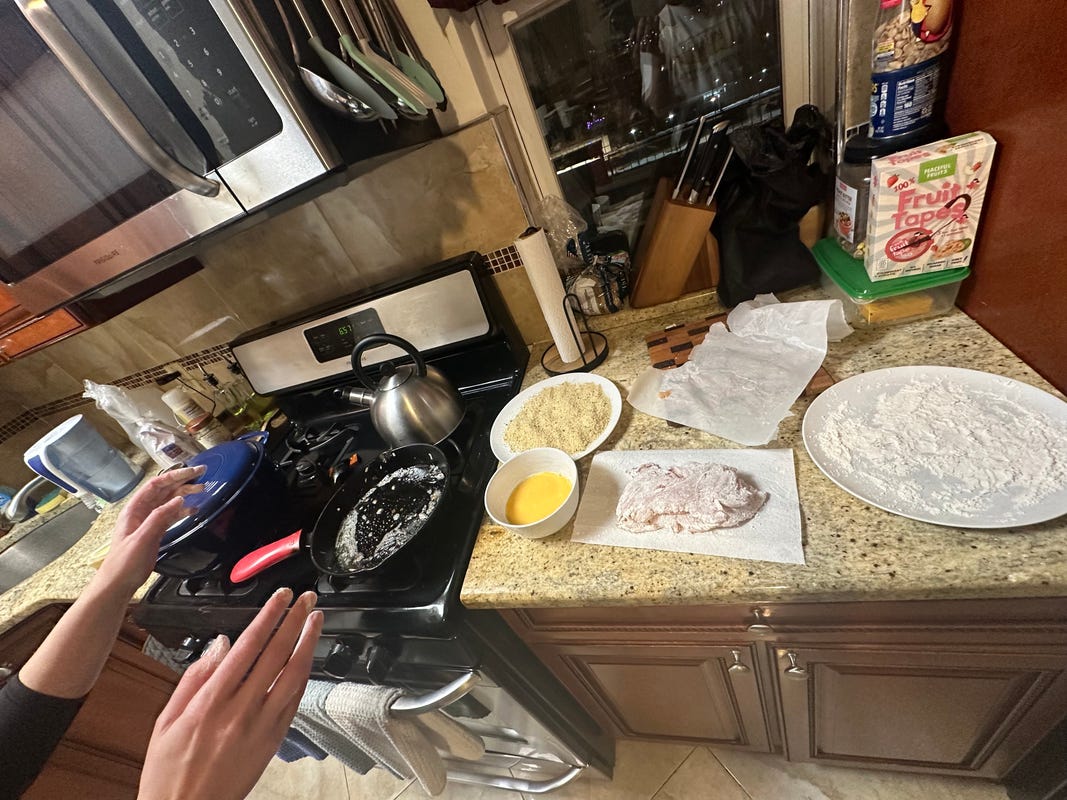
Making chicken Parm.
Courtesy Emily Stewart/Business Insider
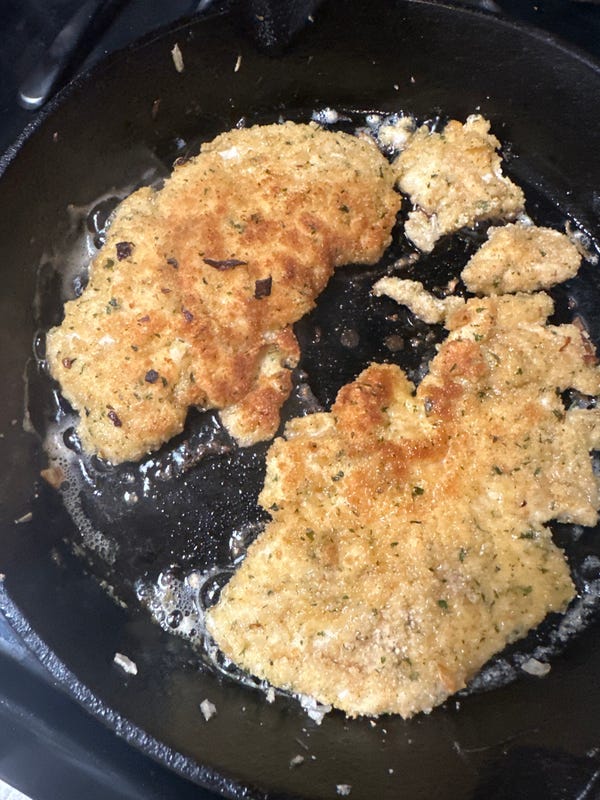
Cooking chicken Parm.
Emily Stewart/Business Insider
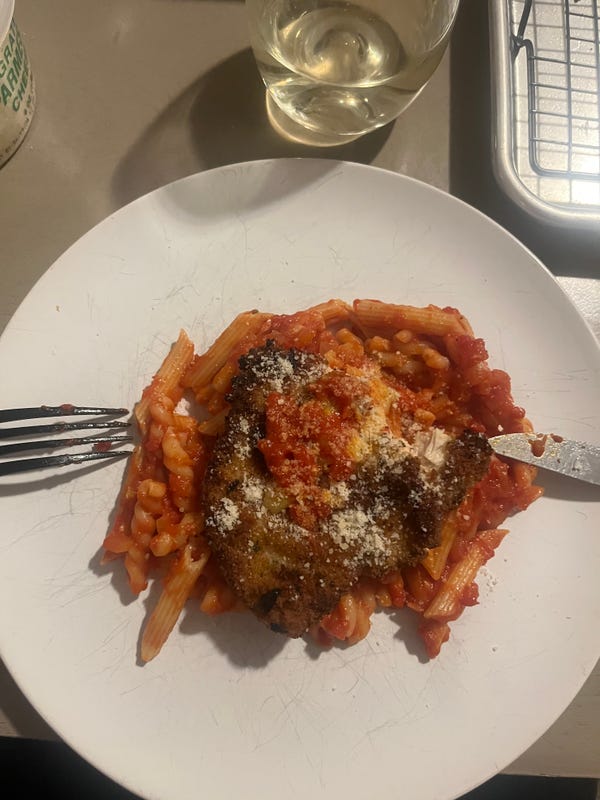
Eating chicken Parm.
Emily Stewart/Business Insider
Day 7: Monday
Part of what set this exercise in motion was comments from Agriculture Secretary Brooke Rollins, where she recommended a meal composed of a piece of chicken, a piece of broccoli, a corn tortilla, and “one other thing.” This is what I choose for my lunch finale, adding a quarter of an avocado as my “other thing.” It’s pretty good, though I have to embiggen it from the description to make it actually filling.
Breakfast: 1 corn tortilla with 2 slices of cheddar cheese, ¼ avocado
Lunch: The Brooke Rollins Special — 1 corn tortilla, chicken, broccoli, and ¼ avocado
Dinner: Ground beef and chickpea skillet with broccoli
Vibe: Victory.
So what did I learn from the diet?
Doing the RFK diet on a $105-a-week food plan was not as hard as I thought it would be. I came in under budget by $13, even with the mid-week grocery trips and the dog show empanada (and not counting the Sunday freebies or Saturday cheat meal). But being on such a strict diet and budget did lead to some notable limitations. My regimen lacked any appreciable amount of variety, and it made eating into an act focused almost exclusively on survival.
I ask Dickison, the dietitian, for a final rating of my adventure once I wrap it up. She says that, like a lot of people, I have room for improvement with fruits and veggies, commends my integration of chickpeas and lentils, and says I did a good job with protein at every meal, even if I was too heavy on ground beef. The budget piece of this undertaking is the hardest part, she says. It makes it challenging to incorporate some of the new food pyramid recommendations, such as berries, fresh vegetables, and fish, and it’s not aligned with how people live. “When I’m speaking with patients, we talk about all the different ways that you get food,” she says. Sure, sometimes it’s cooking at home, but it’s also fast casual at the office, a restaurant on a night out, or delivery when people are pressed for time. “The more convenient the option, the more expensive it gets,” she says.
What’s also unrealistic: The ability to religiously follow such a rigid diet for an extended period of time. Hunger levels and cravings matter. “It can be really difficult to manage those biological drives and also this premeditated budget, even if you did have the best intentions,” Dickison says. I wish I could text her every day for food advice, but I fear she would block my number.
This funny little food journey of mine has coincided with a giant internet debate about some people using DoorDash too much and others scolding them for not cooking more at home. After a week of being bound to team cook-at-home, I’m overly sympathetic to team DoorDash, if only because I’ve spent the past week envisioning the treat I’m about to get myself — via my delivery app of choice, Seamless — now that this is all over. Variety is, as the eye-rolling adage goes, the spice of life. Being able to switch up not only the dish but also the delivery method from time to time is part of that.
The experience has made clear the sacrifices we constantly make around affordability, sustenance, and gratification when it comes to food. The cheapest option is never the healthiest option. The healthiest option is never the most thrilling option. The most thrilling option may be the cheapest, but it’s usually bad for you.
It’s an economic issue as much as it is cultural and political. When people on the lower end of the income spectrum — or public benefits — are told to focus on whole-food basics, they’re told to give up on ease and joy as well. When people rely too much on delivery, they’re almost certainly overspending, but they do so because it saves time and energy compared to an elaborate kitchen production. It’s true that it’s generally better to cook real meals with fresh ingredients at home. It’s also true that life is complicated, and for a variety of reasons, that’s not always possible. I probably could have stretched my budget just as far, if not farther, with frozen, preprepared options.
Ultimately, for most of us, dinner is less of an ideological project than it is a daily logistical problem — one that has to be solved, night after night, in perpetuity.
Emily Stewart is a senior correspondent at Business Insider, writing about business and the economy.
Business Insider’s Discourse stories provide perspectives on the day’s most pressing issues, informed by analysis, reporting, and expertise.
Read the full article here