


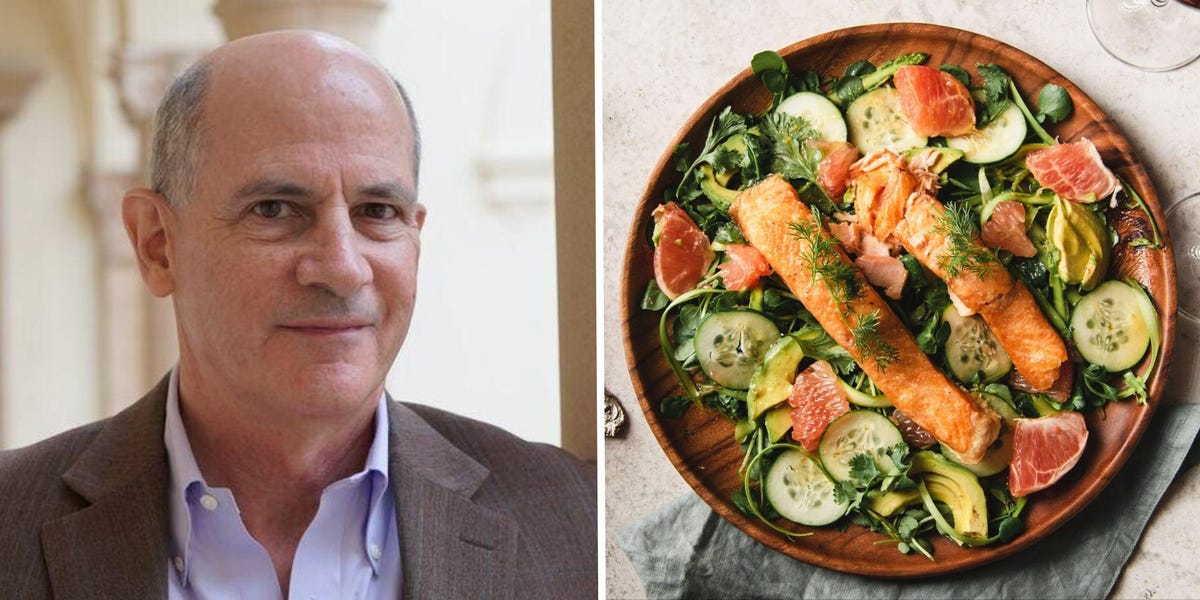
After studying stem cell aging for decades, Dr. Thomas Rando learned that some of the best longevity advice is timeless.
“I often make the joke that the billions of dollars that have been spent on studying healthy aging could come down to the two things your mother told you,” Rando, the president of the American Federation for Aging Research and director of the Broad Stem Cell Research Center at UCLA, told Business Insider.
“Eat a good diet and get plenty of exercise.”
Rando dedicated his career to studying how tissues repair themselves — and why they eventually lose the ability to do it well. What he learned is that many of the drugs tested in animals that are meant to extend lifespan work as effectively as a balanced diet and exercise do. One example was a 2022 study that found mice that were put on fasting diets were as resilient to stress as those injected with ketone bodies.
He said that many drugs and interventions are “just in a way supplementing the challenges that humans face in dieting and exercising.”
In his own life, he said his research hasn’t inspired too many drastic lifestyle changes as much as reinforcing healthy habits, like cutting ultra-processed foods after college or continuing to drink in moderation.
Unlike some of his peers in the field, he doesn’t take any supplements; he’s more persuaded that lifestyle habits such as eating whole foods and taking care of his body are the keys to longevity. “From my own studies, if you are eating well, sleeping well, and exercising, it’s unlikely that supplements are going to make a difference,” he said.
Rando shared the three longevity habits he’s stuck to for years, from avid running to lots of socializing.
He started running in his 30s
By his 30s, Rando realized his work schedule made it hard to exercise: organizing basketball or squash games just took too much time. So, he started running solo a few miles a day, a few times a week.
After a colleague convinced him to run a 5K, he fell in love with racing. He worked his way up to a 10K, half-marathon, and eventually, a marathon. He’s been a marathon runner for the last few decades.
“Not that people should do marathons, but I really believe in the rejuvenating powers of exercise,” Rando said. While he’s still researching all the ways that working out benefits longevity, he said there’s lots of evidence to support that regular exercise lowers the risk of cardiovascular disease and Alzheimer’s.
Rando, who’s currently dealing with an Achilles tendon injury, said he’s running a little less often and focusing a little more on strength training, which is also important for healthy aging as muscle mass declines over time.
Beyond the anti-aging benefits, he said he loves how running makes him feel. “I think clearly, I think I solve problems when I run,” he said. “So that was an added icing on the cake.”
He fasts one day a week
Rando generally follows the Mediterranean diet, considered the healthiest diet in the world. He eats lean protein, fruits, and vegetables while cutting back on red meat, carbohydrates, and processed foods.
“I love a steak dinner, and I’ll splurge on that,” Rando said. “But my typical dinners are either purely vegetarian or with some light meat or some fish.”
For decades, he’s practiced a form of intermittent fasting where he doesn’t eat breakfast. He usually has a light lunch of edamame and hard-boiled eggs, and eats his biggest meal at dinner. Some studies find that intermittent fasting can help control blood sugar levels and burn fat, while others show mixed evidence that intermittent fasting has sustained benefits.
Over the past few years, Rando also fasts for 24 hours once a week, another form of time-restricted eating. Because dinner is his biggest meal, he usually starts fasting until dinner the next day, rather than starting the fast in the morning.
Still, he isn’t super strict about fasting. “My lifestyle is just not conducive to fasting multiple days in a row, partly because of the exercise, partly because I’m going to dinners and lunches with people,” he said. “But I do believe in fasting as a means toward healthy aging.”
Because intermittent fasting is still being studied, including any potential long-term risks, Rando considers it “a leap of faith.”
“I believe from the science that this will have a long-term benefit,” he said. But it’s not because he feels the same immediate effects as he does from exercising. “I just feel hungry.”
Socializing at work
As president of AFAR, Rando naturally interacts with a lot of people. “Through my work, I lead a very social life,” he said, including collaborating with other researchers, sitting on various committees, and attending events. He said he also makes it a point to socialize outside work.
While he said it’s harder to quantify the impact of social ties on longevity, there’s a lot of compelling anecdotal evidence in favor of it. Some of it comes from Rando’s own research: Dr. Ira Eliasoph, a 96-year-old AFAR study participant, said strong relationships helped him live a long life.
“I believe in the evidence that social interactions are really important as people get older,” Rando said.
Read the full article here