


Join Us Thursday, August 20

Western forces are driving tanks, armored vehicles, and motorcycles toward Ukrainian soldiers in training to ready them for Russian mechanized and irregular infantry attacks.

Soldiers from multiple Western nations are helping to train Ukrainian soldiers as part of a Norway-led international effort called Operation Legio at a purpose-built site in eastern Poland. The aim is to prepare them for the fight against Russia’s invasion.

Their efforts include a designated opposition force designed to “resemble how the enemy fights on the front line,” Maj. John, the S3 Operations Officer in charge of synchronizing the overall training operation, told Business Insider. He asked to only be identified by his first name for security reasons.

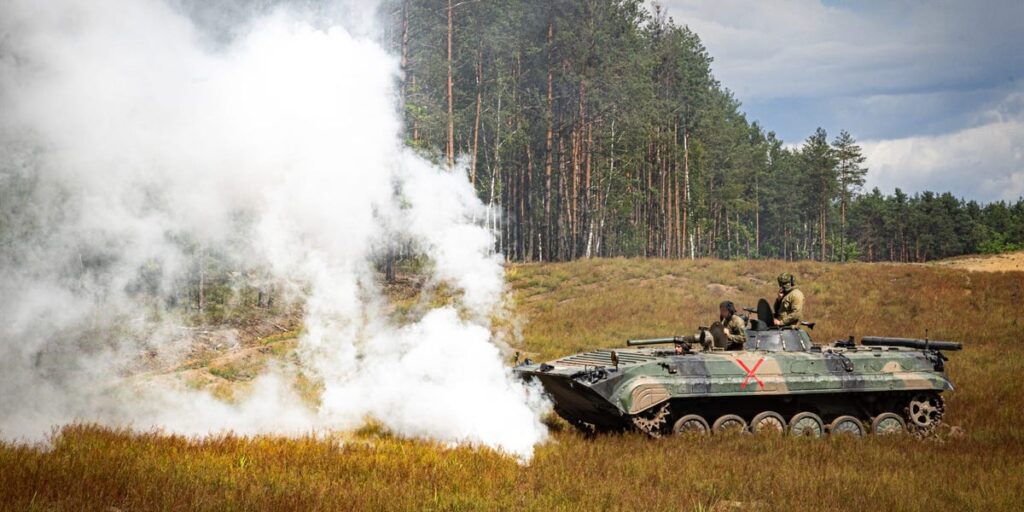
The opposition force uses vehicles like those that Russia uses. Vehicles supplied by Poland include Polish versions of the Soviet-era T-72 main battle tank, BMP-1 Soviet-era infantry fighting vehicle, and other armored vehicles.

It also use drones, motorcycles, and ATVs “because the Russians are using that as well,” John said. “So we make sure that they are exposed to those same scenarios that they will meet when they go back.”

Brigadier Atle Molde, the commander of Task Force Legio, told Business Insider that the Ukrainians instruct the opposition force on how to behave, so they act as Russia does on the battlefield.

The aim is always to have “proper realism,” he said. Having a designated opposition force to act like Russia means that “they can play that role as close to the real enemy as possible,” and that increases the quality of the training.

Ukrainian troops aren’t practicing mechanized warfare as part of their training because large-scale Ukrainian mechanized assaults are no longer a major feature of the war. But it’s important that they know how to respond to them because “we still see that Russians use mechanized vehicles,” John said.

Instead, Russian forces use “small mechanized units trying to utilize breakthrough and so on,” he said. “So that is just a combat effect from the Russian side that they try to expose the trainees to.”

Molde said that Russian vehicle formations are “still a factor they have to be able to cope with because it happens,” even though large-scale mechanized warfare has largely disappeared from a fight dominated by relatively static front lines.

Tanks and armored vehicles played a bigger role earlier in the war, but have proved particularly vulnerable to mine and drone threats. The war has become a grinding, attritional fight, with an expanding front-line kill zone that makes agile maneuver warfare difficult. Tanks and heavy armor are built for the kind of breakthroughs that are increasingly uncommon.

Russia has still conducted mechanized attacks, including smaller, localized assaults with fewer vehicles, trying to push forward and gain ground. So Ukrainian soldiers still need to know how best to face them.

Russian soldiers are using motorcycles, quad bikes, and ATVs in Ukraine for quick attacks and even large-scale assaults that attempt to overwhelm Ukrainian positions. Ukraine is also using them to quickly storm Russian positions. Riders on these vehicles have less protection and are more vulnerable to drone attacks than troops in an armored vehicle, but they’re also able to move quickly, making them harder to spot and target.

Molde said the aim is for the opposition force to perform better with these vehicles than Russia has, giving the Ukrainians a tougher opponent in training.

“It’s an old military principle thing. Train hard, fight easy.”

Asked by Business Insider whether the force typically acts more skillfully than the Russian forces Ukrainians encounter, he responded, “Yeah. Well, we all know about the training standard of many Russian forces. Maybe I should say I hope so.”

John said the aim is to make the terrain look like Ukraine, flat and exposed with scattered tree lines, and train troops with the weaponry Ukrainian soldiers are actually using. The trenches at the purpose-built site in Poland, Camp Jomsborg, are dug by the Ukrainians, or built by allied troops according to Ukrainian instructions, and they’re regularly updated to mirror those on the actual battlefield.

The mock Russian force also updates its equipment and tactics to reflect changes on the battlefield, while laser simulation systems and some explosives add realism to the fighting.

Jørgen, a Norwegian instructor at the camp, told Business Insider that the aim of the opposition force is to give Ukrainian soldiers “realistic experiences that everyone on the course can actually bring back to the war.”

Doing that requires constant feedback from the Ukrainian troops and instructors at the camp, as well as military personnel still fighting the war, he said.

“The guys tell us stories, and try to help us understand how it actually looks and how it actually works,” Jørgen said.

Its leaders don’t describe it as Norway and allies just training Ukraine. Instead, Ukraine identifies the areas where its troops need training, while allies bring doctrine and expertise to combine with the battle-won lessons and skills of the Ukrainian soldiers going through the training and the Ukrainian instructors working alongside allied instructors.

“We have defined this as a Ukrainian training center,” John said.

The work also benefits allies. John said Norway and its allies are trying to learn from the creativity and battlefield experience of the Ukrainian soldiers, while teaching them Western doctrine, planning methods, and military decision-making processes.

They combine both to get the best result, he said, “so we’re learning from each other.”

John said that one of the final things that happened last year, before the first training rotation began, was that Ukrainian soldiers met with the instructors to form a planning group to discuss how it could be as realistic as possible.

There were areas, he said, where the Ukrainians said that the training was “not good enough, this is not in accordance with our request or needs. So we had to revise and change the training program and then fit it to their current operational needs.”

Molde called Camp Jomsborg “one of several, but maybe the most important sensor” for getting wartime lessons back to Norway’s military. Norway is studying what Ukrainians bring back from the battlefield to ensure it takes the right lessons from the war, he said.


Read the full article here

Share.
Leave A Reply