


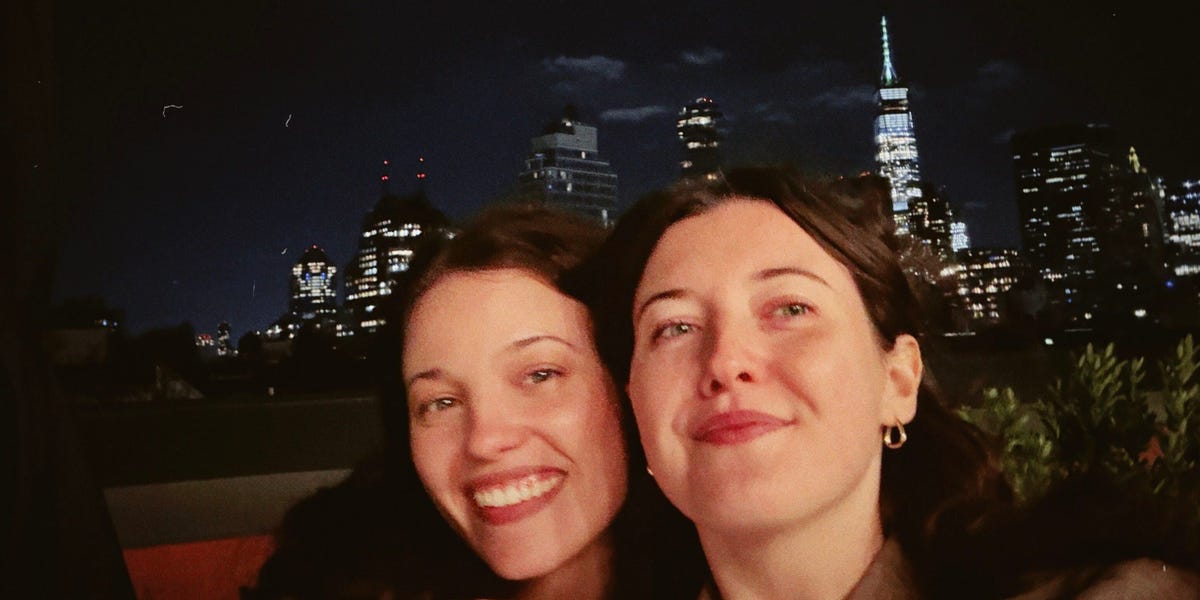
It was the day after the Fall Equinox, and we were partying on a rooftop, pulling tarot cards about our love lives.
The location might surprise you: a venture capital firm’s office overlooking the Manhattan skyline.
Wait, what’s astrology got to do with venture capital? We were at a launch party for a social-astrology app called Lora. The party was hosted by Lora founder Michelle Parsons at the offices of her pre-seed backer — AlleyCorp — in SoHo.
Astrology is a hot subject in tech.
Co-Star, a leading social app for the star-inclined, was acquired by AI company Midjourney this summer, casting a spotlight on the space. Investors and the astrology-obsessed alike want to know: Will an AI-era app take the crown as the next big app in the sector?
“This is a space I’ve been thinking about for a long time,” said Luc Ryan-Schreiber, an investor at AlleyCorp who spearheads the firm’s incubation projects — including Lora. “With AI, there was an opportunity to do something a little bit more interactive.”
Lora, for instance, lets users interact with an AI-powered chatbot that offers advice on personal development, relationships — pretty much anything you want — based on your astrological birth chart.
While there is a litany of other astrology apps ready for download, perhaps the biggest competitors in the market are the larger LLM models themselves. Anyone can upload their star chart to ChatGPT or Claude, and then spend hours on end prompting the machine to spit out answers.
Lora’s founder, Parsons, said she didn’t want to put out another app that gives people the answers they want to hear. Instead of “sycophantic” responses from an AI bot or a straightforward daily horoscope, Parsons wants Lora to help people recognize “patterns” in their lives, whether in relationships or in private.
There are still humans involved in Lora’s experience, too, in the form of real-life astrologists, tarot readers, or coaches people can hire directly within the app.
Some of those humans were at the party.
We sat down with Anne Benveniste, a self-described alignment coach, who provides services on Lora, to read three tarot cards we each pulled. As two single women living in New York City, naturally, we had questions about our love lives. The biggest lesson we both took home from Benveniste: Pain is the price of love.
Techies and astrologers are both looking to the stars
On the elevator journey to the roof, we got cozy with fellow Lora party attendees. Not a word was spoken until someone broke the silence by asking everyone for their Big Three. (That’s your sun, moon, and rising sign.)
Walking into the party, we were met with a manifestation board where guests wrote down their prayers for prosperity, love, and money. $50K monthly recurring revenue; that someone special, also $100K; no seasonal depression.
A DJ was blasting house music, and an open bar with astrology-themed cocktails was grab-and-go ready. Grace chose the Fixed sign margarita that had the lovers tarot card clipped to the cup, while Sydney sipped on a Mutable sign garden spritz with the strength tarot card.
Meanwhile, people in tech got busy talking about the stars.
“When I was a VC, I’d ask founders what their star sign was,” said VC-turned-founder Zehra Naqvi. (She’s a Pisces.)
She was one of several startup founders in attendance at Lora’s launch party.
We asked Eric Phillips Waldstein, founder of dating app Beyond, what brought him to the rooftop shindig.
“Michelle, but you know, more broadly, the universe,” said Waldstein (a Sagittarius). Lora’s Parsons is an advisor for his company. He added that the vibes were certainly “better” than a typical VC party.
We chatted with attendees about topics including other astrology tools they’ve tried, AI, the state of dating apps, socializing IRL, and the brisk end of summer.
In line for a tarot reading, Mia Cooper, an attendee who works in tech (and is a Pisces), is considering a career change and hoping to get some clarifying answers at Lora’s party.
“People are managing a lot of anxiety,” Benveniste said. “So many of my readings ended up in discussions around how to release uncomfortable experiences in a healthy way and create space to hear their inner compass.”
Read the full article here