



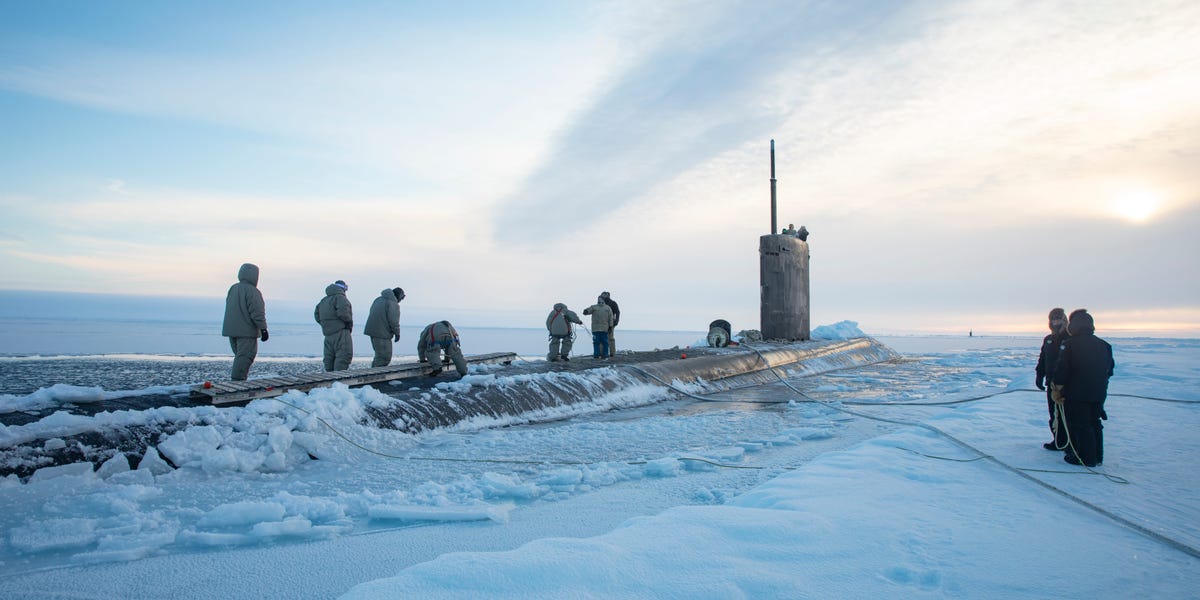
Severe backlogs could leave over a dozen US Navy attack submarines awaiting decommissioning sitting idle for more than 14,000 days through the end of the decade, and cost the sea service over $3 billion, according to a new watchdog report.
Navy maintenance delays have already cost the sea service billions of dollars and sidelined active attack submarines for thousands of operational days, affecting fleet readiness.
A new report from the Government Accountability Office, a congressional watchdog, said: “Over the last 10 years, the US Navy has lost more than 15,000 operational days due to maintenance delays and idle time on active attack submarines. These delays resulted in an estimated $3.4 billion in costs to sustain crews and submarines that provided no operational capability.”
Idle time for active submarines refers to the period when a vessel is no longer certified to operate but has yet to enter maintenance. The Navy may still end up paying out hundreds of thousands of dollars a day for submarines to sit pier-side.
A related backlog for inactive subs is expected to be another substantial cost burden.
“Without mitigation, 15 attack submarines will enter inactive idle time from fiscal year 2026 through fiscal year 2030,” the new GAO report said, “during which time the Navy could incur more than 14,000 days of inactive idle time and $3.1 billion in costs to operate and support these inactive submarines.”
The report cited the Los Angeles-class sub USS Pasadena as an example. The vessel, which entered inactive idle status on January 1, 2025, is not scheduled for decommissioning until November 15, 2028, due to limited shipyard capacity.
The Navy told the GAO that it will use the Pasadena as a training platform while it waits for decommissioning; however, the delay will cost the service over $300 million, the GAO said.
The Navy’s nuclear-powered submarines undergo their most extensive maintenance, repairs, and decommissioning at four public shipyards, though some depot-level work can be done at two private yards. The Navy and shipbuilders are pursuing several efforts to revitalize yards, including increasing capacity and investing in the workforce and infrastructure.
Earlier this month, President Donald Trump issued an executive order directing the Navy and the Department of Defense to establish a fifth public yard as part of a larger “plan to increase nuclear-powered submarine and aircraft carrier readiness.”
The Navy told the GAO that it’s considering alternative options in the meantime, including defueling the nuclear reactors of attack submarines while the vessels are pier-side rather than waiting until they reach a shipyard. “However, officials were unable to provide documentation of detailed analyses conducted on the feasibility and cost-effectiveness of this option,” the GAO added.
The Navy is also looking into using floating dry docks for defueling, but the GAO said that option also needs further study. Other proposed alternatives include transferring inactive crews to active vessels and extending the service lives of submarines to avoid decommissioning backlogs, although “these service life extensions are still pending approval,” the report said.
Read the full article here