


In recent days, President Donald Trump has announced Walmart is lowering prices, and took credit. He went further last week when he cheered Michael Dell for funding Trump Accounts to the tune of $6.25 billion.
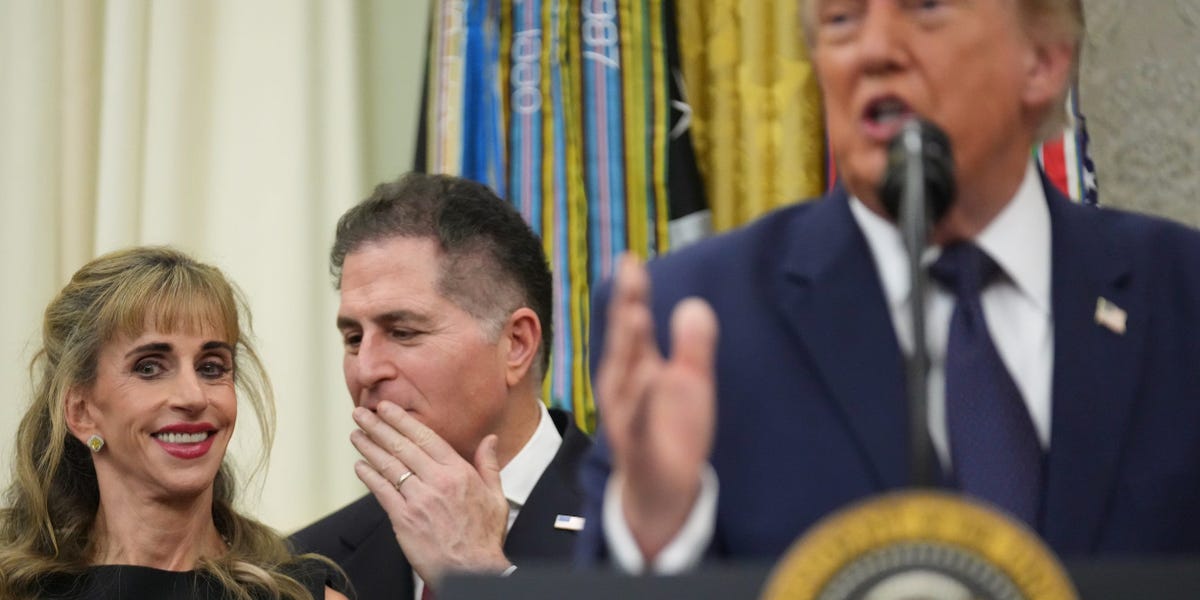
At an Oval Office celebration for the investment accounts for children with the CEO and his wife, Trump issued this exhortation: “Go out and buy a Dell computer.”
Average Americans may like cheaper groceries or no-cost nest eggs for their kids. They may be pleased that the president is pushing for what he wants from corporate America.
The president’s penchant for mixing business and politics has others concerned that his pattern of playing favorites meddles with free enterprise and could distort incentives in the economy. Another concern — he has bought shares in both Dell and Walmart this year.
“It’s a clear violation of misusing public office for private gain, and also sort of implying that there is some sort of government-wide endorsement of Dell products over competitors for laptops and electronics,” Don Fox, former general counsel and acting director of the US Office of Government Ethics, said in an interview.
“For anyone else, it would be a clear-cut violation, and frankly, in any other administration, no chief executive would ever have done this, and if one of their staff members had done it, they would have been called to the carpet on it.”
Richard Painter, who served as the chief ethics lawyer in the White House Counsel’s Office under President George W. Bush, said that during the Bush administration, ethics officials were so careful of perceived favoritism that they rarely allowed high-ranking officials to appear at company-specific events. When such events did occur, Painter said they “bent over backwards” to ensure they did not improperly lend the president’s imprimatur.
Trump’s remarks earlier this month marked the third time he urged people to buy Dell’s computers in five months.
“This is not free enterprise when the government says this company’s good, that company’s bad,” Painter said. “The whole point of free enterprise is to get the government out of the business, picking winners and losers in the economy.”
Jordan Libowitz, a vice president at Citizens for Responsibility and Ethics in Washington (CREW), a nonprofit watchdog group, said Trump’s comments give the impression the presidency “is for sale.”
“If you are a financial backer of the president, you might just see the president using the power of the presidency to benefit your business,” Libowitz said.
During his first term in office, Libowitz said, Trump would single out specific companies, often for ridicule. What’s different now, in Libowitz’s view, is the president’s own bottom line. Since returning to office, Trump has reported tens of thousands of securities trades.
Trump, who has not promoted Dell’s stock, bought at least $1 million in Dell shares and possibly as much as $5 million in February. In April, he reported selling at least $50,000 worth of Dell shares and possibly as much as $100,000. (The president is only required to disclose rough amounts for purchases and sales.)
The Trump Organization has said that neither Trump nor his family has any direct control over the stock trades, which are controlled by outside brokerages. Other presidents have put their holdings into a blind trust or didn’t hold individual stocks.
White House spokesperson Kush Desai said Trump was right to praise the Dells.
“Michael and Susan Dell are patriots who are generously contributing billions of dollars of their fortune to the Trump Accounts of millions of kids from working-class families,” Desai said in a statement.
CREW and the Campaign Legal Center, both of which have filed ethics complaints against Trump administration officials in the past, said there’s little they can do in response since ethics regulations for the executive branch don’t cover the president or vice president.
Painter said the Supreme Court’s landmark ruling in Trump v. United States, which granted presidents a degree of immunity for all but their most unofficial acts, has increased the difficulty of making claims about potential wrongdoing.
“If he says my statement about Dell Computer was an official statement of the president of the United States, you can’t investigate his motives for that statement,” Painter said.
Kedric Payne, a vice president at the Campaign Legal Center, said Trump is different because previous presidents kept their financial holdings in blind trusts.
“So, if you had a president going to some factory and saying, ‘Oh, this is a great factory,’ then the public could have confidence that the president is just promoting that particular factory and not trying to promote the stock that he owns,” Payne said in an interview with Business Insider.
Not everyone is concerned about Trump’s endorsements.
Seth Barrett Tillman, an associate professor at Maynooth University’s School of Law in Ireland who drew attention for his arguments in another Trump-related Supreme Court case, said that the president is entitled under the First Amendment to single out companies for praise.
“The president has freedom of speech just like every other American, and any American who wants to say ‘Go buy a Dell’ is allowed to do that under the First Amendment,” Tillman told Business Insider.
Tillman said it’s possible Dell’s manufacturing rivals may not be bothered by the endorsement.
“So, if the other manufacturers are not upset, I am not going to be upset, and I do not really think it is anyone else’s place to be upset,” he said. “And I do not know that any of them are upset.”
Additional reporting by Steven Tweedie.
Read the full article here