





Justin Blinder was lugging Taco Bell burritos from neighborhood to neighborhood on his bike for his Uber Eats gig in 2020, watching as skyscrapers and modular apartment buildings gave way to brown-bricked housing projects and cracked streets.
It made the Brooklyn-based artist and software developer think viscerally about affordability, and how abstracted the concept had become in modern discourse.
“We’re sort of confronted with that via top-down maps, and it really doesn’t touch upon the lived experience,” Blinder told Business Insider. “That was sort of like the seed of the project.”
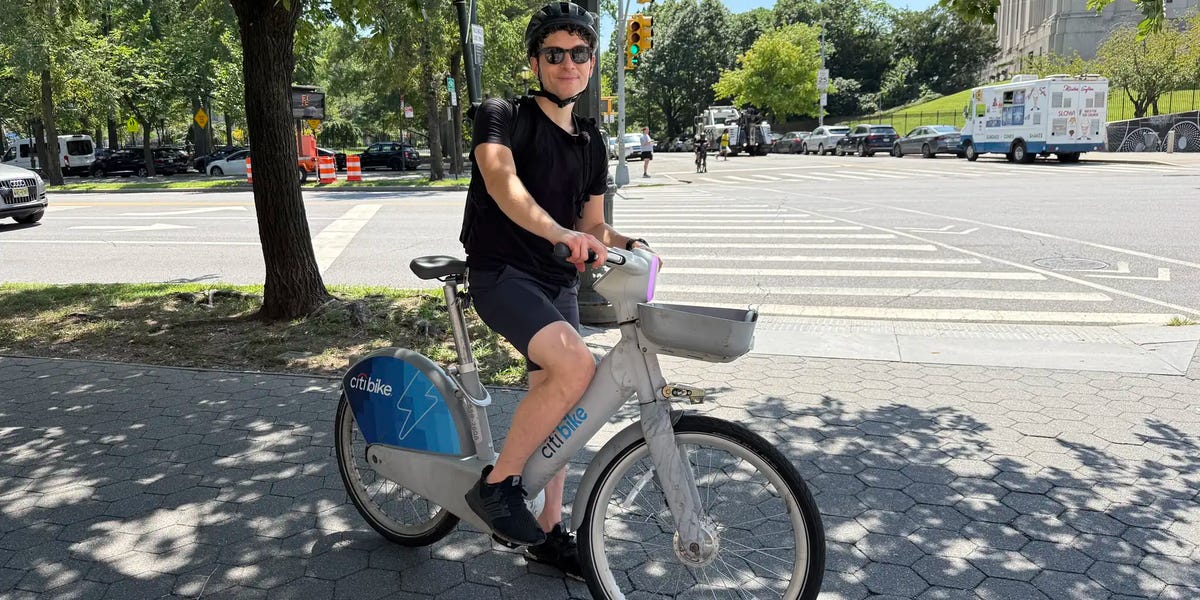
“The project,” as Blinder describes it, is a 3D printed CitiBike attachment that adjusts pedal resistance depending on how rent-burdened the surrounding neighborhood is.
With the device attached to a CitiBike, a rider can glide through parts of the Big Apple where renters give less of their paychecks to landlords. In areas where renters give more — many parts of the Bronx, for instance — the device applies the brakes.
Blinder said the device is meant to physically tie riders to high rent prices in the city. He said that too often, real problems in the world become innocuous data points that are read online and forgotten about soon after.
“It’s so easy to just reduce people to numbers and forget that each is somebody’s sister or child, and these people have names and stories,” Blinder said.
The device earned Blinder a $10,000 grant from Idle Hands, an artistic philanthropic organization, this year.
It did not, however, impress CitiBike. A spokesperson for Lyft, which owns CitiBike, told Business Insider that CitiBike’s terms of service prohibit modification of any bikes.
Want more Business Insider in your news feed?
Add BI in Google so our reporting is easier to find when you’re searching for what matters.
“You may not modify, dismantle, write on, or otherwise alter or deface a Bicycle or any part of a Bicycle in any way,” the terms say.
Affordability
It’s no secret that people struggle to pay rent in NYC.
An NYU Furman report found that “over half” of renter households in NYC spent more than 30% of their yearly income on rent in 2024 — a benchmark the study’s authors, as well as Blinder, classify as rent-burdened.
According to the report, nearly 90% of low-income households with “extremely low” incomes were severely or moderately rent-burdened in 2024. About 70% of these households spent more than half of their total income on rent and utilities.
Mayor Zohran Mamdani rocketed into office this year in part by leveraging the word “affordability” with rhetoric and policy proposals.
In June, one of Mamdani’s signature campaign promises, freezing the rent, was approved by the New York City Rent Guidelines Board, though landlords sued to block it in July, and the policy remains tied up in litigation.
Headlines, however, even if they’re generated by a proactive mayor, do not accurately convey the realities of high housing costs, Blinder said.
“It’s trying to really give the data a human imprint again,” he said of the device.
“Ground Truth”
The device contains a GPS and an SD card loaded with a custom rent dataset that Blinder created for NYC, which assigns each block in the city an “affordability score.”
A block’s affordability score comprises the median share of income spent on rent and the percentage of renter households spending at least half of their income on housing.
Blinder called the project “Ground Truth” because it allows riders to feel affordability in a unique way.
“Ground Truth intervenes by treating tactility not simply as texture or touch, but as friction and labor unfolding over time,” his website reads. “Each pedal stroke becomes a small encounter with the data’s underlying representations.”
Why CitiBike?
CitiBike, Blinder said, is not a fan of the project. And Blinder isn’t exactly a fan of CitiBike, either.
The ubiquitous rent-a-bike service has become “part of this cost of living crisis story,” Blinder said. He said the company has raised prices every year for the past five years.
“CitiBike felt important because it kind of embodies this contradiction that’s at the center of the project,” Blinder said. “Really promises to create a more accessible city, but it’s also making that promise somewhat conditional, and making aspects of the city less affordable.”
For Blinder’s patrons, the device is an ingenious new work of art.
“There’s someone who is doing something that is really exciting and dangerous,” said Linden Renz, who founded the organization.
Read the full article here