






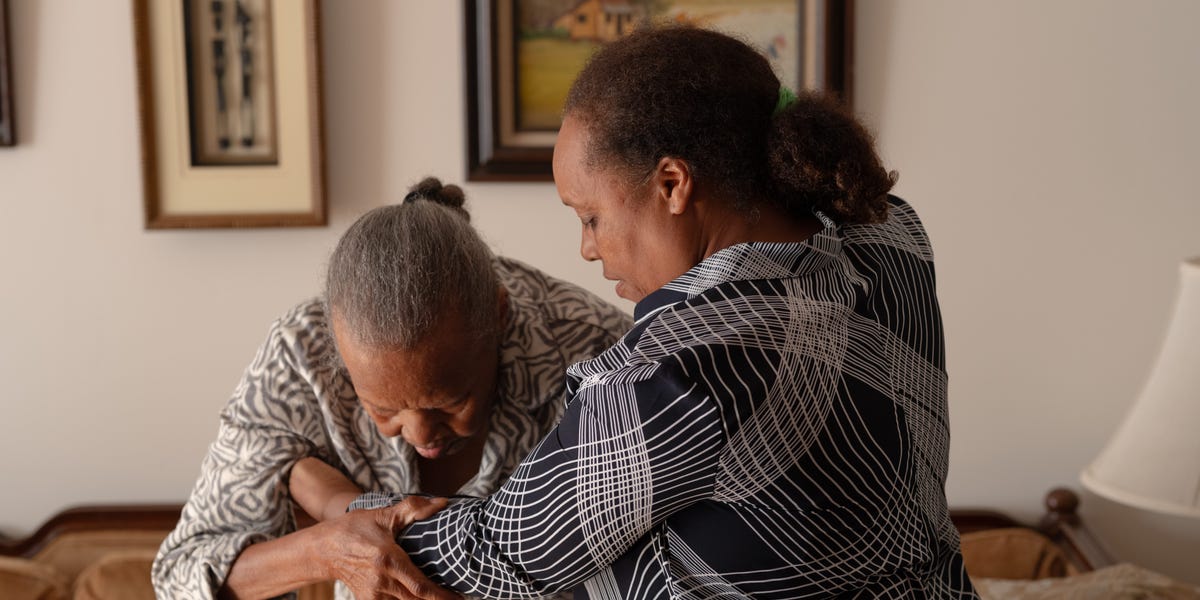
When Angela Davis discovered that her mother with dementia had changed the locks, she knew she had to intervene.
After a standard care facility didn’t cut it, Davis, 65, moved her mother into her own home. Davis now manages her medications, assists with her hygiene, and monitors her at night. She sleeps on a love seat near her mom’s room in case anything happens.
Her mom’s care, plus home maintenance, has cost about $7,000 a month. Her mom receives $3,200 monthly in retirement income, and Davis covers the rest. The stress has weighed her down; last week, she took what she thought would be a short evening nap. Next thing she knew, it was 7 a.m. the next morning and time to go to work.
“It’s death by 1,000 cuts, and in this case, you could say death by 1,000 memories every day,” Davis said.
Seven million Americans have Alzheimer’s, leaving families to navigate rising costs for memory care facilities or home care. One estimate shows that lifetime costs for dementia can exceed $400,000.
Two dozen families navigating dementia care told Business Insider that costs add up for frequent hospitalizations and physician visits, expensive medications, transportation costs, and round-the-clock home care. Those who can afford it spend five figures on monthly memory care facility costs. Other costs included home modifications, power-of-attorney legal fees, and technologies for aging in place.
A report from AARP and the National Alliance for Caregiving found that in 2025, one in four family caregivers cared for someone 50 and over with memory issues or dementia. While an estimated 7 million Americans aged 65 and over have Alzheimer’s, that is expected to surge.
Wendy Rowland, 53, has cared for her husband with early onset Lewy body dementia for years. To manage his treatment, they spent through his 401(k) and sold their house of 20 years, then put him into a memory care facility two years ago that now costs $6,750 a month.
“I hope nothing like that happens with me, and if it does, I don’t know if I would want anybody else to go through the same thing of having to figure out what to do,” Rowland said.
The cost of memory care can be steep
It pained Keith Pavlick, 53, to witness his father slowly forget his family members’ names and lose track of his surroundings. He hadn’t fully anticipated the financial hit that came with it.
Pavlick, a real estate agent in Orlando, has helped his mother, 79, and his father, 80, since his dementia diagnosis in March 2025. His parents moved into an assisted living facility for $9,000 a month.
The $9,000 is just the start, Pavlick told Business Insider earlier this year. He knows his dad will need a heightened level of care, and memory care facilities in his area cost $14,000 monthly.
“Unless you’re starting out investing or bought SpaceX at the IPO, then you’re probably not going to be able to take care of your parents when they’re that age by yourself,” Pavlick said. “I’m probably going to be selling real estate until I’m dead.”
Memory care costs a median of about $8,000 monthly, according to data from SeniorLiving.org. They’re more expensive than standard assisted living centers because dementia patients require 24/7 supervision by specialized caregivers. They also have high security and maintenance costs.
Medicare generally doesn’t fund long-term memory care. Medicaid chips in for eligible families, though many said they have paid out of pocket or used long-term care insurance.
Want more Business Insider in your news feed?
Add BI in Google so our reporting is easier to find when you’re searching for what matters.
Sharon Winterton, 53, has juggled working a tech sales job, raising a 14-year-old daughter, and caring for her 90-year-old mother with vascular dementia. Winterton moved her mom into an independent living facility as her memory declined.
Her mom had invested in long-term care insurance, which she’s used to cover her $7,000 monthly assisted living costs. Winterton said they’re fortunate to avoid the high out-of-pocket cost, though she’s splurged on technologies that allow her to change TV channels and monitor her mom remotely.
“Thankfully, I don’t have to worry a lot about her long-term care,” Winterton said.
There are many costs beyond direct care itself
Jenn Verser, 45, hadn’t anticipated moving into her childhood home in New Jersey to help care for her dad with Alzheimer’s.
Verser is selling her home and planning to build a two-story, roughly 1,000-square-foot addition to her parents’ house. She expects it will cost at least $600,000, which they’re planning to cover with a home equity line of credit, her parents’ investment accounts, and the sale of her home.
She said it’s important to get started as quickly as possible, so that her dad can get familiar and comfortable with the addition as his Alzheimer’s progresses and confusion increases. Her parents will be moving into the addition, which is “elder-friendly,” with the goal of aging in place. Verser, her husband, and her child will move into the main area.
Though some families told Business Insider they avoided memory care in favor of at-home care, the costs are often comparable. Tatyana Zlotsky, CEO of A Place for Mom, a platform connecting senior care providers and families, said that with home care costing about $30 an hour, based on the platform’s internal data, this can end up being over $250,000 a year for 24/7 care.
An early retirement or remote job can help caregivers minimize costs. Families have invested thousands of dollars in age-tech designed for dementia care, such as motion-sensor cameras, medication monitoring, and smart home devices like stove shut-off devices. Others have spent five figures on home renovations for their loved ones.
Ann Gynn, 55, had cared for her mom until September, when she moved into memory care. In 2024, the content marketer in Cleveland started using JubileeTV, a remote caregiving platform allowing for remote monitoring through the TV, after many frustrating back-and-forth phone calls with her mom. Gynn created a schedule of her mom’s favorite shows, and she sometimes uses the drop-in feature to see which nursing aides are in the room.
“It gives me peace of mind that I have ways to get in touch with her and ways to help her that I don’t physically have to be there for,” Gynn said.
Emotional costs can be a heavy burden too
For many families, the greatest cost of dementia care isn’t financial.
For Michelle Keller, 59, caring for her dad has meant sacrificing going out for her 35th wedding anniversary, and, at times, forcing herself to feel optimistic. She said caregiving can be tiring and involve a lot of acting.
“To be able to put on that happy face, it helps to get things done,” Keller said. “If they’re happier, they’ll listen and follow instructions a little better. There’s a lot of work involved that honestly doesn’t allow you to take time to think about the mess you’re in.”
Dementia caregivers said they’ve quit their jobs, gone part-time, or taken on less time-consuming roles to be more present as caregivers. The stress of worrying about falls, wandering, or medication takes a toll on caregivers’ physical health, too. They don’t always have the time or energy to prepare for their own long-term care.
“Asking individual people to find the Goldilocks solution of how much to save for a future even that may or may not occur is unfortunately the wrong question,” said Alan Weil, senior vice president of public policy at AARP.
Laura Ehrlich, 54, knew her aunt’s health was declining when, a few years back, she caught her giving her Social Security number to a scammer.
With help from an aide, she handled her day-to-day needs, but after her aunt fell at the mall, her family decided to place her in an assisted living facility nearby. Ehrlich, who also cares part-time for her mother-in-law, stays afloat by living on a stipend from her aunt’s trust.
“I still haven’t dealt with the loss of my parents, my husband, or my father-in-law,” said Ehrlich, who has worked on and off in between caregiving. “It’s just been putting up a wall and going on to the next person who needs help.”
Read the full article here