





When I was a young lad spending too much time on the internet, I was obsessed with fonts.
I read blog posts on sites like Typographica about the finer points of kerning. I read white papers from Microsoft about the readability of Calibri compared to Arial. I copied and pasted hundreds of pages’ worth of books and essays from Project Gutenberg into Microsoft Word and formatted them to my liking. Among them was a theory of great fiction and taste by Henry James, published in 1884, which I later recast in Cambria and printed out so I could read it on the bus.
James believed that greatness could be defined by its elements, but that taste comes from experience. “Some people, for excellent reasons, don’t like to read about carpenters; others, for reasons even better, don’t like to read about courtesans.” It was futile, he said, to impose what “people ought to like or dislike.”
Back then, I was trying to discern what I liked and why I thought those things were good. Fifteen years later, I’m still writing (nothing as good as “Portrait as a Lady”), and don’t care much about fonts anymore (I wrote this story in Google Docs using Arial). But I realized that the process of figuring out the music and clothes you like — developing taste — is not so different from figuring out which words to use and how to arrange them on a page. It takes time, detours, and mistakes. Taste takes life to acquire.
Now comes a company with $18.5 million in venture capital funding that supposes: What if AI could do all that for you?
The thesis of Taste Labs is that taste is a form of pattern recognition and, therefore, ripe for artificial intelligence to master.
The problem with AI today, says Taste Labs CEO Thais Castello Branco, is that it produces things that might be technically excellent, but it lacks the guidance to understand which parts of its training data are good and which parts are junk. AI-generated outputs are, as a result, statistically average. At worst, you get images of terrifying-looking food. At best, you get a bland LinkedIn post or a soulless actress. In other words, you get slop.
The thesis of Taste Labs is that taste is a form of pattern recognition, and therefore ripe for AI to master.
AI researchers have long recognized this problem. The technology excels in “objective” domains like coding. It struggles in subjective areas like design, creative writing, and fashion, where a right answer could be dependent on context, culture, and differences of opinion. To solve that, Taste Labs is creating taxonomies of quality. Castello Branco tells me that the company is breaking down designs — starting with product websites, slide decks, and brochures, before eventually branching out to higher-order creations — into measurable elements, and then creating the right data to train frontier models to become better at judging and measuring quality.
The central question Taste Labs aims to answer, says Castello Branco, is: What are the criteria that go into defining what is great? The central question Taste Labs raises is: Do we want AI to define what is great?
The idea that an AI algorithm can determine good taste might seem hubristic for a company based in Silicon Valley, the community that brought us Allbirds, digital tokens of unshaven apes smoking cigars, and the Metaverse. Who the hell are these people to think that taste is a problem to be solved by computers? And how dare they think computers can solve it?
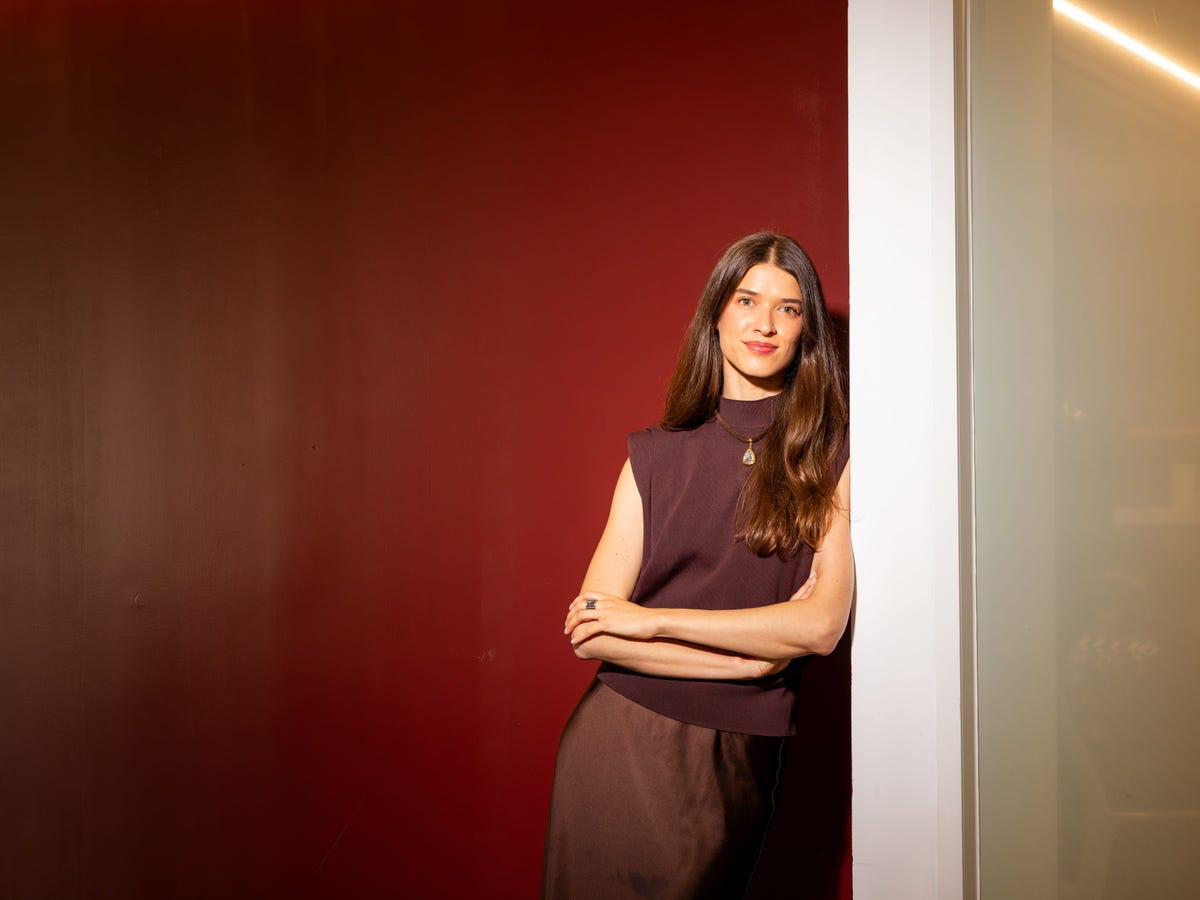
Castello Branco, 29, is quick to admit her own taste can be “basic.” She says her favorite movies are Christopher Nolan films and the Brazilian crime drama “City of God” (she grew up in São Paulo) — a staple of the IMDb Top 250 list. After graduating from the University of Chicago, she developed products for Heinz Kraft, including pickles, desserts, plant-based food, and a “burger sauce.” Later, she cofounded Exa, a company that operates a search engine for AI agents, before launching Taste Labs last October.
Castello Branco’s solution is to outsource taste to a network of about 1,000 “Tastemakers” — contractors in creative fields who train artificial intelligence models on what is good, and what is not. As the logic goes, their aggregate preferences improve upon the entire-internet slurry of data that’s been used to train AI models so far. “Very high quality curated preference data,” she says, helps to improve “subjective domains” like creative writing and architecture.
Indexing and systematizing all forms of human creativity is a tall order. Taste Labs is starting with visual design, a field already in flux with Figma and the rapid rise of Claude Code and Cursor. The task involves breaking down great design into its subcomponents and making sure that AI models can execute each of them well. The models have to visualize the code, understanding how people would interact with it, select appropriate typefaces and colors, and figure out the right spacing and alignment. Castello Branco’s panel of Tastemaker experts, she says, could largely agree on the merits, or lack thereof, for each element. Claude Code might think that the recipe website you asked it to design should have a lot of introductory text; Taste Labs knows the recipe should be near the top. Eventually, the company plans to branch out into other fields, like copywriting, literary fiction, music, and cinematography.
Business is booming, Castello Branco and investors say. The company has 30 full-time employees. Veronica Orellana, a partner at CRV, one of Taste Labs’ lead investors, tells me that the startup already has “tens of millions in revenue.” The steady financial success and clear vision mean Taste Labs doesn’t need to raise more money anytime soon.
Taste Labs is working with “most of the major frontier labs” on various projects, Castello Branco says. She declines to say which.
“Sometimes they come to us with a very broad problem,” Castello Branco says. “Something like, ‘Hey, evaluate our model for web games capabilities, figure out what’s broken about it, and then suggest data that could fix those problems.'”
The logical endpoint for Taste Labs seemed like the end of culture itself: to get AI to do all the things humans are supposed to do.
The Tastemakers do this in a variety of ways. For some projects, they create their own designs and then write explanations of their particular creative choices. In others, they write evaluations of different AI outputs. Some Tastemakers evaluate the work of other Tastemakers, further refining the data.
Whitney Bolin, an art director who’s worked for companies like Adobe and Adidas, tells me she’s worked on tasks that involve “breaking down design and style into things that are kind of measurable and observable, like typography, motion, color, textures — things that could be subjective and giving them a grade or evaluating them as someone with taste.”
“There’s a lot of thought and consideration put into each evaluation,” she said. “It’s not as simple as just rating out of 10.”
Castello Branco was inspired to start Taste Labs after fiddling with widely available AI models and finding that the results for creative work — websites, graphics, that sort of thing — sucked. She looked around and saw piles and piles of slop.
“I really didn’t want to live in that world,” she continues. “I was like, I don’t want this. I want to live in a world of creativity and craft and quality. And I feel like that’s really missing.”
I know what she means. Between interviews with Castello Branco, I was using AI to vibe code a new personal website to showcase my writing. Google’s Stitch web design tool had the bright idea of including a snippet of one of my stories on a yellow legal notepad, a nod to my days covering courtroom trials. But the execution seemed wrong, even when I used Business Insider’s Codex account, an expense I can now justify by including this sentence in this article I’m writing for work. The yellow that Codex selected was garish instead of mellow, and the font was bizarrely florid. I tried to prompt it so that the edges of the paper would curl when I hovered over it, giving the website a tactile visual susurrus of rustling through the notepad’s thin pages. But I just couldn’t get it to look right. These were more issues of baseline quality control than personal taste.
The first product Taste Labs launched is a Brand API. You can plug in a brand’s website, and it can extract and systematize the visual components into a set of rules. That rulebook, in turn, can be plugged into graphic design tools to help companies create new graphics while remaining within the brand’s guidelines. A company like Coca-Cola could hire an ad agency and give it access to an API that’ll ensure any artificially generated ads use the correct shades of red and their new font without constant prompt reminders. Another tool allows users to search for cohesive brand systems. If a pillowcase design entrepreneur told the API, “I want a dreamy brand,” it would produce a color scheme that evokes clouds and sunset colors.
For the past few years, AI companies have been proclaiming that their products will sweep away the drudgery of work and give us the freedom to focus on human creativity. Taste Labs’ grandest ambitions, to automate key components of creativity, go beyond that. The logical endpoint for Taste Labs seemed like the end of culture itself: to get AI to do all the things humans are supposed to do.
Castello Branco reassured me that Taste Labs isn’t looking to replace humans. With AI, you no longer need to learn how to code to make a website, or play an instrument, or use specialized software to make a song. Taste Labs could supercharge all that.
“I don’t think it’s productive to assume that every person in the world that is not an expert in this domain will take the time to become an expert,” Castello Branco says. “They shouldn’t.”
Bolin, the art director, wrestled with the question when she answered an online ad to join the Tastemakers network and learned she would be working for an AI company. She ultimately believes that AI can never replace “the emotional intention and value that a human can add.”
Like me with my digital garish yellow notepad, Bolin found herself frustrated when she sometimes lacked the technical abilities to express her creative vision. Taste Labs can create tools that can “allow people to get past that technical hump,” she says.
“There’s always going to be an evolution,” she says. “In the ’90s, Photoshop and Adobe Illustrator came out, and a lot of people were saying, ‘Oh no, designers are going to be replaced.’ Everything was done by hand.”
Most people won’t take the time to master website design or architecture, but Taste Labs could help them execute their visions at a higher level, rather than stumble around in the dark with Claude prompts. Maybe I could get back into typography again. Maybe I could design my own fonts with AI, and have Taste Labs figure out the kerning instead of wondering what my life would be like had I gotten an internship with Tobias Frere-Jones instead of Interview magazine.
Castello Branco shares her own hesitations about traversing into more creative domains. She recognized that developing AI that could “guarantee a minimum bar of quality” was related to, but different than, catering to an individual’s taste. For the creative people who push culture’s vanguard, Taste Labs would help them bring their ideas to life. “If you want to create a very specific aesthetic, my dream is that you can prompt that and get exactly that very well executed exactly to your taste,” Castello Branco says.
I pushed her. Let’s say we’re decades in the future. AI — and Taste Labs — reaches a quality level beyond anyone’s wildest dreams. Christopher Nolan is dead. You’ve seen every one of his movies, except for “Following,” available only on MGM+, which you’re never going to sign up for. Would you ask Taste Labs to make a new Nolan movie? What would that look like?
Mimicking a particular artist’s work is the wrong mission, she said. It’s more about learning from Nolan’s greatness to produce something that would be great in its own right.
“It’s not imitating Christopher Nolan, but can they create a movie that is as good as Christopher Nolan or directionally closer to Christopher Nolan?” she said. “That is much more the goal.”
Castello Branco’s perspective was not so different from what Henry James believed. Taste is subjective, and it could not — and should not — be imposed from above. And besides, taste is an ever-evolving issue. It’s not something that has a solution. One purpose of having a large Tastemaker network, Castello Branco said, is to try to create something that represents “the actual diversity of taste that exists in the world.”
Something kept nagging at me. As James wrote, taste comes from experience. Experience, he said, was “an immense sensibility, a kind of huge spider-web, of the finest silken threads, suspended in the chamber of consciousness and catching every air-borne particle in its tissue” that could be harnessed for creative work.
That experience — the living, the tinkering around, the trial, the error — is exactly what Castello Branco was trying to cut through. How can you figure out what you like if AI is doing all the hard work for you?
I was inspired by my conversations with Castello Branco. I wanted to make my own font. I started chatting with ChatGPT. I wanted a take on Minion Pro, an Adobe font I admired for its clarity and elegance. Some of the characters, particularly the lowercase “y,” always seemed oddly stubby to me, so I decided to make a version of the font that had a bit more panache when it came to the descenders.
ChatGPT’s first attempt was terrible. If it had Taste Labs integration, I’m sure it would have been better. I kept suggesting refinements, trying to get the font to a place that would satisfy me. The “y” ended up different than what I originally intended, but something that I liked well enough. Was it any good? I wasn’t sure. Maybe I could ask ChatGPT.
Business Insider’s Discourse stories provide perspectives on the day’s most pressing issues, informed by analysis, reporting, and expertise.
Read the full article here