


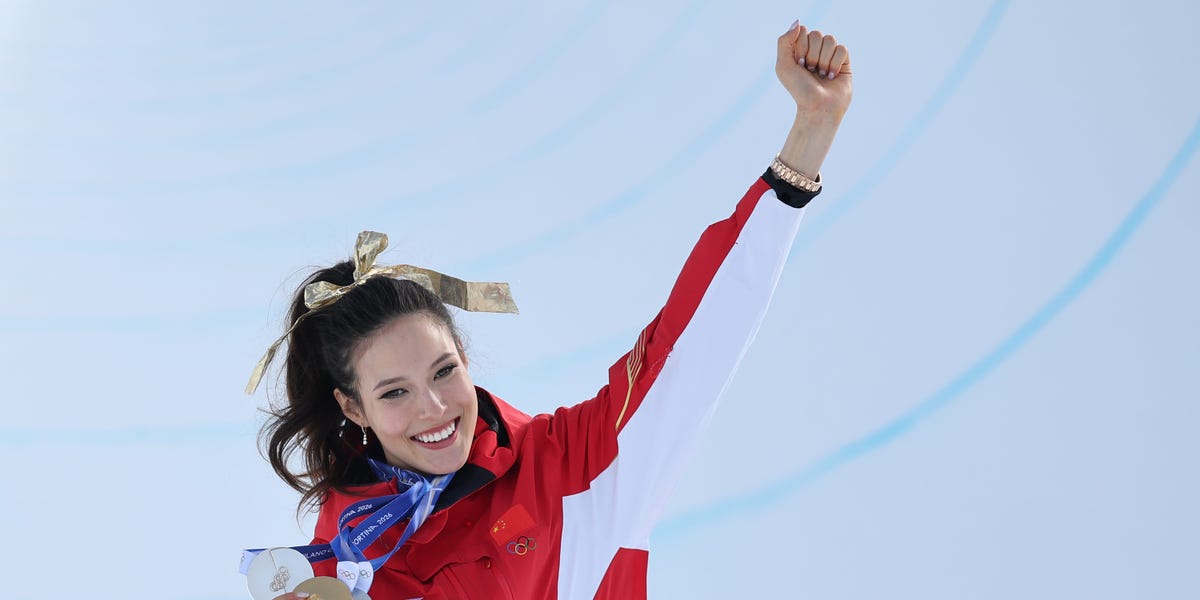
Eileen Gu, the most decorated freestyle skier in Olympic history, said she switches into “contest mode” when she competes.
Speaking to Jay Shetty on Monday’s episode of the “On Purpose” podcast, Gu said she has a mantra that helps keep her performing at the highest level.
“I train like I’ve never won, and I compete like I’ve never lost,” Gu, 22, said. “That’s important because A, I find it’s difficult to win, but it’s way harder to stay there.”
Gu made her Olympic debut at the 2022 Beijing Winter Games and most recently competed at the Milano Cortina Winter Games. In all, she has won three gold and three silver Olympic medals.
She said her mantra also helps sustain her drive.
“The second thing is it keeps you hungry, and that’s what allows you to perform over time,” Gu said.
“The third thing is in order to be a winner, you have to have this insatiable, almost obsessive, religious, just all-in mentality when you compete,” Gu continued. “But because it is so intense, you cannot sustain it always because that’s what creates really dangerous egos.”
Being overconfident or complacent can also get in the way of the self-criticism needed to train well.
“For me, I see only my mistakes when I’m training. I can never do anything right,” Gu said, adding that she picks apart even the smallest errors she makes, whether she is a few degrees off or begins a movement a second too early.
But competition calls for the opposite mindset, and she has to make the switch, she said.
“And I’m like, ‘I am the best person who has ever stepped foot here. Nobody’s even going to touch me. Everyone’s competing for second,'” Gu said, referring to the self-talk she adopts when she’s competing.
Drawing a clear line between her training and competition mindsets “is what protects me from going absolutely insane,” Gu said.
She added that she’s only “a normal amount of competitive” in her daily life.
“It’s only when I compete. I’m like, OK, alter ego. Go time,” she said.
Gu has previously spoken about how she readies herself for high-pressure moments on the slopes.
In a February interview with Red Bull, Gu said her high school cross-country coach told her about a psychological theory that suggests nervousness and excitement can produce the same response in the body — an idea that has helped her deal with her competition jitters.
“When I used to feel really nervous, she would say, ‘You’re not nervous, you’re just excited’. That’s really translated to any high pressure situation I’ve ever been in since then,” Gu said.
Other athletes have also spoken about the strategies they use to handle the pressure of competition.
In February, alpine skier Mikaela Shiffrin said she worked with a psychologist to “desensitize” herself to the Olympics so she can better manage the stakes of the Games.
In August, Naomi Osaka told Australian Tennis Magazine that she takes on a different persona when she’s competing. “I almost feel like I’m a Barbie that dresses up and goes on the court and does something. When I come back in the locker room is when I’m like my true quiet Naomi,” Osaka said.
Read the full article here