


For days, one of the most popular AI models of the week had no known maker.
Ox Alpha was free to try, impressive at coding, and mysterious enough to set developers guessing about which major AI lab was behind it.
Then Z.ai revealed itself.
The Beijing AI company said this week that Ox Alpha was the name it had used to anonymously test GLM-5.3-Flash, its latest open-weight model, on OpenRouter and OpenCode.
The stunt has put the newly public company in the spotlight as China’s AI race heats up.
Z.ai is up against DeepSeek, Moonshot AI — the company behind Kimi — and Alibaba’s Qwen team. They’re competing on performance and price, while trying to make the most of limited computing power.
Here’s what to know.
Z.ai grew out of a top Chinese university
Z.ai, also known in China as Zhipu AI, says it was founded in 2019 based on technology developed at Tsinghua University in Beijing.
The company developed GLM, short for General Language Model, its family of large language models. It launched its chatbot, ChatGLM, in 2023.
It went public just this year
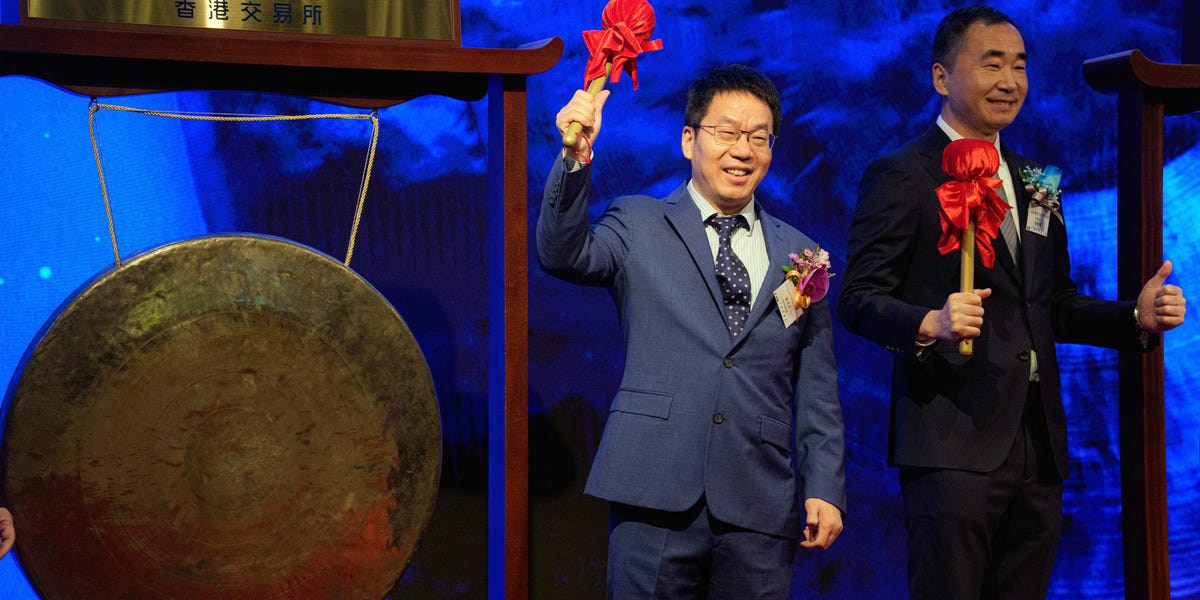
Z.ai was listed in Hong Kong in January under the corporate name Knowledge Atlas Technology, before changing its English name to Z.ai in July.
It priced its shares at 116.20 Hong Kong dollars apiece and began trading on January 8.
Z.ai’s shares are now trading at around HK$1,100 — about nine times its IPO price.
Last year, Z.ai generated 724.3 million Chinese yuan, or about $108 million, in revenue, more than double its 2024 total.
It spent about 3.2 billion yuan on research and development and posted a net loss of about 4.7 billion yuan.
Z.ai is scheduled to report results for the first six months of the year on Monday.
What does Z.ai actually do?
Z.ai delivers its services through two main segments: cloud-based services and customized models installed on customers’ own infrastructure.
Its product lines include APIs, enterprise AI agents, general-purpose models, and technical services.
Ox Alpha was really GLM-5.3-Flash
Z.ai anonymously tested GLM-5.3-Flash under the name Ox Alpha on OpenRouter and OpenCode.
The model’s identity quickly became a guessing game. Some developers suspected a Chinese lab, while others wondered whether Microsoft was behind it.
The mystery also spilled onto the Chinese internet. Users nicknamed it the “Niu Lai Model,” a reference to a low-budget animated Chinese movie about a calf that became a meme phenomenon this month.
Z.ai ended the mystery on Wednesday, confirming that Ox Alpha was GLM-5.3-Flash.
GLM-5.3-Flash is a multimodal model, meaning it can work with text, images, and video. Its model weights are publicly available on Hugging Face, allowing developers to download and run it themselves.
Ox Alpha runs on Chinese chips
Z.ai said all the traffic from the Ox Alpha test was served on Chinese AI chips.
The claim comes as Washington has restricted China’s access to some of the most advanced chips used to develop and run AI.
Z.ai said the Chinese chips it used had limitations in memory capacity and bandwidth. Its engineers compensated by optimizing its software and how workloads were distributed across the hardware.
Z.ai has tested models anonymously before
Ox Alpha wasn’t Z.ai’s first experiment with an anonymous model.
The company previously tested GLM-5 anonymously under the name Pony Alpha.
With GLM-5.3-Flash, Z.ai says the purpose of testing it anonymously as Ox Alpha was to gather user feedback before release.
Read the full article here