



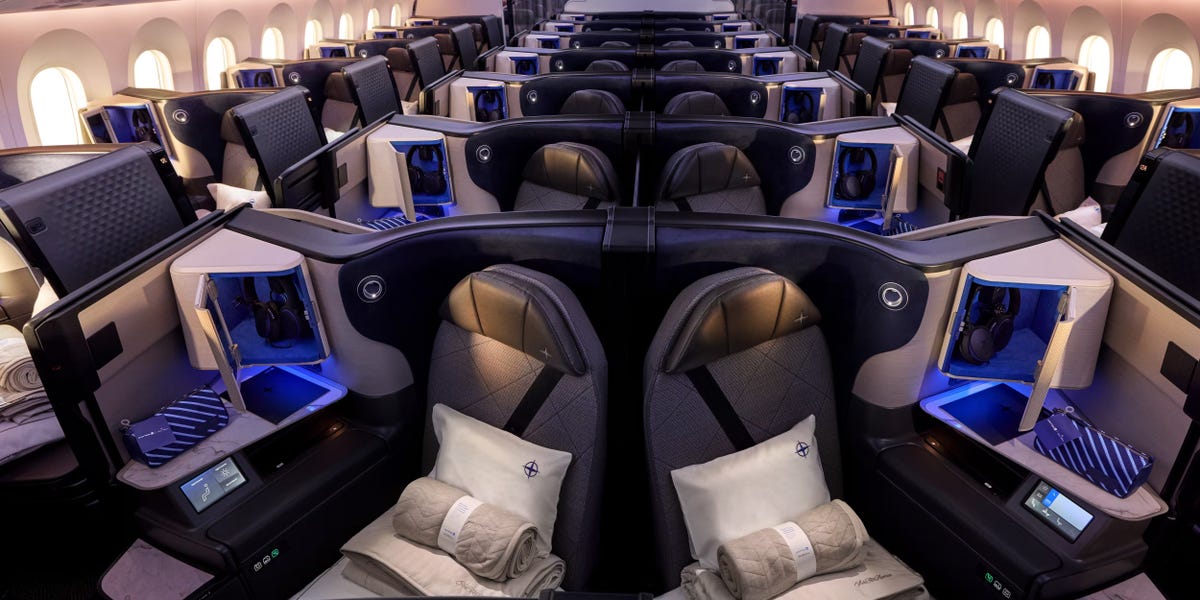
More travelers are shelling out for the best airplane seats amid a boom in premium travel, driving airlines to develop increasingly complex business-class seats — some of which are proving to be a headache for carriers and manufacturers alike.
Since COVID-19, airlines have been packing their planes with fancy new cabins as they try to attract more deep-pocketed customers. In April, United Airlines rolled out an airplane with 64 business-class seats. Delta Air Lines plans to debut its Airbus A350-1000 next year with 53 business-class suites.
But new seat designs must undergo rigorous certification by aviation regulators. And ongoing approval delays are derailing plans, leaving airplanes stuck at factories awaiting delivery and, in some cases, flying with their highly profitable business-class doors locked open or the seats off-limits to passengers altogether.
Sliding doors are a frequent hurdle for certification. First introduced by Emirates in 2003 to give first-class passengers extra privacy, they are now essentially de rigueur in business class.
However, regulators must be certain that these doors won’t impede passengers during an evacuation.
When American Airlines started flying the Airbus A321XLR last December, it had to keep the sliding doors locked open until the Federal Aviation Administration certified them seven months later. The same issue befell United Airlines when it debuted its new Polaris suites on the Boeing 787-9 in April. These were made by the Boeing subsidiary Elevate Aircraft Seating, based on a customizable design similar to one used by several airlines.
“They all have exactly this same door design, and we’re still struggling every time to get them certified, including the ones that are flying already,” Sascha Manitz, a sales director at Elevate, told Business Insider during the UK’s Farnborough Airshow in July. “It seems like the goalposts are moving all the time.”
In a statement, the FAA said it is “engaged with seat and aircraft manufacturers to maintain clear communication throughout the certification lifecycle,” and collaborating with international partners and authorities to “streamline the approval process.”
United’s Polaris suites were eventually certified, and the first sliding doors unlocked in early August. Air India has also locked its new 787 business-class doors open, but it’s still navigating FAA certification.
Some planes are flying with business-class empty
Some airlines have faced longer setbacks as they have pursued more ambitious designs.
For example, Lufthansa’s Allegris business-class suites come in five unique formats: some have extra legroom, or a bigger bed.
When Lufthansa began flying an Allegris-equipped Boeing 787 in October 2025, certification delays meant passengers could use only four of the 28 seats. Partial approval came about four months later, but three seats are still unusable.
KLM, the Dutch flag carrier, plans to start operating its first Airbus A350 in October — but all 34 business-class seats will be empty, potentially leaving millions of dollars of revenue on the table. The airline cited “a revised interpretation of regulatory requirements” in a press release.
While Air France uses a similar seat, a spokesperson for the European Union Aviation Safety Agency (EASA) told Business Insider that KLM’s configuration “includes more rows and different seat angles,” requiring additional safety tests.
“From a safety perspective, seat design and approved installation are crucial to ensuring that a passenger has the best possible chance of surviving any unexpected event and is therefore able to evacuate safely,” they said.
Slow seat certification is also a pain for Boeing and Airbus
Planemakers are being hampered by the delays, too. In an April earnings call, Boeing CEO Kelly Ortberg said the seating issues were affecting deliveries more than production because the company can still build the planes without sending them to customers.
However, he said there are “a fair number” of already-built 787s that are “held up” while they wait for seat certification, and the process is taking longer than expected. In Boeing’s July earnings call, Ortberg warned investors that seat certifications “may make our deliveries a little bit lumpy,” but also said there had been “important progress.”
He said Riyadh Air was the last situation in which Boeing had a large number of aircraft tied to an individual seat certification, and that “the seat certifications are going to be with us for the balance of the year.”
Earlier this year, several 787 Dreamliners built for the new Saudi airline were ready for delivery but were awaiting seat certification before they could be handed over. Two of the jets were eventually delivered in June.
Justin Hale, Boeing’s marketing director for the 777X, told media at the July airshow that the planemaker has tried to offer pre-certified catalog options to reduce delays, but airlines want their own distinctive business classes.
“So this is a very difficult area of the cabin to try to reuse something that was certified, maybe either generically, or by another operator,” he said.
The EASA spokesperson similarly said that delays have arisen because “many airlines are seeking to differentiate and enhance their cabin experience in different ways and for different purposes.”
Seat delays haven’t necessarily stopped Airbus from delivering aircraft. In an April earnings call, Airbus CEO Guillaume Faury said that when the seats supplied by the customer aren’t ready in time, Airbus can contractually hand over the planes without them, though he prefers to find another solution.
Despite the regulatory hurdles and complications, the aviation industry is accustomed to navigating myriad rules because safety is the top priority. With new, complex cabin layouts and seat designs, it’s crucial to ensure there are no risks to passenger safety.
“I think that the real solution is regulators — both in Europe and in the US, and they recognize this — need to get much more efficient at getting through these certifications,” Hale said.
“I think we see some improvement, and we see some commitment to do that, but that has not solved a large backlog of seat certifications.”
Read the full article here