




NATO militaries need to learn how to disperse weapons production, as Ukraine does, before entering a war to preserve their ability to keep producing while under attack, a senior defense official advised.
Raivis Melnis, the defense minister of Latvia, an alliance and EU member state bordering Russia, told Business Insider that industry in the West might not be ready to operate as it would need to in wartime.
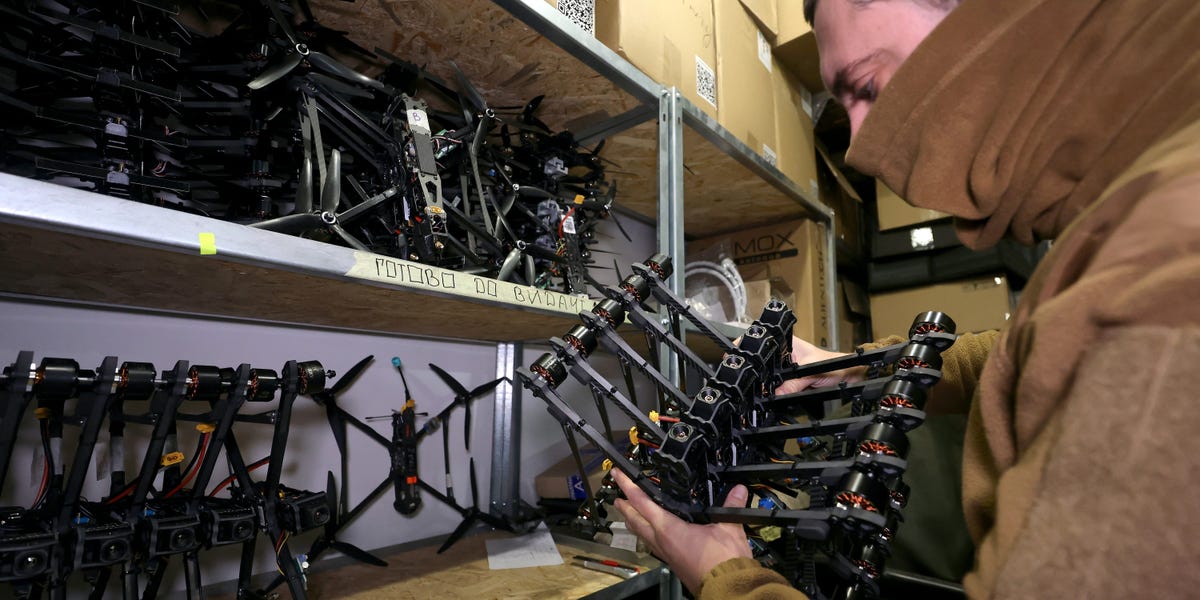
Ukrainian arms makers split up manufacturing across multiple sites, operate underground, and even move around to prevent a single successful Russian strike from having a huge impact on their operations. But in Europe, many companies run projects from larger factories, which could become a single point of failure.
“Our industry is a peacetime establishment” that has been built under conditions where “there is no threat,” Melnis said.
NATO companies work in a far more concentrated way, he said, and “the question is whether we are ready to produce the systems in different locations, dispersed, and how we organize that.”
He said this is why he encourages partnerships between Latvian and Ukrainian defense companies, so they can learn from how the Ukrainian companies operate, including how their systems are “built for war purposes.”
Ukraine has also demonstrated how a country “can provide that reassurance if, for instance, an industry site is destroyed.” Kyiv offers compensation for some business properties damaged or destroyed in Russian attacks and is planning additional support.
Ukrainian officials and company leaders have been pushing for Western companies to adopt a more disaggregated approach to prepare for the possibility of a wider conflict.
Davyd Aloian, the deputy secretary of Ukraine’s National Security and Defense Council, told Business Insider that the Russian threat to Europe is so substantial that companies across NATO should “definitely” start breaking up their production more.
Mykyta Rozhkov, the chief business development officer at Ukrainian arms maker Frontline Robotics, told Business Insider that some alliance defense firms have sought Frontline’s advice on dispersing manufacturing operations. The company, he said, has adapted to “endure the loss of any site.” Any loss is still “painful,” but the company survives. Operations are designed so it’s “as easy as possible to move,” he added.
Oleg, a company executive at Ukrainian drone maker TechEx, told Business Insider that “every day we are facing another level of threat from Russia trying to hit the factories.”
The company, he said, has to find “creative ways to switch the locations every couple of months to raise the level of security for our people, because, of course, you want to take care of the people and keep them safe.” He said the company warns its international partners that their conventions are “slightly outdated.” He requested that only his first name be used for security purposes.
The CEO of Ukrainian-Estonian defense tech company Ark Robotics told Business Insider that his company makes different components at different sites, something he said is “necessary” even if it’s not ideal. A single site is “the best way to do it,” but, he explained, the company has to be “smart about it and not create a big enough target for it to attract too much attention or to disclose where our operations are happening.”
He said this should be the “default for defense-based manufacturing going forward,” even outside Ukraine.
Some companies are already taking heed. Estonian company Krattworks, which makes drones used by Ukraine, agreed with these assessments. Karmo Saar, the company’s head of sales, told Business Insider that for Ukrainian companies, it “would be a lot more economical, cheaper, and better to run this operation in one big facility, but they cannot do that.”
“In Europe, we do that,” Saar said. “And when the war strikes, I think we’re going to be punished.”
Srđan Kovačević, the CEO of Croatian drone technology company ORQA, which has signed up to begin working in Ukraine, told Business Insider that it is “our deep philosophy that distribution is more resilient” in Ukraine.
“Distributed systems are much more resilient to any disruption than concentrated systems, centralized systems,” he said, noting that the thinking appears to be shifting across Europe. “This distributed nature actually reinforces resilience, even though there are economic downsides to it,” he added.
Latvia is one of the NATO countries most worried about a Russian attack or invasion and has been a vocal supporter of increased defense spending within the alliance, helping to arm Ukraine, and taking lessons from Ukraine’s fight. These lessons are being fed into a new automated anti-drone defense wall and the acquisition of Ukraine-tested gear.
Melnis wants Latvian firms to learn directly from Ukraine’s battlefield experience and has announced a series of deals to deepen cooperation between the two countries’ defense industries.
He told Business Insider that he wants Latvia’s companies to learn from Ukraine’s “proven, combat-tested” systems and combine that with Latvia’s “peacetime establishment, where our scientist engineers can work and can develop and bring those two together.”
Ukraine’s wartime experience and understanding, he said, is something for which “you can’t just sit in a normal office and build and simulate and create.”
Ukrainian companies, he said, work much more closely with front-line units than Western firms do. Ukraine’s “military industry has established really close cooperation with the armed forces,” he said. “We don’t have such experience.”
“This is something I want to bring as well, that experience in,” Melnis said, saying he wants to “take those best practices.”
Deterring Russia, he said, requires strong capabilities and also continued support for Ukraine. Russia wants “to destroy that support for Ukraine,” he said. “Therefore, it is important for us to support, and we will be supporting Ukraine to build the victory.”
Read the full article here