

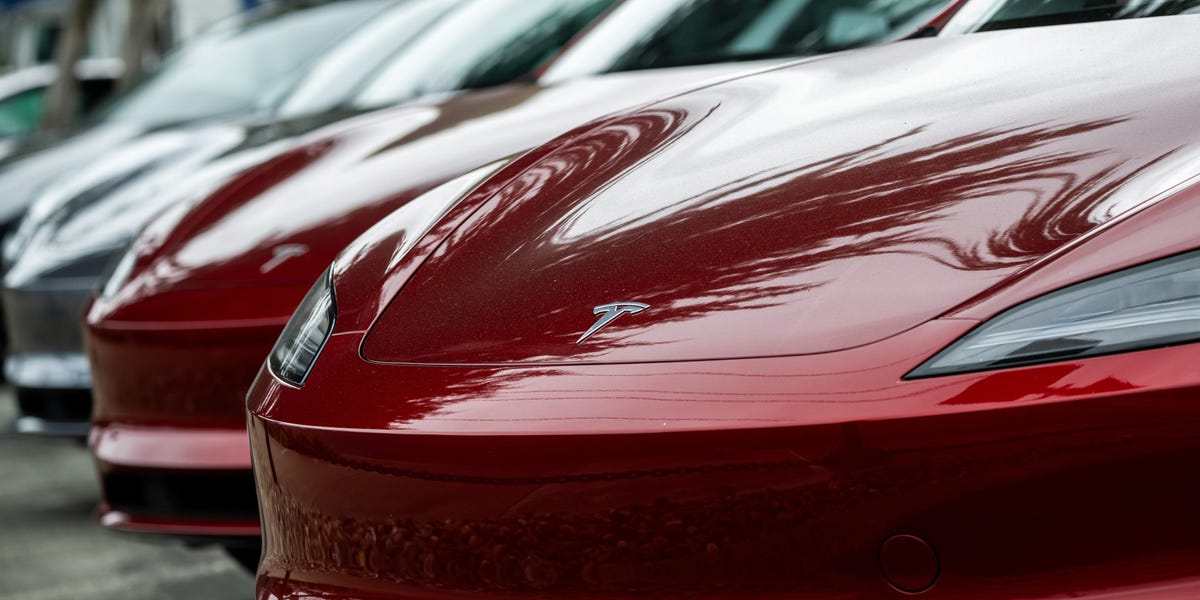
For years, Tesla sold its EVs with the promise of an autonomous future. Now, some owners face being left behind.
On Tesla’s earnings call last Wednesday, Elon Musk said that Tesla vehicles shipped before 2023 — which are equipped with a previous-gen Hardware 3 computer — would not be able to achieve fully unsupervised Full Self-Driving (FSD).
“I wish it were otherwise, but Hardware 3 simply does not have the capability to achieve unsupervised FSD,” said Musk.
The billionaire said that Tesla would offer Hardware 3 owners the choice of a “discounted trade-in” or a physical replacement of their car’s computer and cameras at “micro factories” in major cities.
The announcement is a major blow for longtime Tesla owners, who paid thousands of dollars and have been waiting for years under the impression that their vehicles have the tech necessary to achieve fully autonomous driving.
As far back as 2016, Tesla stated in marketing materials that all its vehicles had the necessary hardware for “full self-driving capability at a safety level substantially greater than that of a human driver.”
In a 2019 tweet, Musk said that all Tesla vehicles produced since 2016 had the right hardware for FSD or were “trivially upgradeable.”
“It feels like a bait and switch at this point,” Andrew Apperley, who bought a used 2018 Model 3 with FSD for $53,000 in 2023, told Business Insider.
“They kind of shot themselves in the foot by saying that this is going to come, and then it never does,” Apperley said, adding that he felt like Hardware 3 customers would find it hard to trust Tesla and Musk’s promises in the future after waiting in vain for unsupervised FSD.
Tesla did not respond to a request for comment from Business Insider.
Autonomy angst
Rick Flashman, who paid $10,000 for FSD when he bought his Model 3 in 2022, told Business Insider that, despite receiving increasingly generous trade-in offers from Tesla, he was not interested in swapping out his EV for a vehicle with up-to-date hardware.
“My car’s in great shape. It’s got 73,000 miles, it’s driving perfectly, so I have no reason to upgrade it,” Flashman said.
The Florida resident said that FSD was one of the main reasons he bought a Tesla, adding that he uses it for “over 90%” of his driving.
Hardware 3 vehicles in the US run a more limited version of FSD, with Tesla planning to release a “lite” variant of FSD version 14 for older vehicles in June.
Despite his car’s limited capabilities, Flashman said he was well satisfied with the tech and is happy to wait for the overhaul Musk promised on Wednesday.
“It might take another year, but I’m one of the ones who’s just waiting it out,” he said.
“I wish it were sooner, obviously. But I don’t feel like I was ripped off,” Flashman added.
Matt Simmons, a Tesla owner who bought his Model 3 Performance in 2019, told Business Insider he added FSD for an extra $6,000 because he was curious about the hype. Seven years later, he says he rarely uses the feature.
“It kind of sucks, if I’m being honest,” said Simmons, who said he doesn’t use FSD on highway trips because of issues with the software’s speed control.
Simmons said that he was not surprised by Musk’s comments, pointing to the Tesla CEO’s track record of making ambitious predictions for self-driving cars have often failed to fully pan out.
“We realize we’re being strung along at this point,” Simmons said.
The Pittsburgh resident described his Tesla as “long paid for” and said he had no intention of trading it in for a more advanced model.
“That would mean I’d have to buy another Tesla,” said Simmons, who said he was hoping that rival EV maker Rivian would offer a similar deal for disenfranchised FSD owners.
Backlash goes global
Some Hardware 3 owners are done waiting for the software they paid thousands of dollars for years ago.
Tesla is already facing several lawsuits in the US from owners who say they were misled by the company’s FSD marketing, and the backlash is starting to go global.
Earlier this month, Tesla finally received the green light to launch FSD in the Netherlands, marking the tech’s debut in Europe after a yearlong campaign to woo regulators.
However, the rollout in the Netherlands excluded Hardware 3 owners, prompting Mischa Sigtermans, an executive at Amsterdam-based Ryde Ventures, to start a website to gather European Tesla owners for potential legal action.
Nearly 4,000 verified Tesla owners have now signed up to Sigtermans’ website.
The Model 3 owner, who paid 6,400 euros ($7,530) for FSD in 2019, told Business Insider that Musk’s comments confirmed many owners’ worst fears, and said that the proposed solution of a discounted trade-in would simply make owners “pay for the same broken promise twice.”
“Musk said out loud what many of us have been saying for months, if not years,” said Sigtermans. “The admission is there, the solution isn’t.”
Read the full article here