



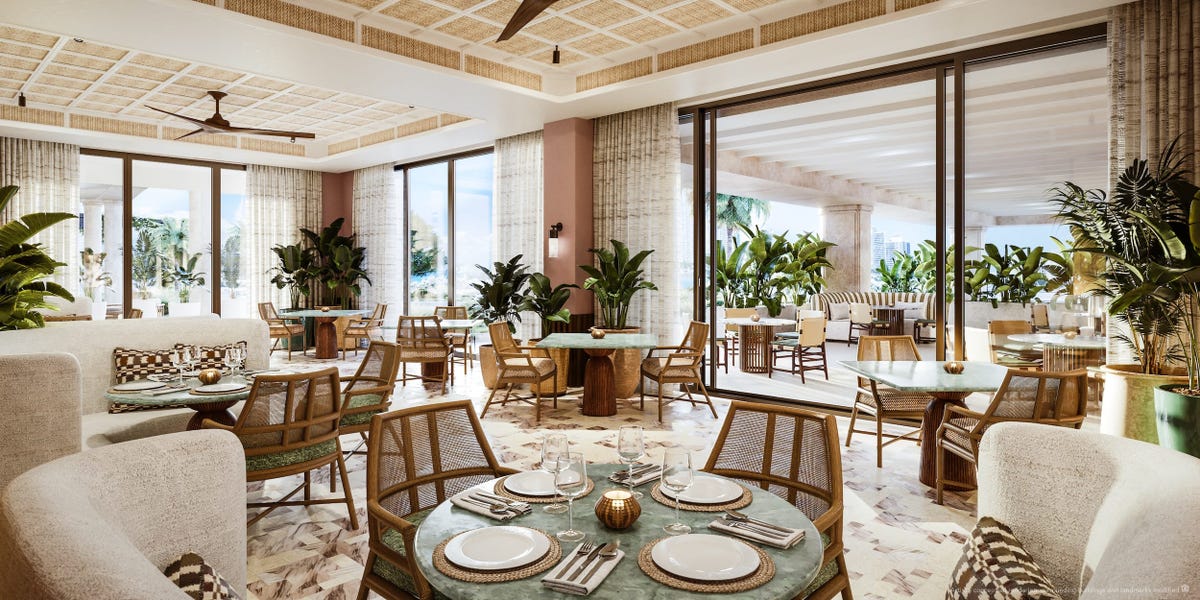
A waterfront pool, a private spa with saunas, a 9-hole golf course, a 24-hour butler: there are plenty of luxurious amenities that the ultra-exclusive Residences at Six Fisher Island is offering to their tenants, who will pay $15 million and above for units in a building set to open in 2026 in the richest ZIP code in the country. But there’s one amenity developers are betting will be their secret weapon in luring prospective buyers: a residents-only restaurant.
In a post-pandemic world where more people are treating their homes as destinations rather than places to sleep, developers are competing with one another to set their buildings apart from the pack with unique amenities. It’s no longer enough for newly built luxury buildings to include a lap pool and fitness center — it’s the bare minimum. And while saunas and dog-washing stations are splashy, what really sets a building apart is boasting amenities that others can’t access, like private dining experiences.
At 432 Park Avenue in New York City, where unit prices can range from $9 million to upward of $50 million, residents can enjoy a restaurant experience with dishes curated by Michelin-starred chef Shaun Hergatt without the anxiety of a regular Joe gawking from the corner and snapping a photo for Instagram.
At the Armani Residences in Florida, members enjoy access to a private oceanfront restaurant and the convenience of having food delivered directly to their residence if desired.
Restaurants in residential buildings aren’t an entirely new concept, but interest in luxury dining experiences as an amenity for tenants is on the rise. A spokesperson for property management company FirstService Residential — which manages about 50 to 100 buildings with food and beverage components, like the Armani Residences, and thousands nationally — told Business Insider that food and beverage expenses among their portfolio are up 30% to 40%, “reflecting a broader shift toward delivering restaurant-level dining experiences within residential buildings.”
Restaurateur Stephen Starr, who signed on as the culinary curator for Florida’s The Residences at Six Fisher Island, is on board with the trend.
“I think it makes the difference between, ‘I’m going to choose this building without that, or this building that has it,'” Starr said. “To have a place where you can go down with your kid and get a steak or a burger or an omelet, it’s awesome. It would make me want to spend that extra whatever dollars to be there, for sure.”
Convenience and privacy are key
Eric Fordin, the senior vice president at The Related Group, the developer behind The Residences at Six Fisher Island, said that convenience is something residents are willing to pay extra for.
Data from FirstService Residential shows that demand for food and beverage consulting from developers more than doubled in 2025 for future developments.
“The true amenity is, if I’m flying in on my private plane and I don’t have any food in my kitchen and it’s late at night and I want to call down for in-room dining and I want a Caesar salad, there’s someone who can make it fresh,” Fordin told Business Insider.
Landy Labadie, the vice president of hospitality and new development at FirstService Residential, said residents also value seclusion.
“The reason why these are members-only typically is because of privacy and security,” Labadie told Business Insider. “These residents want it just for them, they don’t want it public. Similar to their gym — you don’t want your neighbors to be able to come use your gym for $20 a month.”
Just like any amenity, residents are footing the bill
Unlike commercial buildings anchored by restaurants open to the general public, the amount of traffic a residents-only restaurant receives is capped.
In a development like The Residences at Six Fisher Island, there will only be 50 residences, meaning only 50 families have the opportunity to dine there. But while that may be too small of a consumer base to sustain a regular restaurant, it’s not a concern when the dining is tenant-funded.
“We’re not taking a risk by staffing it, and if not enough customers come, we lose money,” Starr said. “This is all part of the association of residents — it’s their decision to subsidize this sort of project. So we don’t have the same stress and pressures that we do when we open our own restaurant.”
In Six Fisher Island’s case, it’s the HOA that makes the decisions for residents. Whether they want a grab-and-go option versus caviar in the building or a 24-hour restaurant instead of an 18-hour one is solely up to them, Labadie said. Regardless of what they choose, they’re the ones paying for it.
“The chef may say, ‘Hey, Landy, this burger is $20.’ I may say, ‘OK, we’re going to price a burger at $30, and your monthly HOA fees won’t go up,'” Labadie said. “Or I can charge you $10 for that burger, but your monthly fees are going to go up $100 or $200 a month.”
“You’re also paying for the equipment, the labor, the service, the food costs, the beverage costs,” Labadie added. “And that’s something that a lot of people don’t understand is the financials behind it.”
Even if you don’t dine at the restaurant often, it’s not dissimilar to not using your building’s gym or having a rooftop pool but never taking a dip. From the developer’s perspective, those things are amenities to sell you on the building, whether you ultimately use them or not.
“From our point of view, this is an amenity for the building,” Fordin said. “You can call it a restaurant if you want.”
Read the full article here