




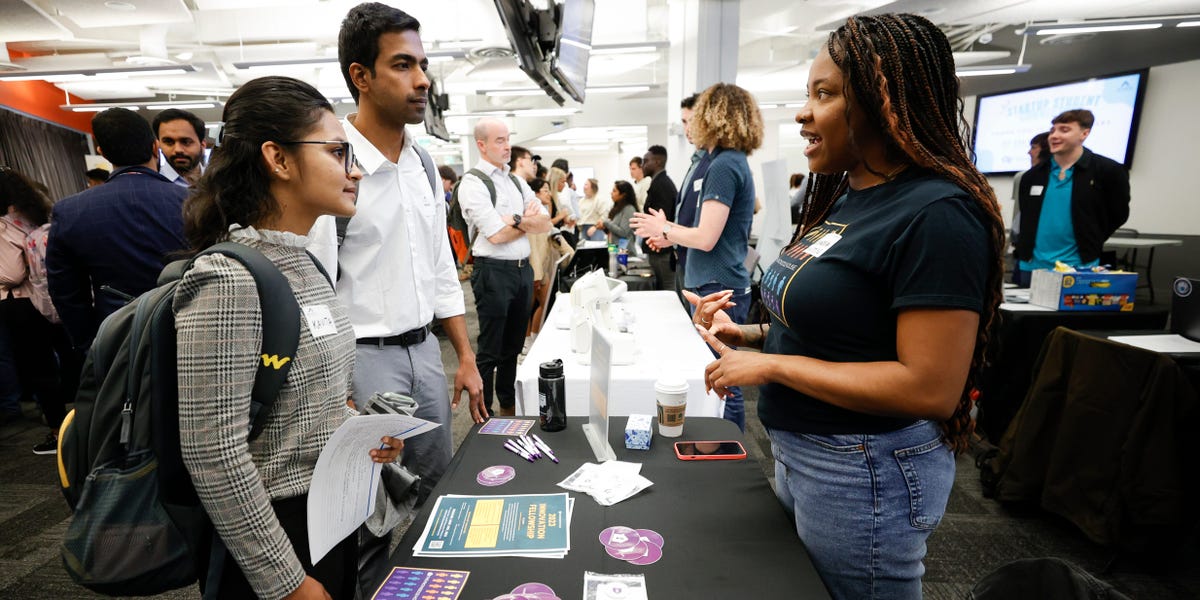
For many college seniors, the toughest assignment this spring might be their job hunt.
Grads are still finding roles, though it often takes more time and hustle, several campus career advisors told Business Insider.
“Soon-to-be graduates are getting jobs, but job searches are long, and hiring is slow,” said Jennifer Neef, executive director of the career center at the University of Illinois.
The challenge is showing up in the data. The unemployment rate for recent college graduates rose to about 5.7% at the end of 2025, up from about 5.3% in the third quarter, according to the New York Federal Reserve.
Underemployment is also up, with 42.5% of graduates working in jobs that generally don’t require a degree — the highest level since 2020.
At the same time, the types of open roles are shifting.
In the job listings at the career office at Wake Forest University, overall openings are up from a year ago, though there are fewer entry-level postings in areas like marketing, finance, and HR — especially for jobs built around routine analysis or administrative work, said Andy Chan, who runs the school’s Office of Personal and Career Development.
“These roles still exist, but the companies don’t need as many people to do them,” he said.
Business Insider asked several university career center leaders what grads should consider. Here’s what they recommend:
Be open to a ‘stepping-stone role’
Grads need to identify their priorities and stay flexible, said Matt Augeri, director of operations and strategic initiatives at the University of Iowa’s career center.
Job seekers who want to be in a certain location might have to take a position that’s not a perfect fit, he said. Another way to be adaptable, Augeri said, is to consider “stepping-stone roles” that build skills toward a longer-term career goal.
“Hiring is essentially flat, so students are going to need to be thinking about option A, B, and C,” he said.
Don’t forget about the ‘hidden job market’
One way to carve out an advantage in a lackluster market is to build connections — both to find opportunities and to stay motivated during what can be an extended search.
Networking is more important now in part because the hiring process has become “even more opaque,” Chan said. One reason is that employers are generally offering fewer formal training programs, he said.
At the same time, Chan said, there are more “hidden job market opportunities,” where grads land roles through networking rather than by solely applying through job boards.
Making connections also matters because it can be harder to stand out. Students can use AI to create tailored résumés, though companies can also scan them using AI, he said.
At the same time, it’s become so easy to apply for jobs with a few clicks — or to have AI do it on behalf of job seekers — that many recruiters and employers report being inundated with applications.
Show your work
Chan said entry-level jobs aren’t going away, though the baseline has shifted. Employers now want hires who can do more than the administrative, data, and research work that once defined many first jobs.
As AI becomes more capable, Chan said, employers are looking for candidates to do the same.
“They want people who are able to be effective in these roles at a higher level,” he said.
To show they’ve got what it takes, Chan said, grads should be able to point to some kind of work-related experience — whether that’s from a job, a project, a student club, or a hobby.
Internships are also key, said Augeri, adding that many employers are scanning résumés for this kind of experience.
“They want to hear about it in interviews,” he said.
Demonstrate your AI chops
Most seniors would have started college not long before ChatGPT’s arrival, in late 2022. Now that they’ve been exposed to it for years, it’s important for grads to show they know how to use AI, Chan said.
Doing so demonstrates a willingness to learn something new — a theme that’s likely shaped much of their college experience. Grads also need to show they could use AI in entry-level work “so that they can actually add value more quickly,” he said.
“If you want to win the job, you want to actually have these experiences, know how to talk about them, and why they’re relevant to this employer,” Chan said.
Augeri said that employers’ thirst for AI know-how is showing up in job descriptions across industries, including for roles that aren’t technical.
Many entry-level roles, rather than going away, are instead “infused with this need for AI and discussion of AI,” he said.
Be patient
When employers do make offers, some of them are extending their timelines, said Kathleen Powell, chief career officer at William & Mary. Rather than hiring someone to start in about a month, she said, it might be in three months.
“They keep moving the end zone,” Powell said.
Overall, graduates — and their parents — should be prepared for a process that could stretch on for months and might involve multiple rounds of interviews, said Augeri.
“Start early and be patient,” he said.
Do you have a story to share about your job search? Contact this reporter at tparadis@businessinsider.com.
Read the full article here