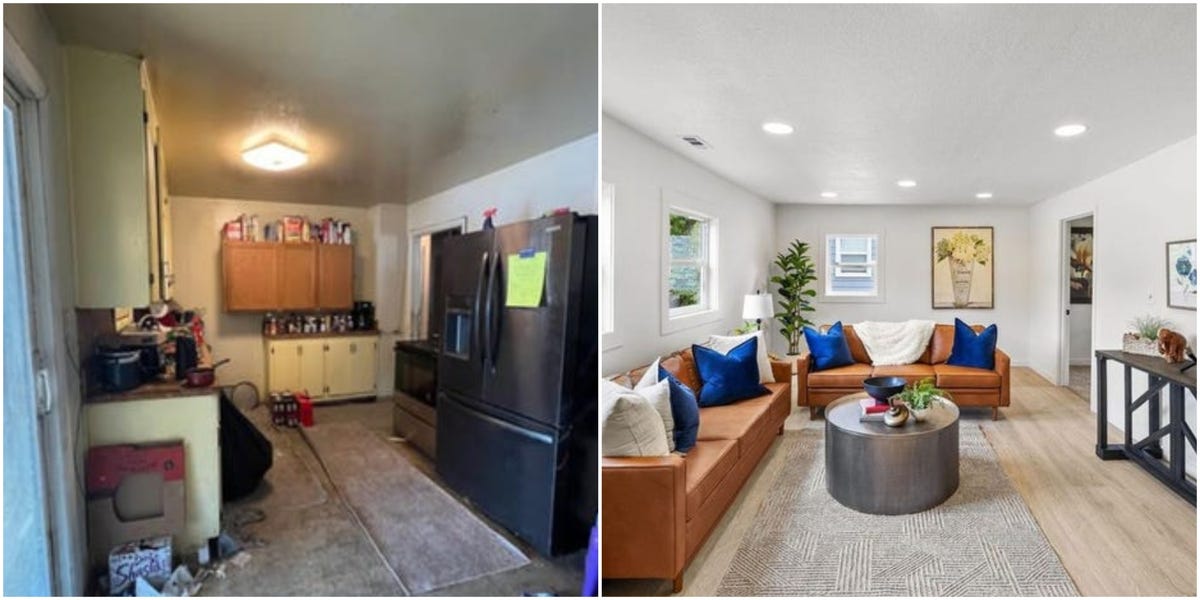
Homes come in all shapes and sizes, and some homes are, frankly, ugly.
Before undergoing a more than $100,000 renovation, a once-run-down four-bedroom two-bath home on Sunset Avenue, located in Boise’s Sunset neighborhood, was in absolutely awful shape.
Built in the 1940s and situated on a nearly 9,000-square-foot lot, the property’s wood was rotting, the driveway was cracked, the interior paint was peeling and grimy, the floors were dirt-stained, and it reeked of moldy food and dogs. The property was such an eyesore that it won HomeVestors’ 2025 Ugliest House of the Year contest.
HomeVestors, the company behind the national cash homebuying brand “We Buy Ugly Houses,” hosts an annual “Ugliest House of the Year” contest showcasing dramatic home makeovers by its independently owned and operated franchises across the country. This year, Boise franchise owners Tanice and Paul Myers emerged as the winners out of 20 entries.
Married for 25 years, the Myerses have spent more than two decades investing in real estate. They expanded their renovation-and-flipping operation in 2018 by joining HomeVestors, and over the course of their careers, have flipped more than 500 homes together.
“We are loving what we’re doing,” Tanice, 53, told Business Insider. “I was in corporate tech sales and spent the last 10 years at Microsoft. It was empowering to be able to walk into my management team and say, ‘I don’t want to do this anymore.'”
The Myerses gave the house on Sunset Avenue a complete makeover. They replaced the roof, windows, electrical and HVAC systems, and plumbing. The two also repaired the drywall, floors, and resurfaced the driveway. They also removed a wheelchair ramp left by the previous owners — one they were able to donate to a local family.
Ultimately, the home was listed for $624,000 in July and sold shortly thereafter. Through the HomeVestors contest, a $20,000 donation was also made to their local Habitat for Humanity in their honor.
“We’re really proud to be able to give back in different ways with one house,” Tanice said. “The original owner was able to move into a much healthier living environment, and a new family was able to come in to start their memories brand new and fresh.”
Take a look at the before-and-after photos of the home.
The house required extensive repairs.
The home’s exterior was water-stained, and the walkway and wheelchair ramp were littered with leaves and debris.
The Myerses removed the ramp and donated it to a Boise-area family, who needed it for their 9-year-old daughter, who has spina bifida and uses a wheelchair. It was then custom-installed for the family’s home.
The inside wasn’t any better — the ceiling had paint blotches and holes.
The home’s previous owner had lived there for decades, Tanice said. Over the years, as health issues compounded, the property deteriorated. Still, the Myerses felt like the home had good bones.
“The house itself is a cool 40s house,” Paul, 51, told Business Insider. “It was begging to come back to life. It was a really strong house with a great foundation, and had survived many years and was ready to survive more.”
The kitchen had outdated appliances and was cluttered.
The Myerses said it was hard to choose between the kitchen and the primary bedroom as the part of the house that needed the most work.
“There was a lot of open food,” Paul said. “There’s a lot of rat droppings and flies everywhere.”
The walls were stained with smoke and had a foul odor.
The previous homeowner was a smoker, and years of smoking left nicotine and tar residue on the walls. It took a lot of effort to get rid of the smell.
“In this particular house, we end[ed] up tearing out most of the floor and most of the drywall,” Paul said. “Once you’ve torn out that much, there’s not much to really smell.”
The Myerses completely gutted the bathrooms.
The couple couldn’t begin cosmetic bathroom updates until they handled underlying structural and plumbing issues.
“Before we can start making it look nice, we unfortunately sometimes have to make it look worse — because you need access to things like plumbing and HVAC, and you have to make sure everything’s done correctly,” Paul said. “Then we can start putting it back together.”
Like much of the home, the bedrooms also had stained walls.
Paul said he believed the bedroom was the worst room in the home. Before the renovation, the floor was covered in trash, making it almost impossible to move freely across the room.
After the renovation, the home looks almost brand new.
In all, the Myerses invested more than $100,000 in repairs and renovations for the home.
“It was a full transformation from top to bottom,” Tanice said. “Like any real estate investor taking on a major rehabilitation, that amount reflects only the construction side of the project.”
Along with the interior repairs, to improve the home’s curb appeal, the Myerses poured a new driveway — something they typically do not do with their home flips — and installed a new sprinkler system.
“Significant additional costs go into responsibly restoring a home to resale condition, including utilities, insurance, holding costs during the renovation, and resale expenses such as closing costs and agent commissions,” she added. “These types of projects require both hands-on expertise and the financial stamina to see the home all the way through to becoming safe, healthy, and move-in ready again.”
When it came to interior design, the couple wanted the home to be as bright and inviting as possible.
“I’m pretty much the guy who designs these houses, and my biggest thing is that we want to sell to a broad amount of people,” Paul said. “So I want to use colors that are current and modern, that can appeal to many buyers.”
The couple completely replaced the home’s old furniture.
“When we can, we will make donations,” Tanice said. “But in this house, the state that it was in, there was no way we could donate any of the stuff in there.”
The kitchen has new cabinets, appliances, and decor.
Since there’s no formal dining room, the kitchen was also opened up to include an eating bar.
“We found that the eating bar brings the family together,” Tanice said. “People come sit and chat while meals are being prepared — it’s just a nice, easy space to be at.”
The bedrooms had to be stripped down before any cosmetic work could begin.
“We had to clean it out,” Tanice said. “In one room, I think we even had to rip it down to the subfloor to install new flooring, then start rebuilding —from fresh paint to new floors.”
The bathrooms got a complete facelift.
They updated the plumbing and bought new vanities, tubs, tile, and fixtures for the bathrooms. Now, this bathroom looks like an Ikea showroom rather than something stuck decades in the past.
Tanice said the project took about six to eight weeks to complete.
Tanice said it wasn’t necessarily the most difficult project they had taken on, but it did tug at her heartstrings.
“Looking at the state of the home and realizing someone was living in it touched my heart,” she said. “It makes you a little sad, but you’re grateful you can help move that person to a healthier place.”
She added that the community’s response has been incredibly rewarding, with many people saying they couldn’t believe it was the same house.