




Walmart has a need for speed.
The retail giant has been growing its online business for years, fueled in large part by its ability to get groceries to customers in nearly every part of the US within hours.
But doubling down on digital is revealing some growing pains, too, as store teams try to balance this new priority with the traditional demands of operating a big box store.
In particular, three workers told Business Insider that the online business is placing new pressure on workers who are hustling to hit digital metrics, hauling increasingly heavy orders like water and mulch, and trying to meet the daily needs of their stores.
Walmart declined to comment for this story.
Walmart workers, of course, are not the first to experience growing pains as their company expands its digital business. Target workers previously told Business Insider the company’s emphasis on digital order metrics was a daily source of stress and disruption.
Last quarter, Walmart’s e-commerce business notched 27% sales growth, marking the eighth consecutive quarter with growth over 20%. The bulk of those sales is fulfilled by employees at the company’s 4,600 US stores.
“We’re getting things to people faster,” former CEO Doug McMillon said at last year’s annual shareholder meeting. “Days are becoming hours, and hours are becoming minutes. Convenience drives our business.”
Convenience comes at a cost
A former store manager who left the company earlier this year told Business Insider that Walmart’s focus and intensity on e-commerce ramped up sharply during their final year in the job. Online sales accounted for about a 10th of their store’s overall revenue, but required almost the entire staff to assist with fulfillment on high-volume days.
The manager and an employee responsible for filling online orders at another location said that colleagues in other departments and store managers were typically cross-trained in digital and often pulled in to help fulfill orders, a distinction that highlights the importance of those tasks. Digital team members, meanwhile, weren’t called on to support other departments nearly so often, they said.
Order volumes can range widely, but it’s not uncommon for a worker to pick several hundred items in a shift.
Having so many workers fulfilling digital orders also means more workers moving through the aisles while focused on a company-owned mobile phone, which contains detailed order instructions. Customers have noticed. Several Business Insider readers over the last few weeks have emailed about Walmart workers appearing to pay more attention to their screens than to customers in stores.
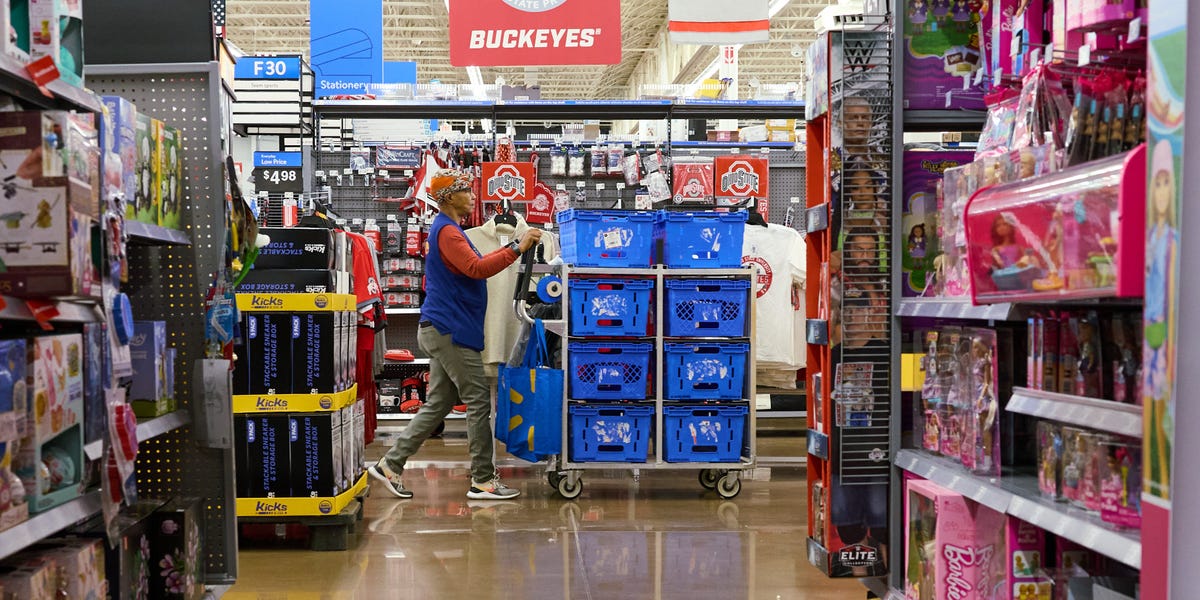
The balancing act Walmart now finds itself in is perhaps best illustrated by the big stir that followed seemingly small rule changes about how workers should handle online order carts. The company told workers late last month to pull their carts so they could see where they were going, but quickly reversed course after workers complained of straining their shoulders and running over their own heels.
Ultimately, Walmart opted for safety over order volume, instructing order pickers to push the carts as they had before, and instead reduced the number of bins on their carts from eight to six so they could better see ahead.
The downside of having two fewer bins, the digital employee said, is that it is now tougher to keep orders on time when their teams are shorthanded.
Demand and competition continue to grow
Walmart is rolling out other technology to make it easier for workers to fulfill online orders, like digital shelf labels, which could also allow online order pickers to work more efficiently, and the company is using AI to make more responsive changes to how work is done.
Online grocery sales aren’t going anywhere anytime soon. Data from the Food Industry Association and NielsenIQ shows that online channels accounted for nearly 75% of total grocery dollar growth in 2025, with in-store sales remaining mostly stable. Online grocery sales are projected to top $450 billion by 2028.
And the competition continues to heat up. Amazon this week expanded its 30-minute delivery service to more US cities as it looks to counter Walmart’s strength in that space.
Either way you slice it, Walmart’s online order pickers have had a busy year and are set to be responsible for an increasingly large portion of the stuff US shoppers buy every day.
Have a tip? Contact this reporter via email at dreuter@businessinsider.com or text/call/Signal at 646-768-4750. Use a personal email address, a nonwork WiFi network, and a nonwork device; here’s our guide to sharing information securely.
Read the full article here