




Who doesn’t love ’90s tech?
For millennials, the decade’s most-loved gadgets came with particular rituals: rewinding VHS tapes before returning them to Blockbuster, burning CDs for road trips, or blowing into a Nintendo cartridge before reinserting it.
Today, as younger consumers seek alternatives to modern digital life — and constant notifications — some of these analog items are gaining traction again.
Among them, Gen Z consumers have been embracing the simplicity of flip phones, digital cameras, and landlines. Companies have responded by reimagining retro products: One such item, Tin Can, resembles a landline but runs off a home’s WiFi, and some parents are leaning in.
“I want my daughter to be able to chat with her friends, like I did as a child in the ’90s,” Alison Bennett previously told Business Insider, especially as she sought to delay giving her 8-year-old a smartphone.
So desperate is Gen Z for tactile entertainment over digital distraction that hacky sack is even back, Business Insider’s Katie Notopoulos reported this month.
Other ’90s tech allows users to be more intentional. VHS tapes turn movie-watching into a commitment rather than background noise, while disposable cameras produce candid photos, rather than edited images.
Here are some pieces of ’90s tech that we wish would become mainstream again, from gaming systems to old-school communication devices, including ones that are already showing promising signs of a comeback.
VHS tapes
After launching in the late 1970s, VHS overtook Sony’s Betamax — another videocassette — to become the dominant way people watched movies at home in the 1980s and 1990s.
The tapes turned movie nights and video rental stores, such as Blockbuster, Hollywood Video, and smaller independent stores, into social activities. Blockbuster reached its peak in 2004, when it operated more than 9,000 stores worldwide.
VHS also changed how people consumed television by allowing them to record shows and movies to watch later, years before streaming made on-demand viewing possible (with a side of decision fatigue).
However, by the late 1990s, DVDs had begun replacing VHS, thanks to their slim size and higher quality. In 2003, DVD rentals overtook VHS rentals in the US for the first time, The Washington Post reported.
In 2015, Sony stopped producing Betamax, and the following year, the final VHS VCR was produced, The Guardian reported, citing low sales numbers.
But the format never disappeared completely. According to a 2025 Consumer Reports report, about 15% of Americans reported watching VHS tapes in the year prior, as Gen Z and millennials increasingly seek out physical media and analog experiences.
Portable CD players
After being developed by Philips and Sony, CDs were released to the public in 1982, the BBC reported. They were more durable than cassettes and records, and could hold around 80 minutes of music.
Two years later, Sony’s Discman was released, giving people a way to listen to high-quality music on the go.
The portable players became a fixture in the late ’80s and peaked in the late 1990s and early 2000s, when CDs were the preferred music format. By 1999, Sony had sold 46 million Discmen worldwide, the company said.
The players came with other ’90s-coded accouterments too: thick binders of burned CDs, Discman belt cases, and tangled headphones.
However, they fell out of favor in the early 2000s with the rise of the iPod, which was released in 2001. These devices could store thousands of songs, no bulky binder needed.
But the Discman could also be making a comeback. The Guardian reported in 2025 that CDs and CD players had regained popularity as Gen Z and millennials embraced ’90s nostalgia and collectors sought out deluxe physical releases from artists including Taylor Swift and Pink Floyd.
The 2025 Consumer Reports report noted that 45% of Americans had used CDs to listen to music in the previous year.
Game Boy
Nintendo’s Game Boy transformed handheld gaming upon its 1989 release. Coupled with successful games such as “Tetris” and “Pokémon Red and Blue,” which were placed into the device’s cartridge slot, the Game Boy became one of the defining gaming products of the 1990s.
Later iterations included different exterior colors, mini versions, and the Game Boy Color, released in 1998, which featured a color screen rather than the original’s monochrome one.
By the time the Game Boy celebrated its 30th birthday in 2019, Nintendo had sold more than 118 million Game Boy and Game Boy Color consoles worldwide, and more than 500 million games, per Nintendo data.
The device continued to evolve through the early 2000s with the Game Boy Advance before more advanced handheld systems, and eventually smartphones, changed on-the-move gaming habits.
Today, Nintendo is also attempting to capitalize on ’90s nostalgia by re-releasing Game Boy games for its newer devices.
Nintendo 64
Which ’90s kid didn’t battle their friends in “GoldenEye 007” or race along the Rainbow Road in “Mario Kart 64” together?
When the Nintendo 64 was released in 1996, it became one of the defining consoles of the late 1990s, thanks to its smoother 3D gaming and iconic titles, such as “Super Mario 64” and “The Legend of Zelda: Ocarina of Time.”
But best of all, it supported four controllers right out of the box, enabling multiplayer modes and turning sleepovers into competition zones.
Its popularity declined in the early 2000s with the release of newer systems, such as the PlayStation 2 and Xbox, which offered more advanced graphics and larger disc-based storage.
Still, the Nintendo 64 remains an unforgettable part of gaming culture and ’90s hangouts.
Today, retro gamers continue collecting original cartridges and hardware, and younger players are turning to the old tech amid “AI anxiety” and the novelty of needing to be together to play multiplayer.
Tamagotchis and virtual pets
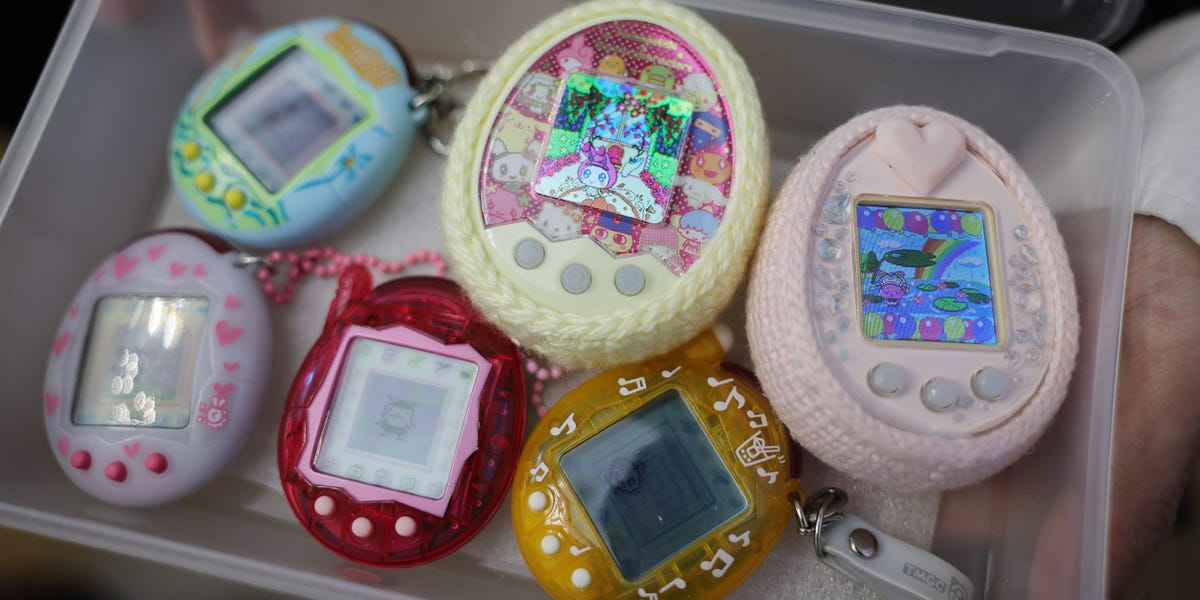
Bandai’s Tamagotchi became a global craze after its 1996 launch in Japan, the Associated Press reported. Owners were required to constantly feed, clean, and care for the egg-shaped virtual pets to ensure they reached adulthood, which typically took a few days.
Other brands, such as Nano Pets and Giga Pets, launched competing models, but schools deemed the pets so distracting that some banned them, The New York Times reported in 1997.
Tamagotchi expanded into mobile gaming in 2013 with an app designed to recreate the original toy experience, AP reported, and the franchise was inducted into the World Video Game Hall of Fame in 2025.
Tamagotchis are still available today. In a 2020 Business Insider article, one adult user wrote that caring for a Tamagotchi during the COVID-19 pandemic helped improve her productivity, happiness, and sleep schedule.
Yet in some ways, Tamagotchis also foreshadowed today’s digital and cellphone habits, as kids and teenagers constantly checked alerts and responded to the toys’ virtual needs — a connection explored in a 2024 article from The Walrus.
Walkie-talkies
The first portable two-way radios were developed for the US military in the 1930s and 1940s, before becoming commercially available to the public, Smithsonian Magazine reported.
These walkie-talkies became a beloved gadget in the 1980s and 1990s, when they were typically used for backyard games, road trips, and camping trips.
Unlike telephones, walkie-talkies allow users to speak immediately without dialing numbers or relying on phone lines. They were also easy for kids to use — no treehouse was complete without the distinctive crackle of a walkie-talkie.
In the 2000s, cellphones usurped walkie-talkies in many households, but they’re still useful today, especially in areas without cell service. As such, they are still used for outdoor activities and music festivals, and for emergency preparedness.
Disposable Cameras
After they launched in the 1980s, disposable cameras, which were cheap, light, and easy to use, became a staple of the 1990s, popping up on family vacations and at teenage parties.
Their popularity waned in the 2000s as digital cameras — and later, smartphones — shifted users toward instant photography. In a retrospective about Kodak, Vox reported digital-camera sales began to outpace film-camera sales in the early 2000s, a change Kodak failed to adapt to before filing for bankruptcy in 2012.
Digital cameras have also regained popularity in recent years. In 2024, NPR reported that digital cameras from the early 2000s had become popular among Gen Zers looking for the nostalgic aesthetic of Y2K photos.
Talkboy
The Talkboy, the handheld cassette recorder featured in “Home Alone 2: Lost in New York,” became one of the most memorable toys of the 1990s after its release in 1992.
Vanity Fair reported that the device was originally created as a fictional movie prop for Kevin McCallister, but overwhelming demand from children prompted Tiger Electronics to turn it into a real product. Its voice-recording and playback features let kids prank friends and create skits, helping make it one of the decade’s must-have holiday gifts.
However, as with other popular devices of the ’90s, the Talkboy dropped out of favor as technology evolved. Eventually, smartphones consolidated the functions of tech like voice recorders, MP3 players, and cameras into a single device.
Today, the Talkboy survives mostly as a collector’s item, although some companies are creating new versions, such as the Texas-based Brand New Noise, which makes wooden voice recorders that distort and loop audio with simple, kid-friendly controls.
Beepers
Before texting and smartphones became ubiquitous, pagers — or beepers — were one of the fastest ways to stay connected.
During the 1980s and 1990s, doctors, emergency workers, business professionals, and teenagers relied on the pocket-sized devices. They developed pager codes that used numbers to convey quick messages before text messaging made it possible. (See: “143,” which meant “I love you” because the words contain one, four, and three letters.)
Their popularity waned with the rise of cell phones, but pagers never disappeared entirely.
CBS News and Reuters reported that some hospitals and emergency services still use them because pager networks can remain reliable during disasters and service outages.
Landlines
Despite quirks that seem unimaginable to younger generations today — being tethered to a wall, potentially spied on by your family, and picking up before knowing who was calling — the landline ruled communication for much of the 20th century.
By the 1990s, cordless phones and caller ID had become common in American homes.
But in the 2000s, as mobile phones became cheaper and more practical, the landline’s dominance faded. According to the CDC’s 2024 National Health Interview Survey, nearly 79% of US adults live in wireless-only households, indicating that many Americans have abandoned landlines in favor of mobile phones.
Still, some people are returning to them, or at least romanticizing them. Many Gen Zers and millennials are pushing back against constant connectivity by “bricking” their cell phones — that is, blocking some apps and websites — and spending more time on offline hobbies instead. After all, one beauty of the landline was that, if you weren’t home, you couldn’t be reached.
Read the full article here