





Roughly one-third of 33 recent US combat casualties evacuated from the Middle East were carrying bacteria resistant to multiple antibiotics, the Joint Staff’s top medical officer said Monday, offering an early warning about a military threat that’s already complicating the recoveries of wounded troops in Ukraine and is projected to worsen without significant medical advances.
Only one of those US troops developed an active infection, Maj. Gen. Clinton Murray, the Joint Staff surgeon and an infectious disease physician, said at a military medical symposium in Florida. The others were “colonized,” meaning the bacteria were present on or in their bodies but were not necessarily making them sick.
Those rates don’t imply that US troops are experiencing an outbreak of drug-resistant infections. It’s normal for healthy people to carry many types of bacteria, and Murray said the findings were consistent with rates seen around the world and in some intensive care units.
However, those recent developments serve as an early indication of a looming danger that the military’s medical system is likely to contend with in the type of large-scale war the US military is trying to reinvent itself for — one in which infections and antimicrobial-resistant organisms could wreak havoc.
“It’s not going to go away,” Murray said. “It’s only going to get worse.”
Weapons — from high-end missiles to cheap drones — and accelerated kill chains are obvious threats, but evolving bacteria and the threat of antibiotic-resistant infections rarely receive similar attention in conversations about the challenges of a large-scale armed conflict.
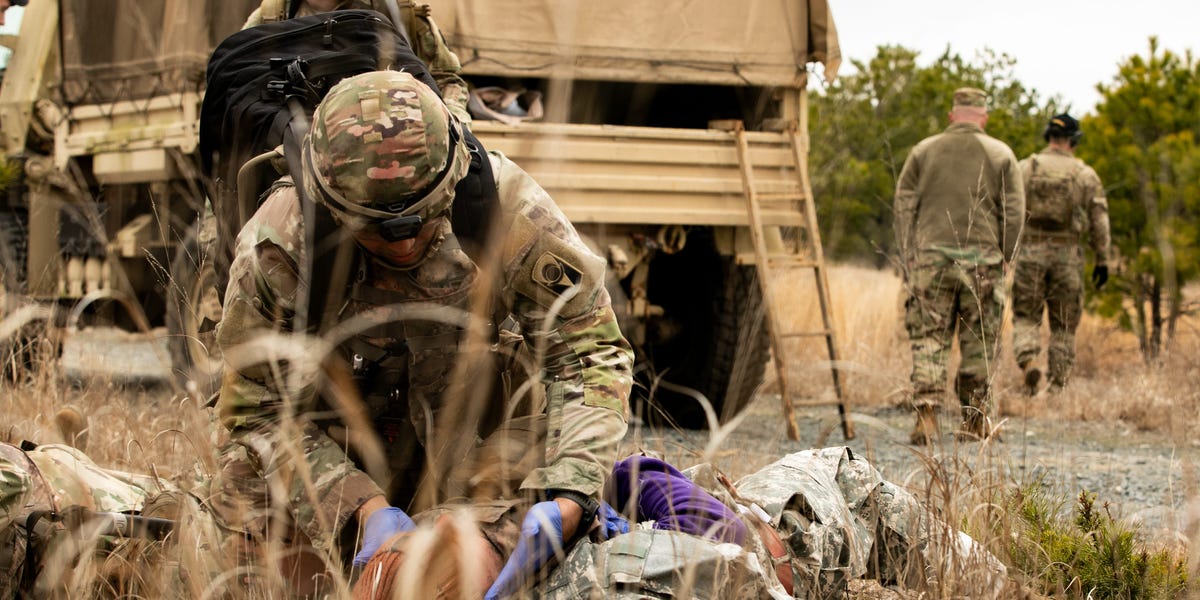
Such a devastating war could leave thousands of severely wounded troops waiting days or weeks for evacuation, receiving prolonged care on the battlefield, where wounds may become contaminated with soil, debris, and bacteria. Those who survive are likely to process through crowded hospitals, where pathogens can spread and infections can proliferate. The resulting conditions could resemble the frequently overwhelmed casualty fl,i;yows of World War I and World War II.
“We need to recognize the threat,” said Army Col. Jennifer Gurney, director of the Joint Trauma System, during the panel, which included presentations from Ukrainian health providers.
In Ukraine, infections and multidrug-resistant organisms, microbes that can resist commonly prescribed medications and antibiotics, have become a serious problem for wounded troops moving through the medical system or undergoing numerous surgeries to repair bodies mangled by explosive drone attacks, shrapnel, and burns.
A 2024 study published in The Lancet predicted that more than 8 million people could die annually as a result of antimicrobial resistance by 2050.
The threat has reached congressional ears, but draft language in the annual defense bill stops short of requiring action. It instead “encourages” the Pentagon to prioritize investments in total wound management and infection prevention.
“Infection is a second hit and a threat to combat power,” Gurney said. “We must change the timeline and move capabilities and diagnostics much closer to the point of need.”
“If we’ve been doing the same thing for 100 years and it hasn’t been working, we really have to think about the strategy,” she added.
Infections and resistant bacteria are not a new battlefield problem. US troops experienced bacterial infections throughout the Global War on Terror, Murray said. But now, bacteria are evolving faster than researchers are developing new antibiotics, two military medical experts told Business Insider, arguing this warrants a more aggressive push for research.
Speaking on condition of anonymity because they were not authorized to speak to the press, they said that the US military may need to become more creative in its approach to treating infections, relying less on antibiotics and more on other solutions.
However, the medical diagnostic tools for identifying and managing infections early, which are key to reducing the heavy demand for antibiotics, have evolved more slowly than in other parts of medicine and are likely to be under significant strain in a large-scale war.
Recalling her time at a military hospital a decade ago, Gurney told the audience that as US casualties arrived for care, doctors didn’t use diagnostic technology to discern types of infections — they used their noses.
“Smell should not be our best early diagnostic capability.”
“We shouldn’t normalize or romanticize this clinical intuition, and early detection must be engineered into battlefield care,” Gurney continued. “Our current approach is probably not working as well as we want it to.”
She compared resistant bacteria to another threat — inexpensive drones that can be produced at scale and overwhelm sophisticated defenses.
That drone threat “is ours now,” Gurney said. “And this [multidrug-resistant organism] threat will be ours as well.”
Read the full article here