





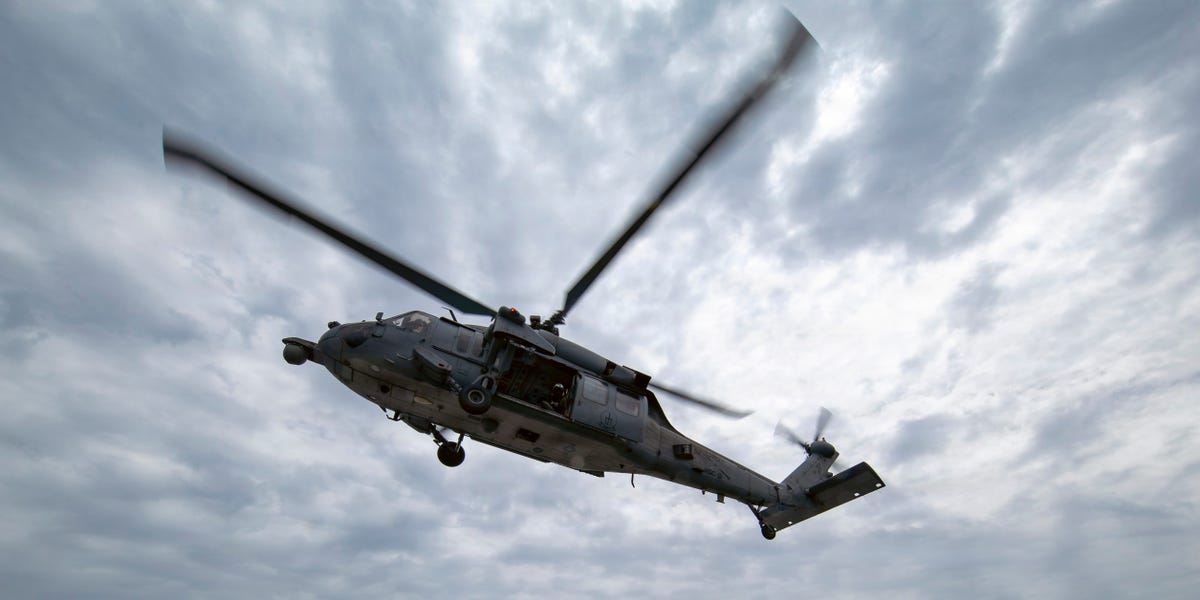
US AH-64 Apache and MH-60 Seahawk helicopters eliminated six Iranian small boats threatening commercial shipping in the Strait of Hormuz, the top American commander in the Middle East said Monday.
Iran has launched new attacks on US military and commercial vessels as the US Navy continues its blockade of Iranian ports and its efforts to clear a path through the Strait of Hormuz. These actions and the forceful response threaten a fragile ceasefire.
Adm. Brad Cooper, the head of US Central Command, shared Monday that Iran had launched cruise missiles, drones, and small boats at ships under US protection, as well as US military vessels. He said that US forces defeated the threats “through the clinical application of defensive munitions.”
“We have an enormous amount of capability and firepower concentrated in and around the Strait, including AH-64 Apache and MH-60 Seahawk helicopters used just this morning to eliminate six Iranian small boats threatening commercial shipping,” said the admiral on a call with reporters.
He added that the small number of Iranian Islamic Revolutionary Guard Corps boats involved reflected the severe degradation suffered by the Iranian armed forces in recent months.
“You typically see between 20 and 40 small boats in a pack coming out,” the admiral said. “Today, we saw six and eliminated them quickly. I think this is an example of the degradation of their capability. It doesn’t mean it’s all gone, but it’s highly degraded.”
US Navy helicopters saw similar action against boats attacking merchant vessels in the Red Sea in December 2023. The helicopters, dispatched after a cargo vessel sent out a distress signal, sank three of four hostile small boats that CENTCOM said had originated from Houthi-controlled areas in Yemen. The Iran-backed militants employ tactics similar to those of the IRGC.
Other US aircraft currently operating in and around the Strait of Hormuz include A-10 Warthog attack aircraft, fighter jets like the F-15 Eagle and F-35 Lightning II stealth fighter, refueling tankers like the KC-135 Stratotanker, and reconnaissance aircraft like the RC-135. The Navy also has two aircraft carrier strike groups and a Marine Expeditionary Unit in the area. Multiple warships are operating in the Persian Gulf.
“The cruise missiles were going after both US Navy ships, but mostly after commercial shipping,” Cooper shared. “We’ve had drone launches against commercial ships,” he said. “And then the small boats were all going against commercial ships, and all were sunk by Apaches and Seahawk helicopters.”
No US military or US-flagged commercial vessels were hit in the Iranian attacks, the latest escalation in a simmering conflict; Cooper declined to comment on whether the ceasefire is over.
American military actions come as the US has launched “Project Freedom.” US forces are guiding commercial vessels that have been stranded and need safe transit through the Strait of Hormuz, which presents a range of threats to shipping, including naval mines.
Cooper said that US forces have cleared a path through the strait and established a defensive umbrella for vessels to travel under. American forces are not supporting individual escorts.
The admiral shared limited details on how the US made this possible. “What I will say is, over the past several weeks, we’ve used low-observable capability to clear that path, and we validated that in multiple ways. And then we took the risk by using US-flagged ships to go through first, setting the example,” he said.
Read the full article here