


Three thousand feet above the fields of Zaporizhzhia, a recon drone watches over a deserted village. Its target: a trio of houses surrounded by trees, tucked into a corner of the settlement.
All looks quiet until a winged drone flashes into view, skimming over the grass. Built like a small plane, it races toward the largest house, striking the roofline. The explosion is instant. Tiles and debris burst above the trees, and within a second, the upper floor is torn open, smoke and dust pouring from the exposed rafters.
“This was a house where Russian FPV drone pilots lived,” said Spring, a drone pilot with the Ukrainian National Guard’s Typhoon unit. Business Insider reviewed footage of a mid-range drone strike from mid-2025, which she said was her first successful strike.
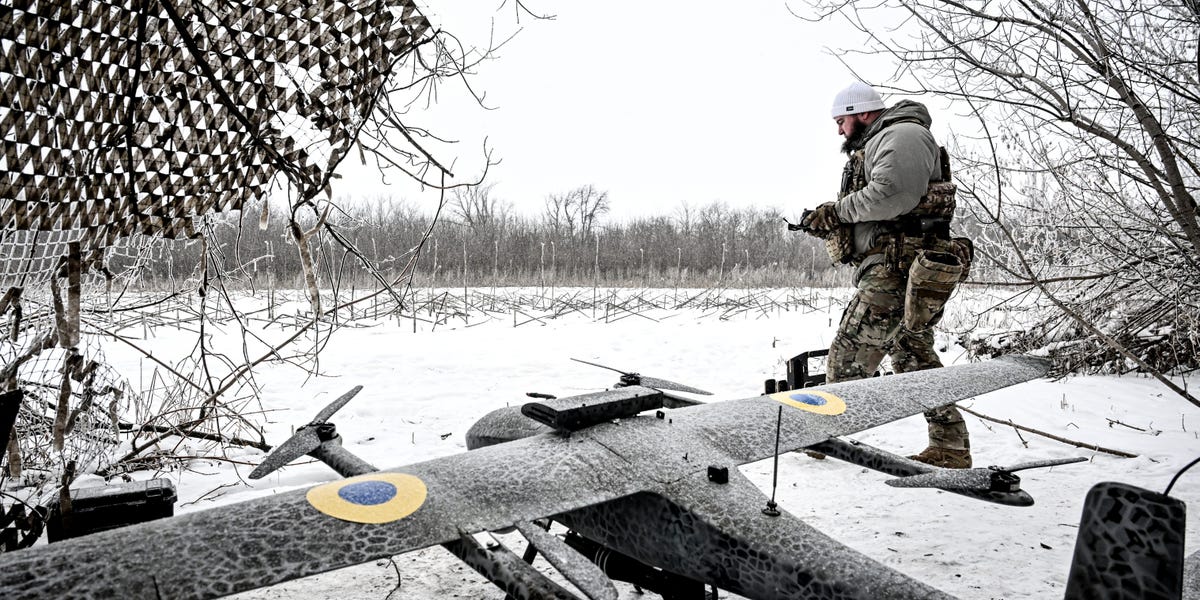
Spring, identified only by her call sign for security purposes, flies a newer type of winged drone that enables Ukraine to consistently strike Russia’s rear areas — a capability previously only provided by Western artillery and munitions, such as the M142 High Mobility Artillery Rocket System.
Mid-range HIMARS strikes were key to undermining Russia’s attack style early in the war, but Russia was able to curb that threat after the first year, analysts told Business Insider. Now, they said, the new drones are bringing that strike effect back in a way Western arms have not been able to do at scale.
“We argue that the Ukrainian mid-range strike is actually heralding a new phase of the war,” said George Barros, the director of Innovation and Open Source Tradecraft at the Institute for the Study of War. “What we’re looking at here is a really solid foundation for Ukraine to blunt Russian advances.”
These cheaper, medium-range drones can travel roughly 30 to 300 km, carrying heavier explosive payloads built to devastate command posts, supply trucks, and air defense assets. Some, equipped with artificial intelligence systems, can overcome Russian jamming by autonomously locking onto their target if they lose the pilot’s signal.
“In some sectors of the front, they appear to be having a meaningful impact on Russian logistics, which steadily affects front-line forces and makes even the piecemeal Russian infiltration tactics less viable,” said Gil Barndollar, a non-resident fellow at Defense Priorities.
The use of these drones has risen in the last two months, and Russia has been losing more ground than it has gained, marking a reversal of a yearslong trend in which Ukraine had been slowly bleeding territory.
“We’re actually quite bullish on the prospects for Ukraine having some substantial upper-hand momentum as we go into the summer,” said Barros of ISW.
HIMARS supremacy in the war has faded
Mid-range drones give Ukraine several new advantages: Kyiv can now conduct intermediate-range strikes at much lower cost, independently decide what to target, and hit those targets more effectively despite jamming.
Early in the war, Ukraine’s ability to strike deep behind Russian lines was heavily dependent on Western-made weapons.
British-French Storm Shadow missiles allowed Kyiv to hit headquarters, rally points, supply depots, and other key rear targets, while its roughly 40 US-made HIMARS launchers could fire rockets up to 150 kilometers and longer-range missiles up to 300 kilometers, delivering similar blows.
However, those weapons came with strings attached. Ukraine often relied on donor countries for targeting support, giving foreign governments a say in which attacks could proceed. The US Department of Defense has repeatedly restricted what Kyiv can hit, including a monthslong 2025 freeze on the use of the longest-range HIMARS munitions made available to Ukraine. And by the time the restrictions had been lifted, the weapon’s overall effectiveness had been diminished.
“The peak of HIMARS was in the summer and autumn of 2022,” said Mykola Bielieskov, senior analyst for Ukraine’s largest crowdfunding organization, ComeBackAlive.
Ukraine only received a limited number of the longer-range missiles, and Russia learned to electronically disrupt the GPS guidance on other HIMARS-launched rockets. As for the Storm Shadows, those are too few to be used at scale.
Barros said that by 2023 and 2024, the Ukrainians continued to use HIMARS, but that they were “quite a substantial downgrade” in the face of Russia’s jamming.
“In the past, it may have taken one rocket to achieve an effective strike,” he said. “Now, it maybe would take four or more rockets to achieve the same level of efficacy.”
Beating HIMARS at its own game
Mid-range drones provide Ukraine with the ability to survive Russian electronic warfare, but the capability wasn’t easy to come by.
“They have to communicate at this longer-than-100-kilometer range, and then overcome really aggressive Russian jamming,” Barros said. “There’s a lot of actual technical challenges in being able to maintain communications with the pilot or control stations at that range.”
Ukraine has worked for years to get that tech to work over longer distances. Now, it’s finally showing up on the battlefield, he said.
Key to these developments is that artificial intelligence is now reliable enough for many mid-range drones to feature an onboard targeting system that can read what the camera sees and pursue a target in the terminal phase, Barros added.
“That is a significant and new technology that is absent in long-range strike tech,” he said.
For example, the AI can be trained to identify Russian logistics trucks as legitimate targets and attack one even if it loses contact with a pilot or operator.
Therein lies another advantage over HIMARS, Bielieskov said. The smaller, more nimble drones can strike moving targets, whereas rocket systems like HIMARS typically attack fixed positions.
Bielieskov said that in the last six to eight weeks, there’s been video evidence of at least 100 targets, such as fuel lorries, destroyed by Ukrainian mid-range drones in Russia’s reserve areas.
The full impact on Russia’s overall war effort is still a “work in progress,” said Bielieskov, adding that it would largely depend on how quickly the Kremlin introduces countermeasures.
“The key piece going forward is true autonomy,” said Barndollar, the Defense Priorities researcher.
“If that can be attained and maintained in an EW-soaked environment, then yes, drones will be replacing most of what artillery does, to include rocket artillery and SRBMs,” he said, referring to short-range ballistic missiles.
HIMARS-style strikes at scale
Another major advantage is the cost. A single Guided Multiple Launch Rocket System, the standard HIMARS munition, costs about $187,000 per rocket, while its extended-range version costs an estimated $479,000 per rocket. The Army Tactical Missile System, the longest-range HIMARS-launched weapon provided to Ukraine, costs about $1 million per missile.
Mid-range drones, meanwhile, can reach targets at a similar depth while typically costing as little as $5,000 each, though some advanced models are sold for up to $50,000. Spring, the Typhoon drone pilot, said that she’s flown about 10 types of mid-range drones, which cost between $1,000 to $15,000.
The low-cost allows Ukraine to scale this capability in a way it couldn’t with HIMARS or other Western weapons.
“We have been seeing more and more footage of these strikes; it means companies like FirePoint are producing at a steady rate,” Bielieskov said. FirePoint is a local manufacturer that charges about $50,000 per drone, saying in May that some of its mid-range models would soon carry an explosive payload of 440 pounds.
That could put the explosive yield on par, or even above, that of a GMLRS or ATACMS strike, which are about 200 and 500 pounds, respectively. Until then, HIMARS retains an advantage in the pure devastation its payload can unleash, analysts said.
Barros said that the US’ newest HIMARS munition, the Precision Strike Missile, is much more advanced than the older munitions and would likely still work effectively against Russian jamming. This weapon has not been offered to Ukraine.
“We can’t be certain that we can rely on the US,” Bielieskov said. “92 kilometers, GPS-guided is not enough, it can be spoofed. So we have the incentive to develop something of a bigger range, more reliable, and with a bigger warhead.”
Read the full article here