


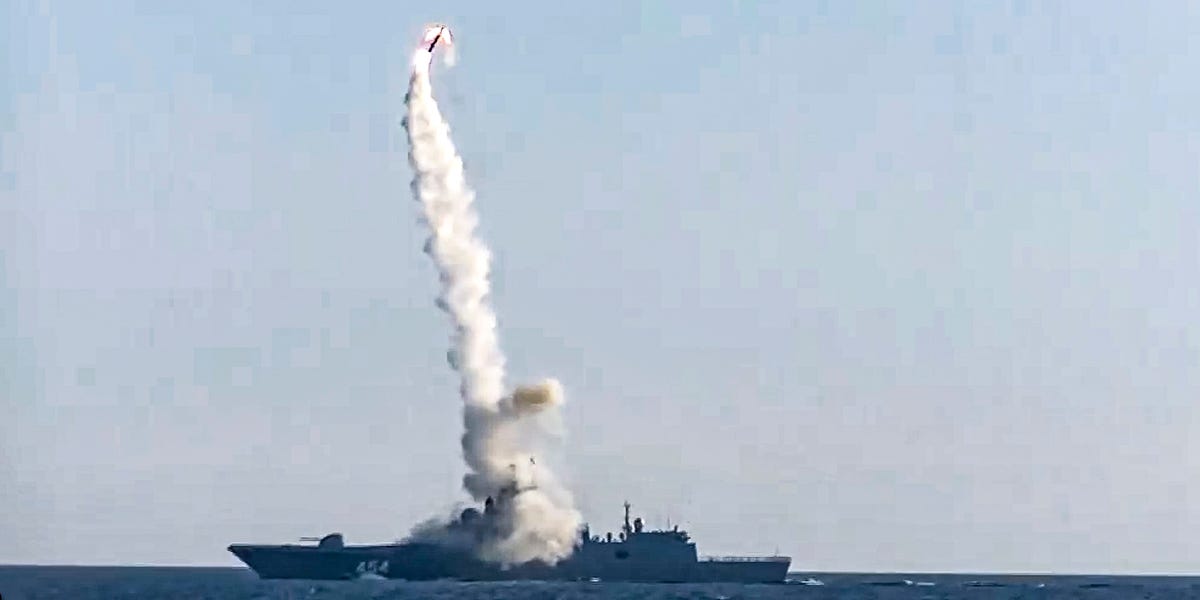
Ukraine’s main military intelligence agency published a breakdown of Russia’s Zircon missile, a weapon Moscow has increasingly employed in its intensifying strikes.
Russia has been investing heavily in advancing its missile arsenal, upgrading systems and making them harder for air defenses to intercept. That reaction to Ukrainian air-defense wins now represents a major challenge as interceptors run low.
On Monday, Ukraine’s GUR, the country’s military intelligence agency, shared details on Russia’s 3M22 Zircon missile, including its components and production.
It also provided details on the main manufacturer NPO Mashinostroyeniya, a Russian defense company that is part of the Tactical Missiles Corporation, and foreign parts used in the weapon, which included some made by US companies. The disclosure also named more than 70 companies and dozens of people involved in its production.
In its new assessment, the GUR referred to Zircon as a ballistic missile, a departure from Russia’s description of it as a hypersonic cruise missile. New details published by Ukraine describe it as a two-stage ballistic missile featuring a solid-fuel booster and a solid-fuel sustainer for flight.
Cruise missiles and ballistic missiles differ in how they fly and reach their targets. Ballistic missiles typically climb on a ballistic trajectory before descending at high speed toward their targets, while cruise missiles are jet-propelled and fly lower within the atmosphere.
Ukraine’s assessment challenges Russia’s long-standing characterization of the weapon.
The GUR also assessed that the Zircon is slower than claimed, with a maximum speed of Mach 6.8. Russia claims that the missile can reach speeds of Mach 9.
Russia has previously touted the Zircon missile as one of its “invincible” hypersonic weapons. It first used the missile against Ukraine in February 2024. At that time, Ukraine estimated that Russia had around 40 stockpiled.
Want more Business Insider in your news feed?
Add BI in Google so our reporting is easier to find when you’re searching for what matters.
The arsenal has since grown, though estimates vary, and Russia has increasingly fired these missiles in strikes on Kyiv and other Ukrainian cities, leaning harder on more advanced missiles as Ukraine has demonstrated it can intercept other Russian systems.
“Since we learned to shoot down more than 90% of cruise missiles and drones with gasoline piston engines, Russia has decided to rely on ballistics and jet drones,” Yehor Cherniev, the deputy chairman of the Ukrainian parliament’s national security, defense, and intelligence committee, told Business Insider.
Russia did not immediately respond to Business Insider’s request for comment on Ukrainian assessments of its weapons and motives.
Cherniev said that Ukraine assesses that Russia has reduced production of Kinzhal missiles because of accuracy issues and instead focused on producing Iskander and Zircon missiles. Russian forces have ramped up ballistic missile attacks on Ukraine this year, including debuting a new upgraded variant of its Iskander series, the Iskander-1000, earlier this summer.
These ballistic missiles are more difficult for Ukraine to intercept, and Russia’s growing reliance on them comes as Ukraine struggles with shortages of critical air-defense interceptors. Ukraine relies on the US-made MIM-104 Patriot surface-to-air missile system to confront Russia’s more difficult missiles, but it has warned that interceptor stocks are running low.
“This is a new and extremely dangerous stage of the war, which requires us to be more effective in the fight against high-speed jet drones, as well as additional assistance from the United States in the form of PAC-3 missiles for Patriot systems,” Cherniev said.
Read the full article here