



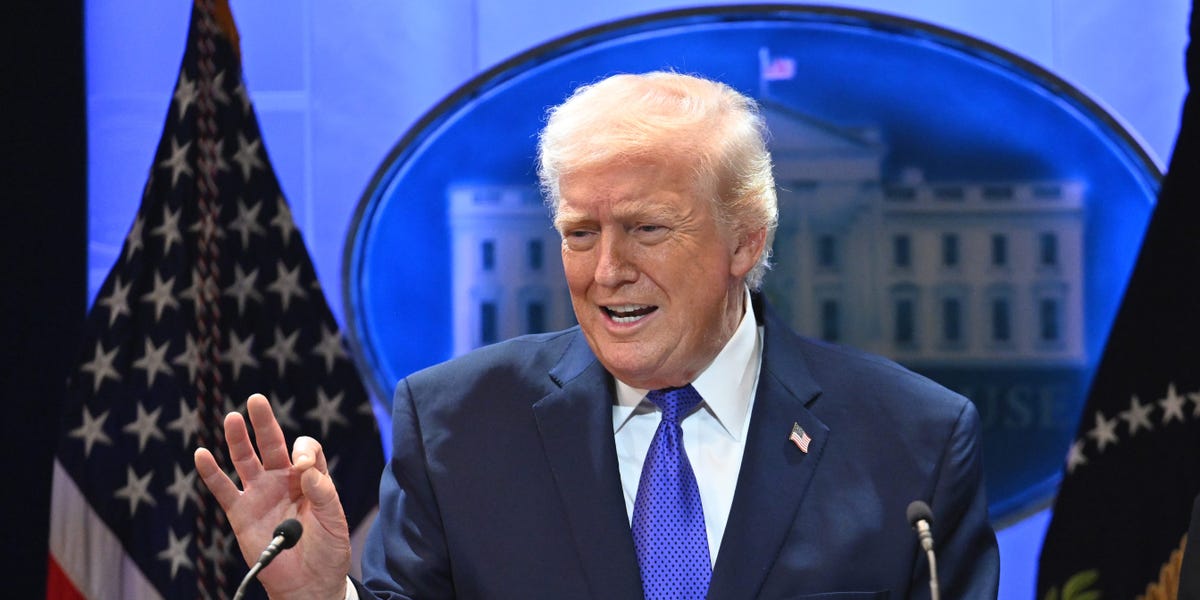
The Trump administration on Thursday finalized new double-digit tariffs on dozens of U.S. trading partners as it seeks to reconstitute sweeping duties struck down by the Supreme Court in February.
The new duties, which range from 10 to 12.5%, follow a five-month investigation into trading partners’ efforts to root out products made with forced labor from their supply chains and are set to take effect just as a temporary global 10% tariff expires.
Starting Friday, 17 trading partners — including Canada, the European Union, Indonesia, the United Kingdom and Mexico — will face a 10% duty, along with another 10 countries that agreed to address forced labor through signed trade agreements with the U.S.
Another 43 other countries, including Japan, China, South Korea and Australia, will face a 12.5% tariff rate. The rates are in line with the investigation’s preliminary findings, published in early June.
“Today’s action is the most sweeping international labor rights action the United States has ever taken — that any country has ever taken,” said a senior administration official, granted anonymity to preview the new tariffs. “It encourages stronger labor rights enforcement abroad, it will restore fairness in the global market for American workers, and it incentivizes our trading partners to join the United States in eliminating forced labor from global supply chains.”
A few countries were able to lower the tariff rate on their goods by implementing a forced labor ban after the proposed tariffs were first announced in June, including India, Trinidad and Tobago, Honduras, and Sri Lanka.
While the new order maintains existing tariff exemptions for a wide array of products like coffee and goods compliant under a 2020 North American trade agreement, the administration also created more carveouts for products like cork, which primarily comes from Portugal, roses from Switzerland, and gems like diamonds and rubies from several countries.
The duties, imposed under Section 301 of the Trade Act of 1974, will go some way to rebuilding the tariff wall felled by February’s Supreme Court decision. In the wake of that ruling, President Donald Trump imposed a 10% global tariff under Section 122 of the same statute. But that law only authorizes tariffs for 150 days, and the current ones are set to expire Friday.
Many countries still face tariff rates lower than they did last year, when Trump imposed “reciprocal” duties under the International Emergency Economic Powers Act. The Supreme Court ruled that law did not justify tariffs.
China faced a 20% tariff on most products when the IEEPA tariffs were still in place; IEEPA tariffs on Japan and South Korea stood at 15%; duties on Indonesia, Malaysia, Pakistan and Thailand were at 19%.
Senior administration officials on Thursday tried to delineate the new tariffs from the ones struck down earlier this year.
“I think it’s a little simplistic just to say, ‘Oh, you’re just replicating whatever,’ because it’s just obviously not the case,” the senior administration official said. “I think it’s an easy shorthand, whether they’re analysts, or even folks in administration, to say, ‘Well, you know, we can see tariffs going up.'”
The Office of the U.S. Trade Representative is expected to issue more tariffs after it completes other Section 301 investigations that are still underway. A second sweeping probe on 16 trading partners’ manufacturing overcapacity could result in higher duties on China, the EU, Indonesia, South Korea, Vietnam, Mexico, Japan and India, among others.
Asked Thursday whether that second probe was on pause, the senior administration official said “not at all.”
“We’re trying to be quite thorough. The issues surrounding structural excess capacity are quite complex,” the senior administration official said. “That investigation continues apace.”
Another 301 investigation is looking into Germany’s pharmaceutical pricing practices. U.S. Trade Representative Jamieson Greer told POLITICO last week that he has similar investigations “waiting in the wings” if ongoing discussions with France and others on drug pricing collapse
The administration recently wrapped a separate probe into Brazil’s trade practices after a year-long investigation. New 25% tariffs on Brazilian exports are set to go into effect Wednesday, with significant carveouts.
Ari Hawkins contributed to this report.
This story originally appeared on POLITICO and is courtesy of the Axel Springer Global Reporters Network, which harnesses the resources of the company’s newsrooms to publish ambitious scoops, investigations, interviews, opinion pieces, and analysis. It allows journalists — including those from POLITICO, Business Insider, WELT, BILD, Onet, and Fakt — to collaborate on major stories for an international audience of hundreds of millions across platforms.
Read the full article here