




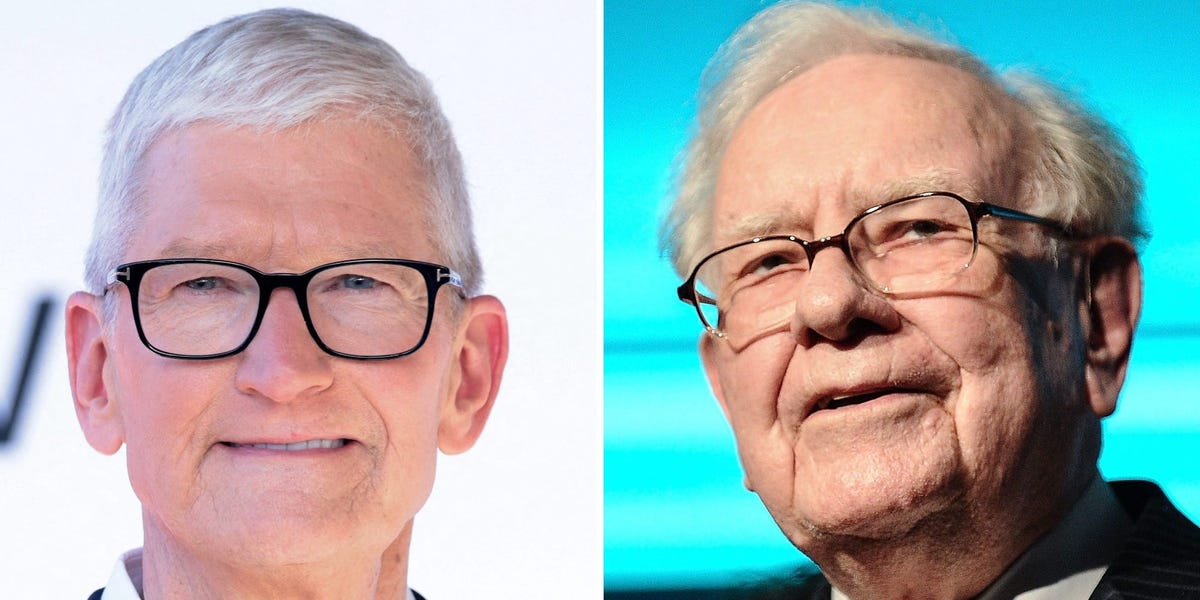
Two iconic business leaders are showing that stepping down as CEO doesn’t have to mean stepping away from a company.
Tim Cook resigned as Apple’s CEO this month after 15 years in the job, while Warren Buffett ended his six-decade run as Berkshire Hathaway’s CEO at the turn of this year.
Yet Cook is set to become Apple’s executive chair, earning a CEO-sized paycheck and playing an ambassador-like role. As Berkshire’s chair, Buffett continues to pick stocks and help make key decisions.
There are clear parallels between the two men’s approaches to post-CEO life, Kevin Carpenter, who writes an investing Substack named Kingswell and “The Berkshire Beat” newsletter, told Business Insider.
“They each passed the torch to the next generation, while still staying heavily involved behind the scenes,” Carpenter said, noting that Cook has said Apple will remain his main focus.
Apple and Berkshire didn’t immediately respond to requests for comment.
Keeping busy
Buffett told CNBC in March that Cook “somehow gets along with everybody in the world.” Carpenter said that this ability could allow Cook to be a “diplomat of sorts” for Apple and “leverage the relationships” he has with governments, regulators, suppliers, and other parties.
Apple has said that as chair, Cook will help with “engaging with policymakers around the world.”
Cook has been described as a “Trump whisperer” for his close relationship with the president. During his tenure as CEO, Apple gave gifts to Trump, donated toward the construction of the White House ballroom, and pledged to invest in US manufacturing.
Want more Business Insider in your news feed?
Add BI in Google so our reporting is easier to find when you’re searching for what matters.
After news broke of Cook’s departure, Trump posted on Truth Social that he had “always been a big fan” of the executive, and praised Apple’s success under Cook’s leadership.
Cook, who succeeded Apple cofounder Steve Jobs, took the company to new highs by scaling and strengthening its global supply chain and catering to China’s mushrooming middle class.
Apple clearly expects Cook to continue generating value, as his target compensation for fiscal 2027 is $45 million before cash bonuses, not far off the $58 million figure for new CEO John Ternus.
As for Buffett, he’s responsible for building an Alphabet stake from scratch into the third-biggest position in Berkshire’s stock portfolio in under 12 months. The holding was worth around $38 billion at the end of June.
Berkshire’s new CEO, Greg Abel, has said he frequently speaks with Buffett and consults with him on major decisions, including the acquisition of housebuilder Taylor Morrison and Alphabet’s private placement earlier this year.
“Just like Buffett is making Abel’s job easier by staying so involved with Berkshire’s stock portfolio, I think Cook will do similar for Ternus by handling stickier issues in the political, antitrust, trade realm that might be too much for a brand new CEO,” Carpenter said.
Finding the right balance
Having Cook and Buffett remain so central to their companies could yield benefits but also poses risks, Larry Cunningham told Business Insider.
“Keeping an iconic predecessor as chairman can give a new CEO both continuity and counsel — but only if the predecessor resists becoming a shadow CEO,” said the director of the University of Delaware’s Weinberg Center for Corporate Governance and the author of several books about Berkshire.
“The key is ‘wisdom without command,'” Cunningham said.
If Cook and Buffett allow their successors to run the show, they may be able to avoid pitfalls such as leadership confusion and power struggles, while adding value by taking on responsibilities that suit their skill sets, namely diplomacy and picking stocks.
Read the full article here