





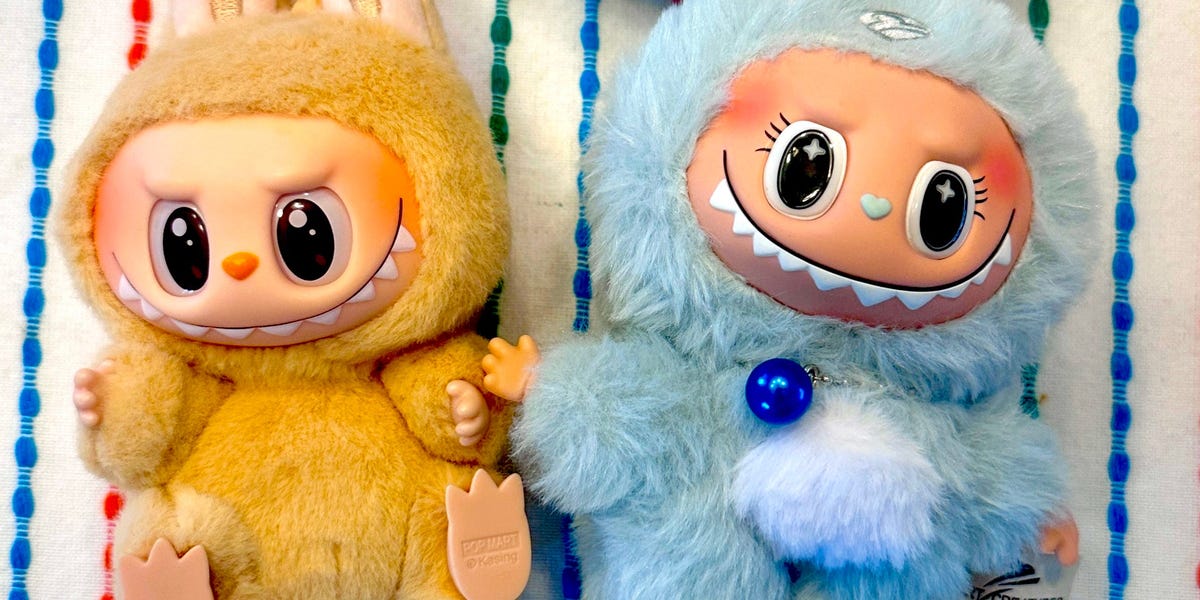
I can’t completely say that the Labubu trend is over, because I bought a Labubu just last month. Ok, technically it was a “Lafufu” — a fake knockoff version that I got for $15 at a sidewalk stall on Canal Street for my daughter’s birthday.
So yes, among kindergarteners, Labubus still hold sway. But among the fashionable young adults who first adopted the fuzzy monster plush? Old news. Rihana and Blackpink’s Lisa kicked off the craze over a year ago when they were spotted with Labrabus as bag charms. The frenzy peaked during the summer of 2025, when surging demand left them constantly out of stock online.
By the holidays that fall, the tides had turned, and Labubus were plentiful and easy to buy. You could even buy them in person, with Pop Mart (the Hong Kong-based maker of Labubu) starting to open more stores and vending machines in the US. [In a cruel twist of fate, my daughter is convinced that the real Labubu that she got for Christmas is a fake, and because it’s from Santa, I cannot demonstrate its legitimate provenance. Real Labubus from Pop Mart feature blind packaging to hide the toy’s color, and it turned out to be a beige disappointment. The fake one, in the blue she wanted, has made her much happier.]
This chart, based on Comscore web traffic data collected by Emarketer, shows web traffic to the Pop Mart website over the last year. Because of the unique demand, rarity, and risk of fakes, Pop Mart’s official website was the key place to buy Labubus — unlike other toy brands, where sales happen more often at other retailers rather than directly through their website. (Hasbro also saw a decline in web traffic during this period, but that’s not as clear an indicator since most Hasbro sales happen in stores or other sites like Amazon).
You can see a sharp decline after September — coincidentally, when they restocked and became easier to obtain. There’s an uptick for the holidays, and then it craters.
There are other factors that might have affected this drop — the opening of several brick-and-mortar stores in the US may have shifted sales away from the website and into physical stores (or other online retailers). The first Pop Mart store opened in 2023 in the American Dream Mall in New Jersey, and there are now over 65 stores across the US. Pop Mart did not immediately respond to a request for comment.
In August, I wrote that the Labubu bubble — on its way to reaching $1 billion in sales — was ready to burst. Looks like it did.
Every time Katie publishes a story, you’ll get an alert straight to your inbox!
Stay connected to Katie and get more of their work as it publishes.
By the time I went to Toy Fair, the biggest toy maker convention in the US, in February, every vendor I spoke with agreed that the Labubu craze had peaked. But they also said its impact was lasting: toys aimed at adult collectors and sold in blind packaging had become major trends that are still going strong.
In March 2026, Pop Mart reported that 40% of its revenue was coming from Labubu, which my colleague Aditi Bharade reported made investors a little nervous. A hit product like this can be a blessing and a curse once the fad fades.
Pop Mart believes it has more to offer than a one-hit-wonder product. During a March earnings call, Pop Mart CEO Grant Want said: “Looking back, while we acknowledge there are still many issues to address, we have built solid strengths over the past year: a robust IP portfolio, a highly capable management team we take great pride in, and a deep understanding of brand building and market dynamics that we have accumulated.”
Read the full article here