




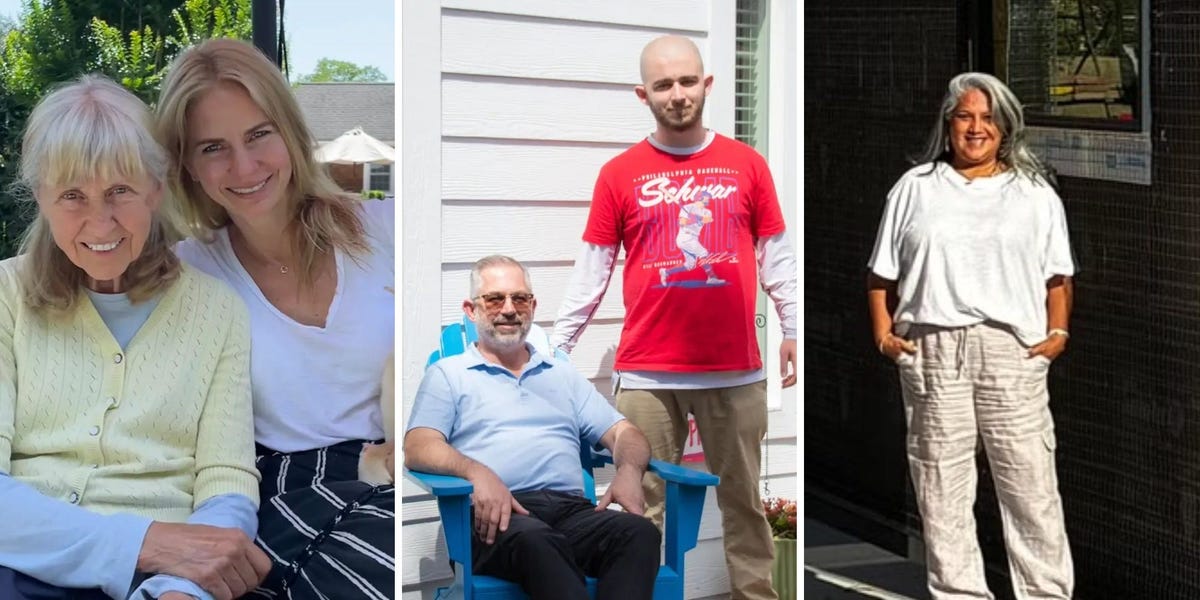
Lena Koropey’s mother was diagnosed with Alzheimer’s disease nearly a decade ago. Since then, she’s watched her once-independent mother come to rely on others for nearly every part of daily life.
“It’s definitely getting harder each year,” Koropey, 48, told Business Insider.
Six years ago, Koropey bought a three-bedroom home in Mattituck, on Long Island’s North Fork, where she lives with her mother and a live-in caregiver. The house is only 1,300 square feet, but it sits on half an acre, giving Koropey room to rethink their living arrangement as her mother’s condition progresses.
“I’ve created spreadsheets and mapped out various scenarios, including building a small cottage or an accessory dwelling unit (ADU) on our property, moving to another house, or, as a last resort, placing my mother in a care facility,” she said. “For now, we’ve decided to build an ADU.”
Koropey plans to build a 750-square-foot home on the property and move into it herself, leaving her mother in the main house with her caregiver and familiar surroundings.
“There is no perfect solution, but my property gives me the flexibility to adapt our living arrangement as her needs change and, ultimately, to care for her at home for as long as possible,” she said.
People are building ADUs for loved ones who need care
An ADU is a small home, often built in a backyard. They typically range from 150 to 1,200 square feet, and cost $100,000 to $300,000 to build, before extras like permitting fees. As ADUs have grown more popular, some states, including California and New York, offer financial assistance to homeowners who build them.
Business Insider has spoken with dozens of people over the years about why they built ADUs on their properties. Some needed extra space or a home office, while others saw an opportunity for rental income. Increasingly, families are also using ADUs to keep loved ones who need care close by.
Rachael Reiner, director of pre-construction and project management at the Bay Area-based ADU company Villa, told Business Insider that the trend has grown in popularity as multigenerational living becomes more common. According to Reiner, 75% of Villa’s sales so far in 2026 have been for multigenerational living purposes.
“The majority of our ADU projects are driven by families seeking to balance independence with accessible care,” Reiner said. “These spaces provide either aging relatives or loved ones requiring support the autonomy they desire while ensuring they remain close to family for support and oversight.”
For the Kuchtas, building an ADU opened the door to more disability services
Building an ADU isn’t necessarily cheap, but in an expensive housing market like California, it can still be a more affordable option. That was the case for Todd Kuchta, who lives in Napa County with his wife, Gabrielle, and son, Jacob.
Jacob has autism and needs help with daily tasks like taking medication and preparing meals, but he still wants his independence. When he told his parents he was ready to move out, they carefully weighed their options.
They could buy a larger home, giving him more space, or move Jacob into supported housing, where he’d have his own room and staff available to help with his needs. But neither option seemed affordable. Jacob’s medical support costs alone could sometimes exceed $9,000 a month.
Instead, the Kuchtas decided to build an ADU on their property in 2023.
Jacob’s 480-square-foot, one-bedroom home cost them $248,000 to build— far less than Napa County’s $907,440 median home price in August. They financed it in part through Napa County’s Affordable ADU program, which offers forgivable loans to homeowners who rent the units to low-income tenants for at least 5 years.
“Napa County provided $63,000 as a forgivable loan, and we worked with Redwood Credit Union, which provided an additional $160,000 loan as a second mortgage,” Kuchta, 60, told Business Insider. “We used a portion of Jacob’s disability income to help cover the ADU rent, which, in turn, offsets our monthly mortgage.”
Not only is Jacob, who turned 28 this year, thrilled to live on his own, but he has also gained access to more support. He’s now eligible for additional disability services through the state of California, including an in-home aide for eight hours a day during the week. Kuchta’s wife also became certified as an In-Home Supportive Services (IHSS) provider and is paid to help care for him.
“The ADU has provided us just what we need to provide independence to Jacob and provide us with the ability to continue supporting him while having more freedom,” Kuchta said.
Shalini Karnani Bonjour’s mother can comfortably age in place
For some families, an ADU can be a way to keep an aging loved one close before a health issue or an emergency arises.
When Shalini Karnani Bonjour’s father died in 2024, she didn’t want her mother living on her own hundreds of miles away in Michigan.
“My mom was 78, and my husband and I didn’t feel comfortable having her so far away, especially when it came to her day-to-day needs,” Bonjour, 50, told Business Insider.
After helping her mom sell her home and move to California, Bonjour and her husband explored different living options for her, including renting an apartment, moving into an independent-living community, or moving into assisted living. But “none were ideal,” she said.
In 2024, the couple purchased a 2,222-square-foot home in the Coachella Valley to live in with their son and Bonjour’s mother. The following year, they began building a 1,100-square-foot accessory dwelling unit for her mother on the property.
“When people tell my husband and me we’re smart or strong for doing this, I think, ‘What other option do we have?’ I’m an only child. Who else will be there to take care of my mother?” she said.
When completed, the home will have two bedrooms, two bathrooms, and a walk-in tub in the primary bathroom. The $475,000 project has cost more than they initially expected, and construction has been more complicated than anticipated, but Bonjour said it will be worth it.
“We love where we live, and building this on our property means we can stay close to my mom while still giving her independence and a home of her own,” she said.
James Richard Cornell wanted to be a more hands-on caregiver
About 11 years ago, James Richard Cornell’s mother called him to say she was over living on her own.
“My mother was living in Florida, and as she got older, she would always say, ‘Let me know when you’re ready for me,'” Cornell, 63, told Business Insider reporter Noah Sheidlower. “It was clear her time to take care of the house she had was getting shorter.”
Within weeks, Cornell and his brother helped their mom pack up, sold her home, and moved her in with him. He has been helping care for his now-87-year-old mother, who later developed dementia, ever since.
At first, she lived in a bedroom in Cornell’s home. But after becoming interested in tiny homes, she decided she wanted one of her own. Around 2013, Cornell built her a roughly 1,000-square-foot home in his front yard. His mother covered about 90% of the $110,000 cost, while Cornell handled much of the construction himself.
“When I walk out my front door, I can look to the right, and she’s right there,” he said. “She’s just 30 feet off the corner of my house.”
That proximity has become important as his mother’s health declines. Cornell gives her medication twice a day and installed an alarm and monitoring system so she can alert someone if she needs help. His friends also help with her care, giving Cornell some relief.
“Nursing homes are awfully expensive, and I promised her years ago that I would take care of her until her final days,” he said. “She’s done so much for me, so it’s fitting that I return it. If it wasn’t for her, I wouldn’t be where I am today.”
Read the full article here