




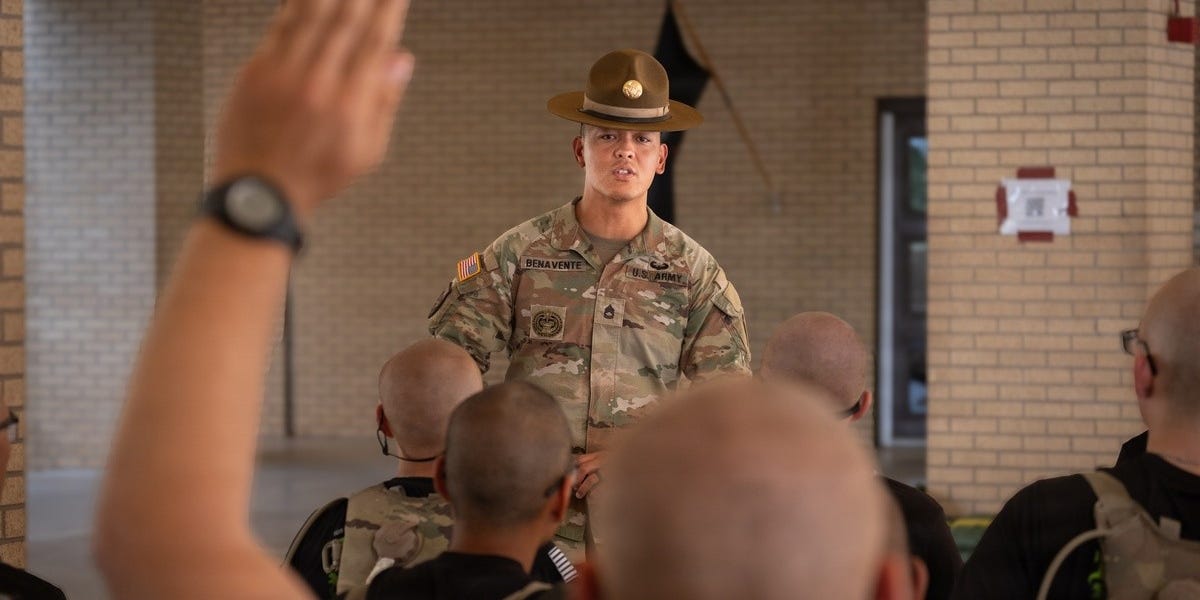
The US Army is testing whether it could use reserve drill sergeants and other personnel to quickly expand basic training in the event that a major conflict suddenly needed training pipelines to produce far more soldiers.
An experiment called Operation Wildcat Rising put dozens of Army Reserve drill sergeants into a single basic training cycle at Fort Sill, Oklahoma, this summer to examine how the Army might increase its existing training capacity while also maintaining basic training standards.
While the reserve already helps reinforce the Army’s training base, its drill sergeants have previously been distributed individually to fill gaps in active units, the Army said in a news release. Wildcat Rising tested a different wartime model and gave a reserve formation under its own leadership a larger share of the training mission.
“Our drill sergeants told us this experience was worth several traditional rotations,” Col. Matthew Horning, the commander of 1st Brigade, 95th Training Division, and one of the officials who oversaw the experiment, said in the release.
“Now we take what we learned, give our formations the preparation time they need and refine the model for the next phase,” he said.
In a large-scale conflict, the military may be forced to grow its ranks on a scale not seen in decades, potentially putting serious pressure on the bases, instructors, and other resources involved in transforming civilians into soldiers. Because of that, Army officials want to assess how reserve troops might help that formative training in a time of crisis.
“At the end of the day, we have to train these men and women for combat,” Maj. Gen. Michael Dougherty, commander of the 80th Training Command, said in the release. “Basic Combat Training is step one, and we have to get that right.”
Training recruits is a notoriously grueling task that can be assigned to troops in nearly any military job. The work comes with long hours, little sleep, constant responsibility for recruit safety, and the relentless physical and emotional strain of overseeing basic training.
A post-training review highlighted the challenges ahead as the Army looks to scale. Some reservists arrived at Fort Sill lacking required certifications for their new roles, and communications failures left others unclear about the requirements before they arrived, the Army said. Tight rotation timelines also left little time for teams to exchange insight as they arrived and departed.
Want more Business Insider in your news feed?
Add BI in Google so our reporting is easier to find when you’re searching for what matters.
Army officials said encountering those obstacles this time will help it shape a larger follow-on brigade-level effort next year.
Read the full article here