





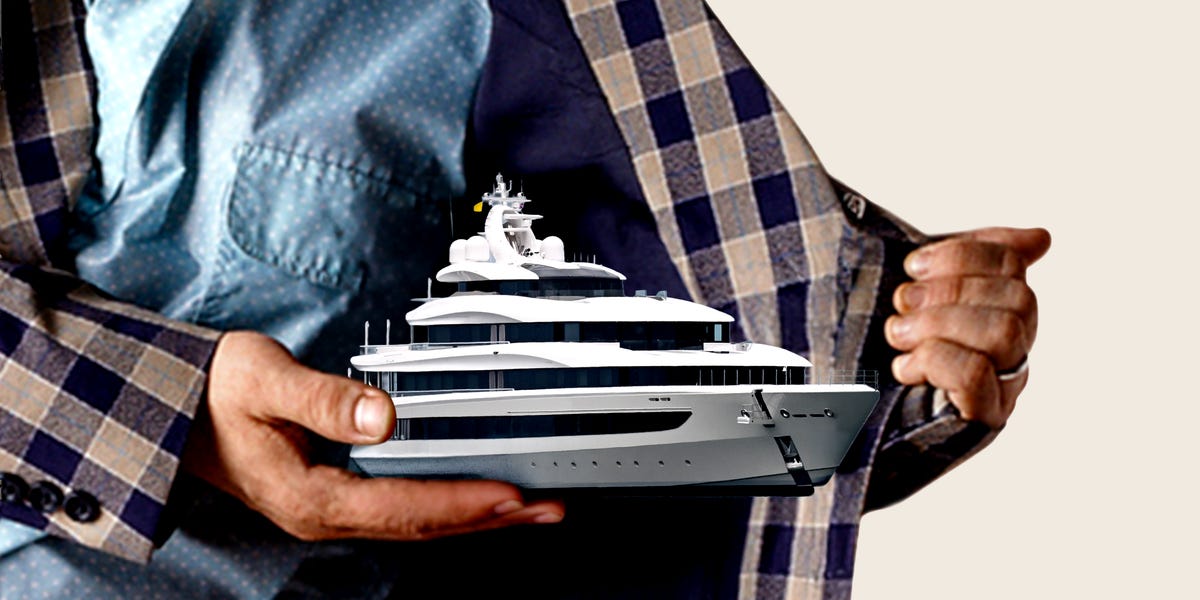
Tomek Wrzesinski has spent more than 20 years selling supersized boats to the uberwealthy, and he’s found one nearly foolproof way to get a client to bite.
It starts with sending a cryptic weekend text message: “Maybe I have something for you. I just need to check if it’s still available. It’s an off-market offer.” The last three words are usually enough to cinch the deal. “After 20 minutes, you have an answer: Yes, yes, yes,” says the Monaco-based yacht broker.
Wrzesinski’s method takes advantage of his place in a discreet network of off-market brokers who help the rich purchase boats without them being officially listed for sale. Thanks to the AI boom, a wave of newly minted billionaires is in the market for only the best of the best of yachts — yachts so large and opulent, they’re typically never listed on any exchange, but are only heard of through word-of-mouth. It is the market, in other words, for people who want to purchase a yacht that could be worth several million to several billion dollars — the sorts of boats padded out with glass pools, beach club apparatuses, and saunas in the back.
The trend attests to the enormous amount of wealth that has been created in markets over the past year, as well as the increasing lengths the rich will go to conceal their spending. It’s difficult to quantify off-market transactions, but what data there is available suggests that they’re on the rise. Known off-market transactions are on track to increase by around 5% this year compared to 2025, according to data that Super Yacht Times Intelligence shared with me. Anders Kurtén, the CEO of the brokerage Fraser Yachts, estimates that off-market transactions have probably doubled since 2019.
Wrzesinski, who says inbound business has increased by around 300% since 2019, thinks off-market transactions have surged in part because brokers have adopted this sales tactic to enhance the luxury experience.
“There are a lot of tricks when you are selling very expensive things, but one of them is that you show that you are treating your clients in a very special way,” he says.
Fraser’s Kurtén says the amount of wealth created in markets over the last several years, combined with a huge bottleneck of large ships being built, has kept off-market transactions humming. In some cases, brokers seeking a ship for a client will approach owners of large yachts cold, asking whether they’re open to a sale.
“As with anything, if there’s the right price to be found, a lot of stuff that isn’t officially for sale ends up being for sale,” he adds.
‘They are treating the boats like toys’
The boom in off-market superyachts comes at a time when the broader yacht market has moored. Sales of all yachts — a loosely defined category that’s thought to comprise ships of at least 10 meters long — are on the decline based on most publicly available broker data. By contrast, sales of superyachts, which are generally defined as yachts more than 30 meters, clocked in at 442 in 2025, up 12% from the prior year, per data from BOATPro, a yacht intelligence firm. Sales are continuing to soar this year, hitting a 3-year high in the first-half of 2026. The even more exclusive categories of mega-yachts (between 60 and 100 meters) and gigayachts (over 100 meters, or about the length of a football field) are the strongest in the yacht market. Not only are the number of sales in these categories increasing, but these ultra-exclusive boats are also going for more: Data from the brokerage Camper & Nicholsons shows final asking prices for megayachts and gigayachts soared 33% and 38%, respectively, last year.
The top tiers were also the only two categories that saw a decrease in the average time spent on the market before purchase, a testament to the fact that only the upper echelon of boats is getting snapped up.
The fuel for this red-hot superyacht market is the AI boom, as well as the huge run-up in stock and crypto prices in recent years, John Hermanson, an off-market yacht broker based in Kuwait, says. The world has minted 400 billionaires so far this year, bringing the total to 3,428 worldwide, the largest number ever recorded. The group holds more than $20 trillion in combined wealth.
Boats are complicated status symbols. Wealthy people who may ascribe to the “quiet luxury” philosophy in other parts of their lives may be pushed by the spirit of one-upmanship that is a huge driving force behind the upper-end of the yacht market, Wrzesinski says. After all, it’s hard to be subtle when your boat is longer than a blue whale. And the appetite for upgrades doesn’t end: Generally, a yacht stays with a buyer for around three years before the itch to upgrade finally becomes too hard to ignore, Wrzesinski tells me. He pointed to one of his clients, who recently sold a 60-foot yacht and purchased a new one after the embarrassment of docking between two larger ships in Europe.
“The truth is that when you buy a boat, and you go somewhere, you meet other people with boats and somebody always has a bigger boat than you,” he says. “You will buy a bigger one. It’s always like this.”
People are motivated to invest in their ships for one main reason, he adds: the wow factor when showing it off to friends. “Clients for the boats, they are treating the boats like toys. If they are selling, they are selling just for one reason: because they want to buy a new one.”
‘They exist in relationships’
While it’s hard to hide a megayacht once you own it, you can be a bit quieter in the buying process. These off-market sales usually go something like this: First, you’ll find a yacht broker, ideally one with extensive ties to other brokers and shipyards. You’ll go over the items on your wish list and show the broker your proof of funds — a requirement to complete most sales. In most cases, the broker also signs an NDA to assure clients that their identities are fully protected. Text messages and internet searches related to the yacht are also usually encrypted, Hermanson says.
Connections are key, Hermanson says, adding that he’s been building a sprawling network since the 2008 financial crisis and runs a LinkedIn group with around 120,000 industry professionals. Most quality brokers find ships for sale through relationships, word of mouth, and, in some cases, the power of persuasion.
“Off-market listings don’t exist in a database. They exist in relationships. A broker who has been in the industry for decades will know about a yacht before it is even listed,” he says.
Brokers are paid handsomely for this insider knowledge. On a typical boat over $10 million, Hermanson says he can expect to make 2.5% of the final sales price, equivalent to at least $250,000. (The average price of a used motor megayacht typically starts at around $60,000,000, per the chartering platform Yacht.com.)
A good broker has many faces. They may need to consult on the materials used in the yacht’s construction, shift into family counselor mode to get the wife and kids on board, and act as the client’s “best friend” throughout, Wrzesinski says, being brutally honest about which boats are worth their time and money. Ideally, they negotiate with their clients’ wishes and help them ask the right questions, such as whether it’s really a good idea to add gold to the interior (an aesthetic choice that can cost hundreds of thousands of dollars a year in extra fuel costs), and whether the renovations they want will jeopardize the overall float and safety of the boat.
These days, the most common requests are to install a “beach club” area at the back of the boat, and renovations such as glass-walled pools, open-plan lofts sheltered by glass, on-board gyms, massage rooms, and saunas are also becoming more common, the brokers I spoke to say. Helipads, golf-driving ranges, and basketball courts are also “fairly standard,” Wrzesinski says, with requests for custom amenities occasionally veering into the “absurd.”
The final bill for renovations will depend on the size of the yacht, but a “full beach club conversion” on a typical superyacht might run someone between $1.7 million and $3.4 million, Hermanson estimates.
The level of luxury is also evident in how specialized the requirements for deck hands are nowadays, Kurtén says, adding that expertise in mixology, spa treatments, and fitness instruction is now commonplace. Recently, he was on the search for a yacht worker who could speak at least three European languages, be able to play a portable instrument, and who could make a mean martini.
“They really expect to be able to take their onshore lifestyle and park it seamlessly on board,” Kurtén says.
Most critically, brokers must be down to celebrate once the sale goes through.
“Part of my job is drinking alcohol against my will,” Wrzesinski says. “He says, ‘What? You don’t want to drink with me? I’m buying a €10 million boat, and you don’t want to drink?’ And what do you say? Of course I will drink.”
Brokers, who typically hash out the terms and conditions with each other before presenting the details to the buyer and seller, can be extremely competitive. In some cases, brokers will try to swipe clients from the other, such as approaching a potential buyer after a showing and offering to represent them for a lower commission, Hermanson says.
Wealthy clients can also be quite mercurial. One buyer whom Wrzesinski represented roped in a team of lawyers to demand a warranty for all appliances on the yacht, which is not the industry norm. That took one month — or, for brokers who work around the clock, several hundred business hours — to smooth over, Wrzesinski says. In another instance, Wrzesinski says he spent the evening crying after a client changed their mind at the last hour on a yacht, wiping away days of high-stress negotiations.
Business, as far as everyone in the ecosystem is concerned, shows no signs of slowing down on the high end of the market, though there’s one concern that seems to be on the back of everyone’s minds: what could happen if the AI bubble were to burst. Kurtén says he’s aware a large amount of wealth could be erased if markets were to see a sudden drop, but he remains confident that the underlying demand for big luxury boats is strong enough to rebound in just a few years’ time.
“It was just a profound love for being at sea and the personal freedom that having your own boat or, in this case, yacht gives you. I think that is something sort of endemic despite what goes on in this world,” he says.
Jennifer Sor is a reporter on Business Insider’s Markets team with a focus on retail investing, job trends, and the pursuit of wealth.
Read the full article here