




There’s infighting among Silicon Valley insiders and elites about whether AI could kill us all and if frontier companies should slow down because of it.
How do the normies feel, though? You know, the everyday people whose lives AI leaders say will be forever changed for generations to come?
“Lukewarm” is how Jason Jones put it.
Every day since February 16, 2024, Jones, a computational social scientist at Stony Brook University, has surveyed 11 different Americans to ask whether they agree or disagree with the following statement: “I support further development of artificial intelligence.”
The sample size was dictated by budget. Jones spends about $10 per day, at around $ 0.80 per respondent, on a third-party platform that collects responses. Jones calls his tracker an “AI vibe check.”
The professor said the sample size is too small to get an insightful daily read: “It’s kind of a noisy signal, and it ends up looking like a stock chart.”
Instead, Jones said the goal was to find the “Three Island Mile” moment, or the critical turning point, in which the US mood on AI completely shifts.
That moment has yet to come.
“The major story here is that it doesn’t move very much,” Jones told Business Insider of the tracker. “I’m capturing the mood, and the mood is ambivalent and has remained ambivalent.”
When the daily responses are pooled by month — roughly 300 responses at a time — Jones’s tracker has consistently shown a net-positive support for further AI development. The sentiment, however, is hardly euphoric and is gradually trending downward.
Jones’ data shows that the monthly average peaked in April 2025 at 1.57 on a seven-point scale running from -3 to 3, where 1 means “somewhat agree.” Across the 2026 responses collected so far, the average stood at 0.53 — still above neutral but notably cooler than the previous two years.
Jones has collected more than 10,300 responses since his survey began. The tracker is not a nationally representative poll, but it offers a read on whether sentiment in the sample is shifting over time.
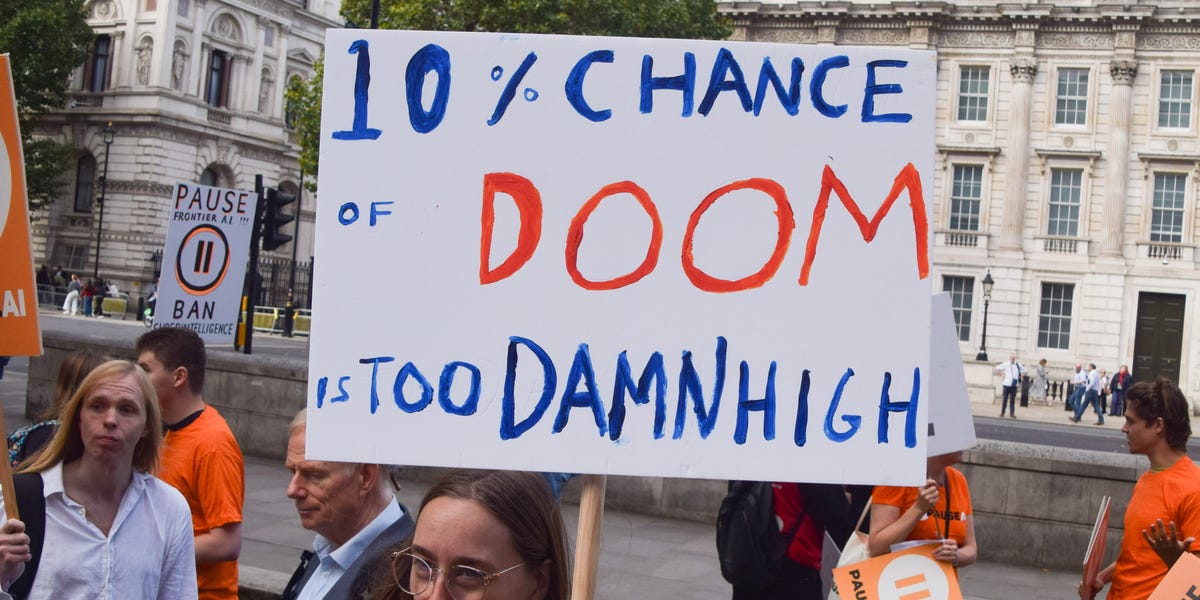
The past two weeks have brought a frenzied debate online and in Washington among AI doomers and boomers after industry figures, including an ex-Anthropic researcher, again raised alarms about the possibility of an AI-caused human extinction.
A poll conducted by Politico and Public First showed that 63% of 2,064 US adults surveyed saw at least a moderate risk that advanced AI could “destroy humanity.”
It also found a 48% plurality that said, “AI is now good enough and we should pause the development to reduce any risks.”
Still, it’s not an anti-AI consensus. Thirty-one percent of respondents said AI should continue to be developed because “they could still bring significant benefits,” while 22% said they don’t know.
The split suggests something more complicated than either side of Silicon Valley’s doom-or-boom fight.
Want more Business Insider in your news feed?
Add BI in Google so our reporting is easier to find when you’re searching for what matters.
In the open-ended responses to Jones’ survey, concerns about existential catastrophe and a US-China AI race appear, but they’re not the dominant frame. The most common recurring themes are more immediate: jobs, usefulness, regulation, corporate incentives, privacy, and the environmental costs of the AI build-out.
Daniel Schiff, a political science professor at Purdue University who studies AI policy and ethics, said the idea of a swarm of AI agents hacking critical infrastructure, or the race with China, can feel too abstract or inaccessible to much of the public.
“Issues like data centers, cost of living, jobs — these things I think will continue to be more salient to people than superintelligence risks,” Schiff said.
Read the full article here