




TAIPEI — About a four-minute walk from the metro station, Taiwanese troops slipped into the Tamsui River on an American-made M3 amphibious bridging vehicle, dropping pontoons and clusters of barrels rigged to explode.
On the shore, six retirees in gym slacks and tennis shoes were winding down their early morning Taichi, unaware that a group of main battle tanks — built with designs as old as they are — watched over the scene.
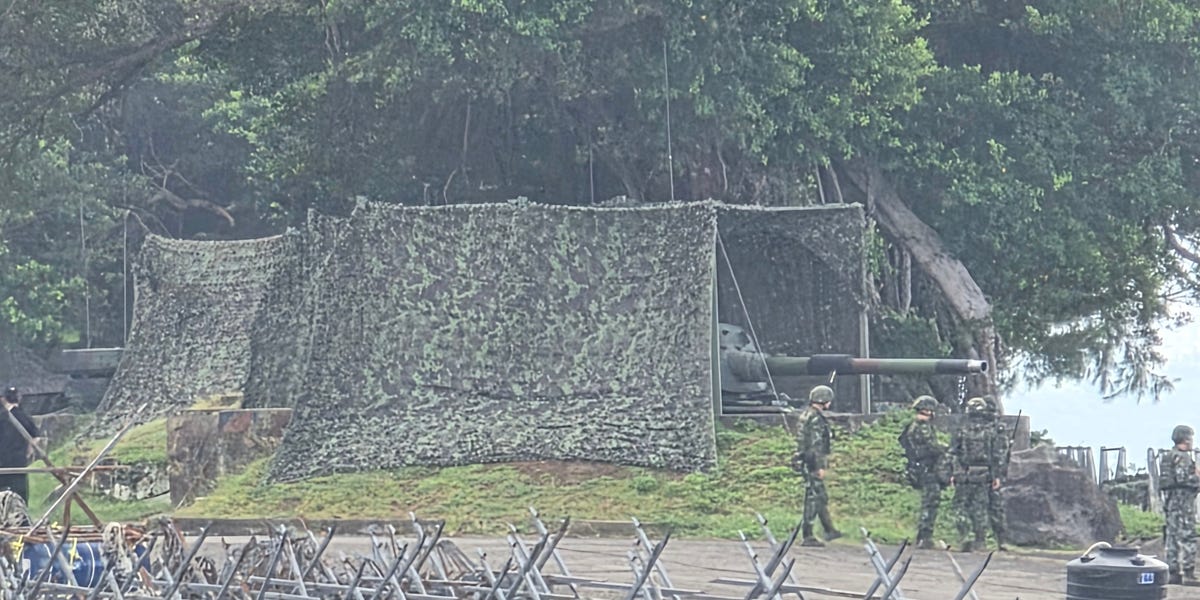
Taiwan deployed at least three CM-11 Brave Tiger tanks during the river drill that Friday morning, as part of the island’s 10-day annual Han Kuang exercise.
The Tamsui, about three-quarters of a mile wide, is vital to Taipei’s defense because it opens a route from the Taiwan Strait into the heart of the capital, where the island’s presidential office, defense ministry, and military command center are located.
The Brave Tigers, stationed less than three miles from the mouth of the Tamsui, had a clear view of the river from their fixed positions on the eastern shore.
First entering service in Taiwan in 1990, they’re an amalgamation of parts from Cold War-era tanks supplied by the US decades ago. Each one uses the chassis of an M60A3, first introduced in the 1970s, and a turret derived from the M48A3 Patton, an even older tank dating back to the 1960s.
The Brave Tiger’s main armament is a 105-mm M68A1 tank gun, while its fire-control package comes from the M1 Abrams. Both designs are over 40 years old.
Older tanks for a modern fight
Taiwanese forces had these aging armored vehicles sitting in fortified tank bunkers, covered in camouflage netting against a backdrop of trees. The Brave Tiger’s main gun, with a direct-fire range of about 1.25 miles, can easily cover the span of the Tamsui, allowing it to ambush or ward off incoming Chinese landing craft or amphibious vessels.
Ben Lewis, an American analyst and founder of the website PLATracker, which monitors Chinese forces’ movements in the Indo-Pacific, spotted the tanks on the shore and said they appeared to be providing fire support for the troops and divers laying mines.
“For tanks that are as old as the CM-11, using them for support to engineering units and in static positions is logical,” Lewis told Business Insider. “The armor on these tanks is not suitable for protection against modern anti-tank weaponry or tank-to-tank combat.”
Lewis said Taiwan has been modernizing its forces, but still keeps older platforms such as towed guns, support vehicles, and tanks in its arsenal.
Taiwan fields about 450 Brave Tigers, which pales in comparison to China’s roughly 6,000 tanks, nearly half of which are light enough to be sent over the strait in a landing invasion. Taipei also recently received 108 M1A2T Abrams tanks, serving as a modern spearhead for its tank forces.
But its armored vehicles, outnumbered and likely to contend with Chinese air support, would better serve the island by holding chokepoints or ambushing Beijing’s forces, a veteran local analyst told Business Insider.
Business Insider has reached out to Taiwan’s defense ministry for comment on its use of the Brave Tigers at the Tamsui drill.
Using aging tanks as static artillery has been proven as a somewhat viable concept. In Ukraine, where drones and a mine-laden frontline have made tank-on-tank combat exceedingly rare, Kyiv’s forces put older tanks, such as the T-64, in concealed positions to provide indirect fire from beyond line of sight.
In May, one unit said it used an Italian B1 Centauro tank destroyer to strike a Russian-held house about 11 kilometers away.
Read the full article here