





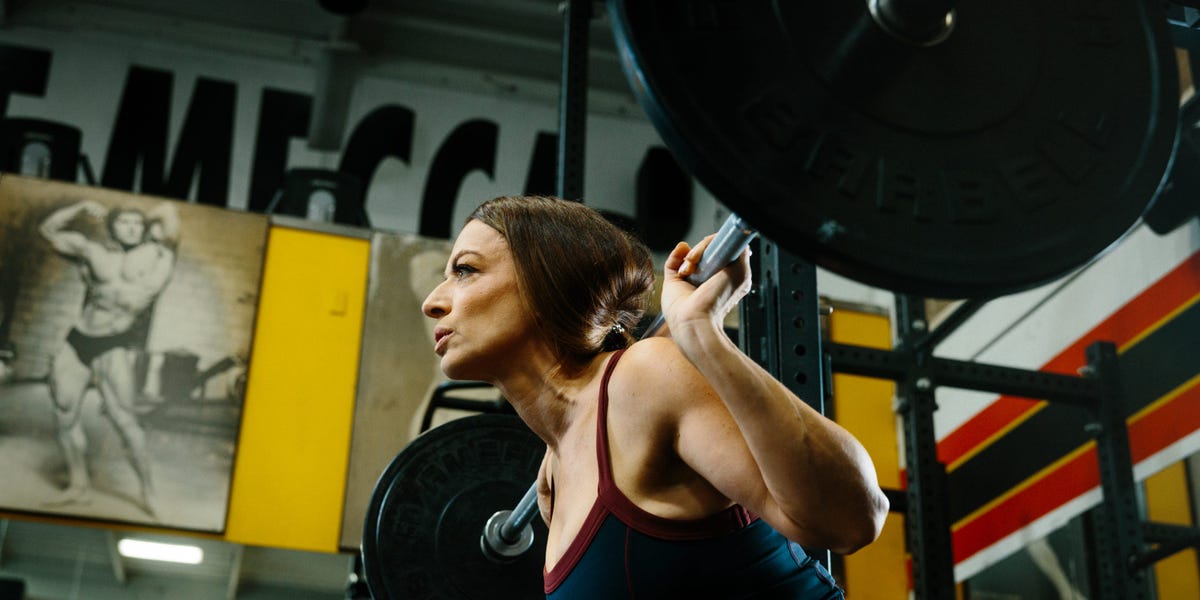
When Deb Stern steps up to the barbell for a heavy back squat, all distractions fall away.
When you’re sweating under cold steel, there’s no room for stray thoughts. Stresses about her busy caseload as an attorney, her packed schedule as a mom of two, and the hustle of New York City living are eclipsed by the more than 100 pounds of metal she’s about to lift.
It’s not easy — everything in her mind and body is alert to the challenge, the possibility of failure. She hoists the weight onto her shoulders, the ends of the barbell dipping under massive plates, and she squats, driving through her legs and core to propel the equivalent of a young hippopotamus down and back up, repeatedly.
After her workouts, Stern said, everything else in her life feels easier. She’s done the hard thing, trained herself to face down uncertainty and discomfort, and came out stronger.
Outside the gym, Stern is a structured finance lawyer, a specialist in navigating the complex legal framework behind massive piles of cash in loans and investments. It’s a high-stakes environment that demands performance every time Stern calls a client or leads a team on a new project. And after a good gym session, she’s not only up to the challenge, but embraces it head-on.
“It happens at work every day. Before weight training, I would have been super stressed out,” Stern told Business Insider. “Now, no matter what gets thrown at me, I can handle it. Bring it on.”
It’s not just the endorphins of exercise (though that helps). In an era defined by GLP-1 drugs promising to shed pounds, many women in business and tech are increasingly turning toward gains instead to project an image of competence, drive, and self-mastery. For these women, lifting weights is a way to signal ambition and confidence, and to showcase their discipline. And women aren’t lifting alone — gyms have turned workouts into a social ritual, moving networking from happy hour to the gym floor.
“I think strong is the new skinny, and that’s why we keep seeing it with young women changing their body image through strength training,” Jim Rowley, CEO of Crunch Fitness, told Business Insider.
With interest climbing, gyms and studios are downsizing their cardio equipment to make way for the weights. For instance, Gold’s Gym has decreased its cardio space by about 15%, according to the director of performance Erin Gregory. At the same time, they’ve added 30% more strength training equipment, like more squat racks, benches, and free weights.
“Women are getting more confidence on the weight room floor, which I love to see,” Gregory told Business Insider.
Beyond sculpted biceps or heavy squats, strength training is also part of a broader antiaging movement that finally acknowledges that healthy muscle mass is a key factor in living a longer, healthier life.
And ambitious women in the workplace told Business Insider that pumping iron helps build the mental strength needed to climb an ever-steeper corporate ladder.
The right to bare arms
In an era where longevity is the ultimate status symbol, it’s hard to beat strength training. Showing off a sculpted, muscular physique signals resilience for the long haul.
A growing body of research suggests that working out, particularly with resistance training, is one of the most effective anti-aging tools we have. Women are increasingly the focus of that research after decades of being assumed to be smaller, less muscular versions of men.
“Once they actually started to study the impacts of strength training on women, the evidence supporting women’s strength training was just unbelievable,” said personal trainer Kristie Larson.
“Now women are understanding, if I want to be independent into old age, then it’s really important for me to start thinking about my bone health and building muscle mass instead of the narrative that we were constantly exposed to of just working out to be skinny.”
Women’s prestige was once tied to staying small, maintaining a petite figure and tiny waist as evidence that we could have it all: a career, 90 minutes or more of cardio a day, and the ability to subsist on salads and smiles.
Former Wall Street Journal reporter Anne Marie Chaker said she vividly recalls, as a rookie journalist, stepping into the office elevator with an editor who tried to compliment her by asking if she had lost weight.
Enter Ozempic.
Over the past five years, prescription weight loss medications have taken the world by storm, with about 1 in every 8 American adults trying them. While GLP-1s are by no means a shortcut to weight loss or health, the drugs have offered an unprecedented means to change one’s body far beyond what diet or supplements can consistently do alone. As the drugs have become more affordable, they’re also reshaping access to long-term weight loss support.
But you can’t buy muscle — yet. It takes hours of sweat and months of consistency to build an athletic body. As a result, showing off a muscular physique has become a status symbol boasting discipline.
Training became a corporate cheat code
More than ever, women are leveraging their physical strength to signal not only their dedication, but their capacity for leadership, said Pattie Sellers, a former assistant managing editor at Fortune.
For two decades, Sellers chaired the magazine’s running list of the world’s most powerful women, who often showed up in historically male-dominated fields like business and tech. In a bygone era, men in charge would broker deals over scotch and cigars, or lavish dinners on the company’s dime.
That won’t cut it in today’s high-stress environment, where the job requires real stamina, the kind of mental and physical resilience that can’t be faked.
“It’s not just optics,” Sellers said. “You’re simply not going to last if you are not strong physically, mentally, emotionally. It is too much of a pressure cooker world for leaders to survive, no matter your industry, unless you’re focusing on health and wellness.”
For women like Sarah Robb-O’Hagan, a lifelong athlete whose résumé spans Equinox and Nike, strength training was a major source of support at key moments throughout her career, including after the birth of her second child.
She said those hours in the gym have paid dividends in terms of energy, focus, and confidence at the office.
“Even if I didn’t feel like getting up and going to the gym, I knew that by the time I came home, it would give me that empowerment for the rest of the day,” she said. “Having a strong body equates to a strong mind, equates to me being able to handle the big life that I want to have.”
Fitting exercise into your day also highlights effective time management and multitasking skills. Chaker said it’s a non-negotiable for her, even when she has to bring her laptop to the gym and take calls or answer emails between sets. She’s seen other women do the same.
“It is a flex to show that this is something you prioritize. You can get it all done, and you can be strong and kick ass,” Chaker said.
For women, hitting the weights is an opportunity to own the room, take up space at the table literally and metaphorically, said Robb-O’Hagan. As a result, we’ve seen a new era of execs focused on presenting their physiques as symbols of discipline and rigor, taking up jiu-jitsu, adopting high-protein diets, and practicing intermittent fasting.
“What you can do physically is such a wonderful metaphor for what you can do mentally and emotionally as a leader in the workplace,” she told Business Insider. “Because ultimately strength training is about self-efficacy, and that’s really what leadership is about as well.”
Happy hour at the barbell
Late last year, Chaker had the networking opportunity of a lifetime. At a women’s leadership conference in Montana, Chaker ran into a top businesswoman — she wouldn’t name-drop out of respect for her privacy, but she’s one of the fewer than 500 women billionaires on the planet.
It all started when she asked to borrow Chaker’s resistance band during a chance meeting in the hotel gym. The impromptu one-on-one chat offered a more memorable moment of connection than any keynote speech or skill-sharing lunch, she recalled.
“Lifting is a great equalizer,” Chaker said.
For Chaker, who became a bodybuilder in her 40s, lifting not only provides her with unique and intimate networking opportunities but also benefits her career.
“When I started lifting, everything in my life changed. I got a raise at work. I was interviewing better. My story ideas got better,” Chaker said. “And it wasn’t just because of cool muscles. It was because it changed my view of how I took up space in the world.”
Women aren’t pumping iron in isolation. Boutique fitness, revitalized post-pandemic, has made health an elevated and social event, prompting business leaders to move happy hour from the bar to the barbell.
But even as more women are interested in the weight room, it can still retain an air of gymtimidation. For savvy fitness pros, that’s created a prime audience for women-centered strength spaces, according to Larson.
Larson opened her own gym, Tension Strength, in Brooklyn after years of coaching for Row House and other studios. She noticed a demographic of high-achieving women who wanted to level up their exercise beyond cardio and Pilates, but weren’t sure where to start.
Strength training, by its nature, requires failure in order to grow. That translates well to an executive mindset, taking on challenges and setbacks to build back better, and gives women in particular a space to practice this skill without judgment.
“We’re a lot more conditioned to see men trying and failing, iterating, whereas with women, there’s this expectation that we succeed the first time or we disappear,” Larson said. “In strength training, confidence translates into all different areas of life because you understand it’s safe to try.”
Sellers, the former Fortune editor, also sees women’s fitness as a means to match the close-knit, exclusive clubs that powerful men have enjoyed for decades. In 1996, just one executive on the Fortune 500 was a woman. Today, they make up 10% — still a long way to go. Sellers hopes that connections built at the gyms could help close the gap.
“We are working really hard to create the female version of the golf course,” Sellers said.
Read the full article here