





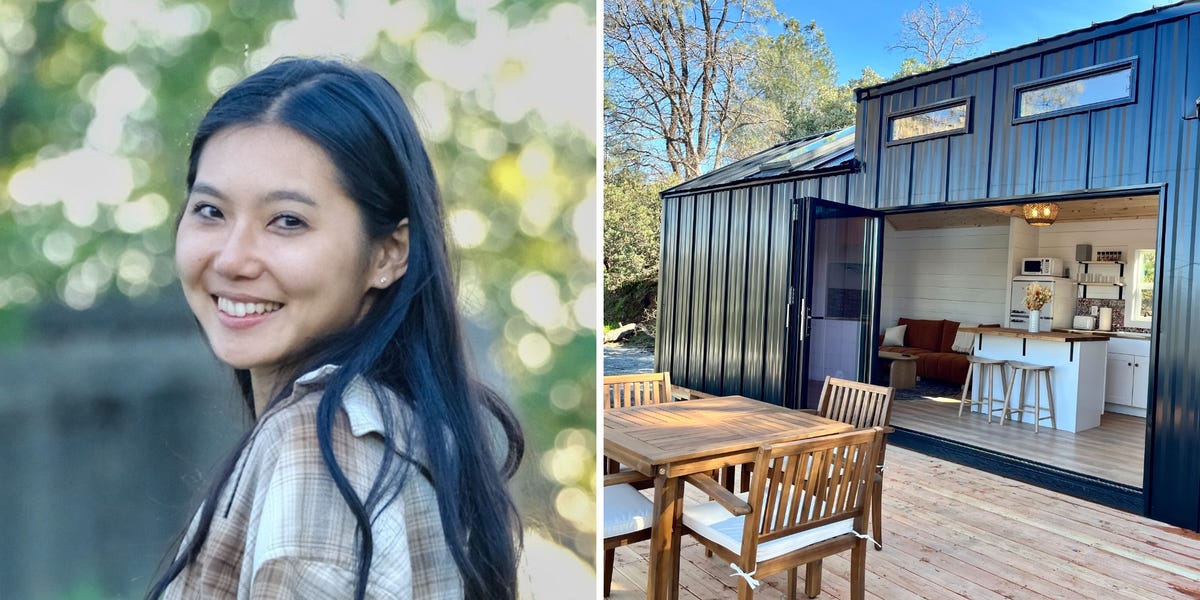
Sakura Kishiro packs a lot into 400 square feet.
The 26-year-old and her partner started seriously thinking about building a tiny home last fall. They soon settled on a modern-style model with bright glass windows and a custom, generously-sized back deck. For a little over $100,000, the investment seemed worth it. And it could be a catch on Airbnb.
“Tiny homes are really creative, small spaces, and that’s always been really intriguing to me,” Kishiro said. “We also knew that, from a rental perspective, these homes can do well. They can be really popular.”
Tiny homes have emerged as a popular housing solution for people looking to downsize, cut costs, or cash in on the hot vacation rental market. Business Insider has heard from parents who raised their kids in tiny home villages, young adults loving their minimalist lifestyle, and seniors who opted to retire in a smaller space. At a time when the cost of living is rapidly rising in many US cities, Americans like Kishiro are embracing tiny homes as a cheaper, highly customizable living option — with lots of decor potential.
Kishiro built a custom tiny home as a vacation rental
Kishiro and her partner primarily live in Seattle, but decided to build the tiny home on a plot of land they own in central California. That way, they can catch the snowbirds and vacation crowds looking for a unique place to stay. It’s already paying off: Since the pair listed their Airbnb for guests in early March, Kishiro estimates they’ve been 80% booked. The tiny home is popular with couples and solo travelers, she said.
The space goes for between $100 and $300 a night, depending on the season and popularity of bookings. Kishiro said the cost per night is determined through a third-party dynamic pricing tool. She expects the time between Memorial Day and Labor Day to be the most lucrative.
The couple purchased a cookie-cutter model from a building company. Then they customized the model — adding things like backsplash tile, a garbage disposal, and a big sliding glass door — Kishiro said they designed “every square inch” of the space. Delivery and construction took a few months. She opted for the slightly bigger 400-square-foot option versus a smaller, 200-square-foot space. And, while it’s undoubtedly a tiny home, Kishiro said it was important to her that the space felt livable, with amenities like a washer-dryer, a dishwasher, and a functional kitchen.
“All these things are typically non-existent or are luxuries in a tiny home,” she said. “We want guests to have all of that so that it is a very comfortable experience. They could stay for one night, or they could stay a month.”
Kishiro would describe the style of her tiny home as “modern Scandinavian.” The outside is completely black with high, A-frame ceilings. Inside, the aesthetic is more “rustic boho,” she said, with wicker light fixtures, butcher-block countertops, splashes of warm terracotta, and burnt-orange throw pillows. She feels that an added skylight and space-saving design choices like pocket doors make the area feel bigger than it really is. A 14-foot back deck extends the living space outside.
It’s still early days, but Kishiro feels the tiny home is a strong investment. The home structure itself was $84,962 and the total cost was slightly over $100,000 once she added electrical, plumbing, deck construction, furniture, decor, and labor costs. If it’s bringing in a few hundred dollars a night consistently, she’s confident the tiny home will make money in the long run.
Her advice to hopeful tiny home owners: “It’s an investment, so you have to be frugal where you can be, but also invest in the things you think are worth it. Think of it as something that is a little bit more long term.”
Kishiro works remotely for a consulting firm. She also hopes to work in the hospitality industry someday, maybe hosting events or opening her own bed and breakfast. This Airbnb is a good trial run, she said. She also likes the idea of having the California tiny home as a secondary living option for herself and her partner — especially as a respite from the rainy Washington winter. As their parents age, Kishiro added that the house could be an option for multi-generational living. That way, the whole family could live on one property while still having their own private spaces. She loves the flexibility.
“Downsizing is a really attractive option, honestly,” she said, adding, “I totally advocate for tiny home living, and it’s something that I would want to pursue in my future as a primary home.”
Read the full article here