



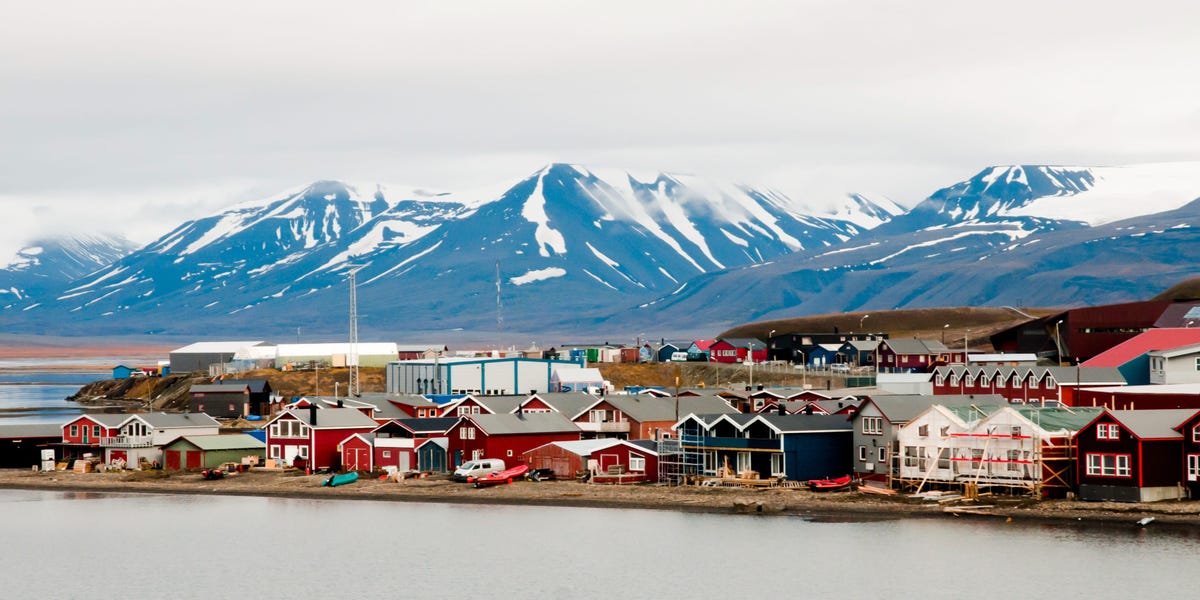
From the driest deserts to remote settlements on volcanic islands, human communities can be found anywhere on Earth.
One such community is Longyearbyen, the northernmost town in the world, where 2,400 residents live, approximately 818 miles from the North Pole.
Located in Svalbard, a Norwegian archipelago between mainland Norway and the North Pole, the town has modern amenities such as schools, restaurants, and stores.
However, it’s unlike anywhere else on Earth.
For starters, it’s dark for four months a year and perpetually light for another four months. Secondly, it’s suggested residents carry a rifle when traveling outside the town borders — in case they run into a polar bear.
See what life is like for the people who live in this town.
Welcome to Longyearbyen, the northernmost town in the world.
Longyearbyen is located in the Norwegian archipelago of Svalbard, which is a three-hour flight from Oslo and about 818 miles from the North Pole.
The town is the largest settlement in its vicinity.
While there are a couple of tiny settlements further in the north, Longyearbyen is the first of any significant size.
The town has a population of around 2,400 residents, according to Visit Svalbard.
Svalbard was founded as a hunting and fishing base.
After its discovery by Dutch explorer Willem Barents in 1596, Svalbard became a base for hunting and fishing the large fauna inhabiting the archipelago.
English, Danish, Dutch, and French companies fought over the hunting grounds, which were rich in walrus and bowhead whales. It’s estimated that the Dutch alone killed 60,000 whales between the 17th and 18th centuries.
Longyearbyen was established as a mining town.
At the turn of the 20th century, Longyearbyen was established as a coal mining town; however, mining operations have since shuttered.
Mining has been phased out of the entire area, with Svalbard’s final mine, the Norwegian-run Mine 7, closing in June 2025. The entrance to the last Norwegian coal mine in the town was permanently sealed earlier this year.
Today, the town attracts tourists and researchers.
As mining phased out, Longyearbyen has become a destination for adventurous tourists and scientific researchers. Before the COVID-19 pandemic, over 150,000 people visited Svalbard as a whole, according to 2018 data.
The town hosts the doomsday seed vault, which stores 1.4 million seed samples.
The doomsday seed vault is home to over a million plant seed samples.
The Svalbard Global Seed Vault is located 400 feet inside a mountain near Longyearbyen and is home to over 1.4 million seed samples.
Its architecture would also make it a spectacular lair for a Bond villain.
The seed vault is meant to withstand natural and man-made calamities.
Buried in permafrost, the vault is supposed to stay frozen for at least 200 years, even if the electricity fails.
It can protect the seeds from climate change, natural disasters, and wars.
This tunnel became “like a glacier” when the meltwater froze, The Guardian reported in 2017. There are five doors with coded locks that anyone trying to get into the vault must pass through.
Local populations are wary of the roaming polar bears.
Wandering polar bears pose a very real threat to the population of Longyearbyen. While the bears mainly live north of Longyearbyen on the pack ice, they can occasionally venture into town in search of food.
In 2018, a polar bear was killed on Svalbard after it attacked a cruise ship guard, the BBC reported. In 2011, a 17-year-old student from the UK was killed by an emaciated polar bear that approached a group on Spitsbergen as they camped, The Guardian reported.
Although polar bear encounters are rare, residents and visitors are instructed to carry a firearm or a “suitable means of scaring off” bears when traveling outside the town limits.
The governor of Svalbard actually has a six-page report detailing the best weapons to ward off polar bears.
The region is also vulnerable to natural threats.
Residents also have to contend with natural disasters.
Two people died in an avalanche in Longyearbyen in 2015 that destroyed 11 apartment buildings. In 2017, another avalanche caused further damage to the town.
Burials are banned, and births are nearly impossible, so the town has nearly no deaths or births.
While there is a small graveyard — the northernmost one in the world — coffin burials were banned in the 1950s after the deceased started to resurface due to melting permafrost, the Financial Times reported.
The island also lacks the facilities to care for the seriously ill or pregnant women, as the Longyearbyen Hospital lacks a maternity ward. If you’re nearing the end of life or about to give birth, you have to go back to the mainland to receive appropriate care.
Immigrants to Svalbard can skip a lot of the legal paperwork of migrating elsewhere.
Immigrants in Svalbard benefit from a unique treaty that allows them to enter the archipelago without a specific visa or work permit, as long as they can support themselves financially.
Hans-Henrik Hartmann, then head of the legal unit at the Norwegian government’s immigration department, told Al Jazeera in 2006: “If an asylum seeker is refused residence in Norway, he can settle in Svalbard so long as he can get there and is able to pay for himself.”
Recent data, however, suggest that more people leave Svalbard annually than move there, and a 2022 study reported that 64% of the town’s residents stay for less than five years.
Although the remote location poses challenges, residents can enjoy public institutions.
While the cost of living in Longyearbyen is unsurprisingly high due to its remote location, residents can benefit from the town’s institutions, such as the school, which reportedly serves around 235 pupils aged 6 to 18.
It is — also unsurprisingly — the northernmost school in the world.
Students in the region don’t get an average city education.
Students at the school won’t just learn maths and literature.
“They will learn how to behave in nature, how to behave with polar bears, how to survive in winter, how to find a safe place to camp, or how to deal with avalanches,” a teacher told The Guardian in 2007.
The town even has a free public university.
The University Centre in Svalbard (UNIS) is, you guessed it, the northernmost tertiary school in the world.
Many of the 700 students who take courses there each year don’t have to pay any tuition fees — they only pay an administration “semester fee” of 710 Norwegian Krone, which is about $75.
They are offered courses in Arctic biology, Arctic geology, Arctic geophysics, and Arctic technology.
All students must learn how to use a firearm, per Visit Svalbard.
There are plenty of activities to enjoy in the world’s northernmost town.
Aside from the Thai restaurant, residents of Longyearbyen can also pass the time in the art gallery, cinema, or museum. There are even a few pubs and a nightclub, also the northernmost in the world.
Besides, they can also explore their extreme natural surroundings.
You can have a kick about on the pack ice — just make sure to bring armed guards in case of polar bears.
Following almost four months of total darkness each year, residents celebrate the sun’s return with a Sun Festival Week.
Due to Longyearbyen’s extreme northern location, it experiences a “polar night” each year between mid-November and late January.
Besides those months of total darkness, the region’s “dark season,” when the sun remains under the horizon but might illuminate a twilight, expands from late October to mid-February.
Every year, the people of Longyearbyen celebrate the end of the dark season with the Sun Festival Week, according to Visit Svalbard. During the festival, the town gathers on the old hospital steps to celebrate the sun’s return. The saying goes that “the sun is declared back in Longyearbyen when its rays reach the steps.”
Although living in months-long darkness isn’t for everyone, it also comes with perks.
Longyearbyen is one of the best places in the world to witness the Northern Lights, also known as the aurora borealis.
The town is a great location for watching lunar events.
It was also one of the best places in the world to take in the “super blue blood moon” that occurred in 2018.
One of the most reliable methods of transportation is the snowmobile.
Many people in Longyearbyen get around by snowmobile. In Svalbard, there are more snowmobiles than people to use them (nearly 3,000 at the end of 2025), according to the Norwegian Polar Institute.
Others rely on four-legged neighbors for transportation.
Some prefer more traditional methods of travel, though. The archipelago is home to more than 1,000 polar dogs, which are basically elite athletes — sometimes running over 100 kilometers (62 miles) per day for weeks at a time, per Visit Svalbard.
Grocery shopping might look a bit different, too.
Shopping at the town’s one grocery store might be a bit of a hassle, but residents know how to get around it.
The town is also home to the world’s northernmost hotel.
Longyearbyen visitors can stay at the Radisson Blu Polar Hotel (the northernmost full-service hotel in the world, as recognized by Guinness World Records), where rooms start at around $250 per night, according to the hotel’s website in August 2026.
Read the full article here