






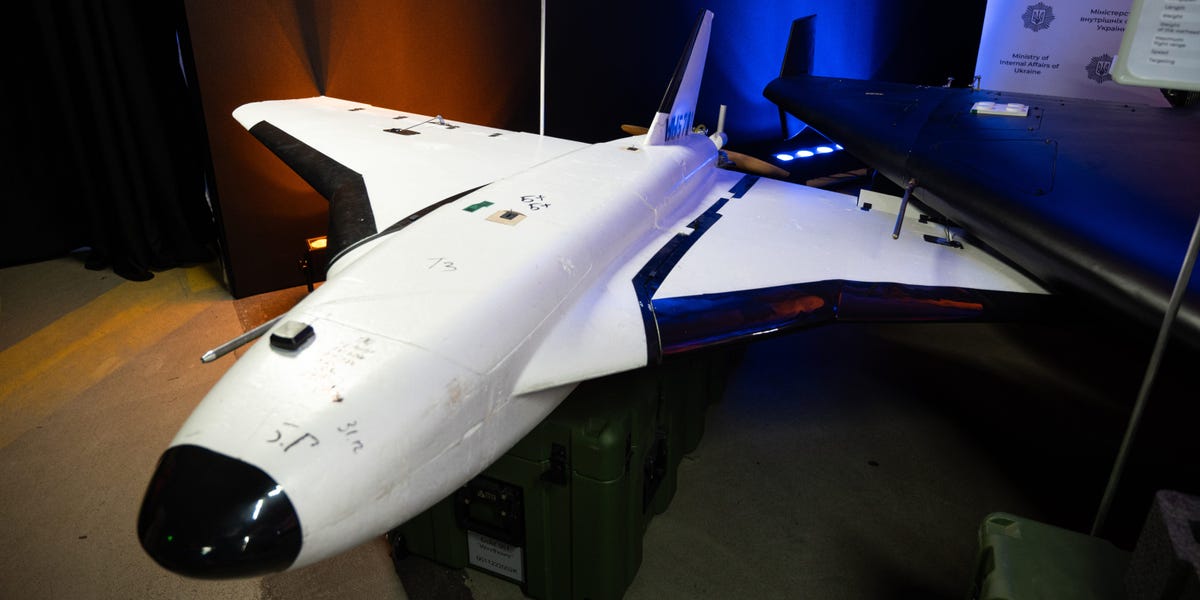
Ukrainian troops are finding advanced antennas with stronger anti-jamming features on Russian decoy drones, a sign that the Kremlin is overcoming a shortage of the key component.
Serhii “Flash” Beskrestnov, a prominent Ukrainian drone analyst, posted photos to social media on Wednesday of a downed delta-wing Gerbera drone and a 12-element Controlled Reception Pattern Antenna.
“Recently, 12-element Kometa antennas have begun to appear on the Gerberas,” wrote Beskrestnov, who is the Ukrainian defense minister’s advisor on battle drone tech.
“For me, this is a sign that the plant that produces Kometa has increased its production capacity. A year ago, there were not enough Kometas even for KABs,” he added, referring to Russian precision glide bombs. “There was a three-to-five-month queue at the plant.”
Antennas with more elements are generally more resistant to electronic warfare, one of Ukraine’s main ways to disrupt or take down incoming drones. More basic versions of the Kometa, Russia’s family of anti-jamming antennas, have four- or eight-element arrays.
That a Russian Gerbera would be equipped with a 12-element antenna is significant. Moscow typically uses Gerberas as decoys to absorb Ukrainian air defense munitions hunting down the Geran-2, Russia’s domestically produced analog of the Iranian Shahed-136 long-range attack drone.
Often made of foam or plywood, the Gerbera is more expendable than the Geran-2, which has an estimated price of between $35,000 and $80,000 each. Gerberas cost about $10,000 each to make, Ukrainian officials estimated in 2024.
Though Russia has, more recently, been seen equipping Gerberas with small warheads or using them as scouting tools, the propeller-driven drones are typically considered distractions or low-priority targets.
Beskrestnov wrote that Russia has traditionally saved heavily on costs for the Gerbera, initially launching them without jamming protection at all.
It later began fitting cheaper, Iranian four-element antennas to the drones, he added.
Russia sometimes equips its attack drones with even more advanced, 16-element antennas — including some of Chinese make — but Beskrestnov said on Wednesday that these were still being reserved for “important products.”
Earlier this month, Kyiv said it used its homegrown Flamingo missiles to strike a production facility for anti-jamming antennas, the VNIIR-Progress complex in the Russian city of Cheboksary, about 600 miles from the Ukrainian border.
The plant has regularly come under attack from long-range Ukrainian drones in the past year, with at least four separate reported strikes in 2024. The extent of any lasting damage to the facility, however, is unclear.
Read the full article here