





Russian intelligence said on Monday that it stopped two major Ukrainian drone attacks on its airfields, describing a clandestine smuggling operation involving trailers, balloons, and fixed-wing drones.
State media outlet TASS reported that the Federal Security Service, or FSB, said the targets of the Ukrainian operation were the Ukrainka military airfield in the Amur region and the Shagol airfield in Chelyabinsk.
Both airfields are hundreds of miles away from Ukrainian territory; Amur is in the Far East and borders China, while Chelyabinsk is in the Urals.
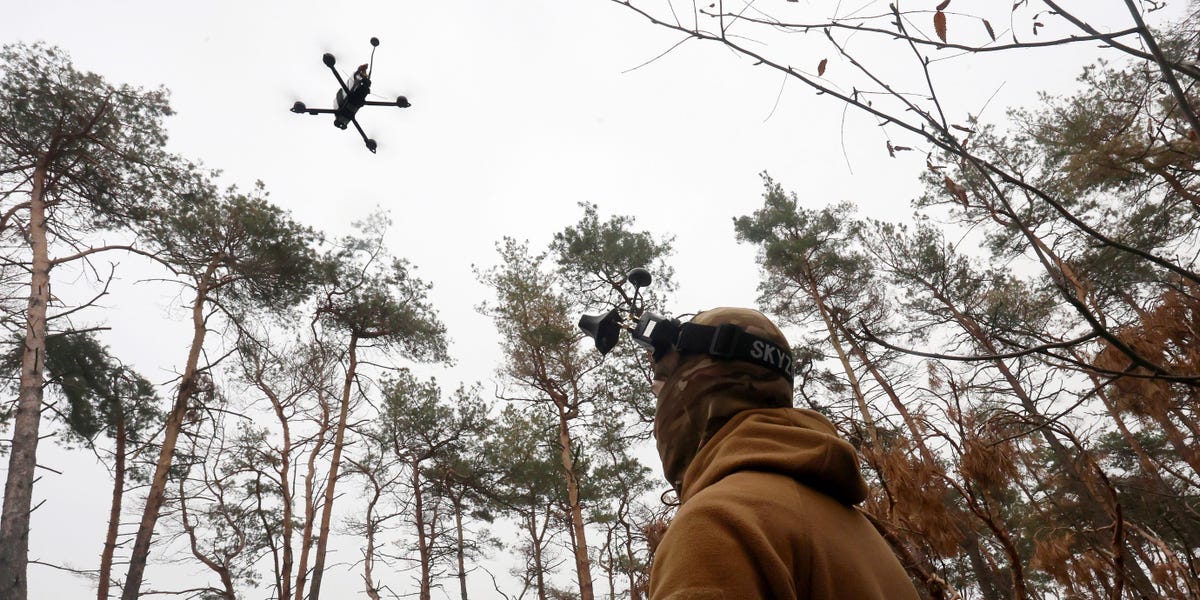
Per TASS, the FSB said the Ukrainian operation began with fixed-wing drones and balloons dropping off first-person-view attack drones in Bryansk, a region bordering Ukraine.
Russian intelligence said the smaller drones were smuggled deeper into the country via car-towed trailers with false bottoms, loaded with household appliances as a ruse.
The drones were then prepared for attack in garages near the airfields, the FSB added.
The agency told TASS that it seized two ground control stations and 24 first-person-view drones equipped with Western-manufactured “neural control modules,” which essentially provide onboard artificial intelligence.
Each attack drone was equipped with 1 kilogram of explosives, and the ground control stations were also “equipped with self-destruct devices continuing 250 grams of explosives each,” the FSB said.
TASS reported that the first-person-view drones were equipped with small fragmentation balls on their sides, as well as a mix of incendiary, anti-armor, and high-explosive payloads.
Ukraine’s GUR intelligence service and defense ministry did not immediately respond to requests for comment sent outside regular business hours by Business Insider.
The details reported by Russia echo those of Operation Spiderweb, a shock Ukrainian drone attack last June that saw Kyiv’s forces using trucks to smuggle dozens of small drones near four Russian airfields.
The strikes drew global attention for demonstrating the vulnerability of airfields to drone attacks. Ukraine said it destroyed or damaged over 40 warplanes, including Russia’s hard-to-replace strategic bombers.
Artificial intelligence has also emerged as a key feature on Ukrainian and Russian war drones. Onboard AI algorithms allow a drone to identify targets and, in some cases, decide to engage them.
When combined with the ability to guide the drone to its target, that AI could essentially form the foundation for a group of drones to operate autonomously as a swarm.
It would also allow the drone to continue attacking while its radio signal to the human operator is jammed.
The FSB referred on Monday to the Ukrainian drones as part of a plan for “swarm drone attacks.”
It also said that it confiscated communications devices used by the suspects transporting the drones to contact “Ukrainian handlers.”
Ukraine’s drone attack last year, Operation Spiderweb, involved several Russian drivers who delivered the uncrewed aircraft to the airfields. Kyiv said the drivers were unaware of the cargo they were carrying.
Read the full article here