





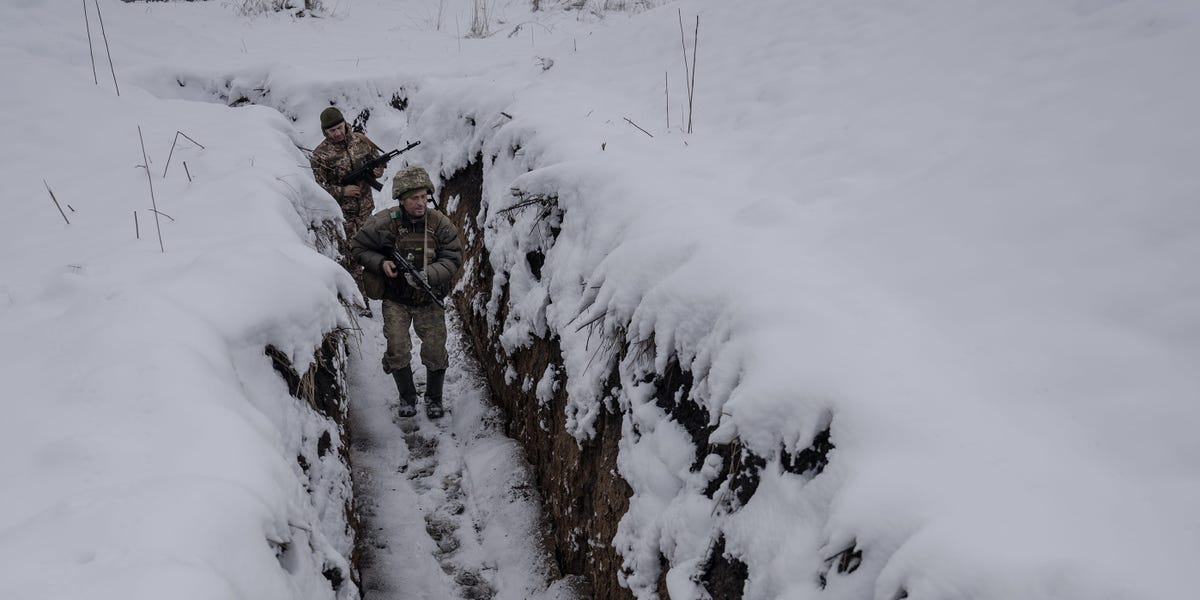
For Ukrainian infantry, surviving the dead of winter requires a delicate balance.
“It’s really, really cold in Ukraine,” said Nefor, the chief sergeant of an infantry company in Ukraine’s 3rd Army Corps. “I think, the first winter in some time with such cold weather.”
A cold snap whipped through much of Ukraine last week, delivering frigid temperatures that sank to -6°F on some nights in the northeastern region of Kharkiv, where Nefor’s corps is fighting.
Business Insider spoke to him and another Ukrainian commander, who oversees a drone company on the front lines, to discuss what it takes to hold a trench position in such weather. Trench warfare, largely glossed over in the last few decades, has seen a resurgence in interest from militaries around the world, especially those in Europe, watching Russia’s plodding invasion of Ukraine.
Staying warm without being spotted
Nefor, who spoke on the condition that he only be identified by his callsign, is in charge of assigning infantry rotations to their frontline positions.
While holding a position, a key item each soldier needs is chemical body warmers, which can be slipped under their uniforms, said Nefor.
“You put this warmer against your body, and your blood circulating is warm. It works, not bad,” Nefor said. “If you want to rest a little bit, you take a chemical warmer, a sleeping bag, and it’s faster.”
At such temperatures, frostbite can easily set in within 30 minutes, so troops constantly need the warmers, he said. One typically lasts six to eight hours, meaning a soldier needs at least three warmers per day, Nefor added.
His company experimented with electrically powered warmers. But they come with a risk — anyone who gets too warm would be more easily spotted by thermal optics, especially since their surroundings are much colder than usual.
Chemical warmers, conversely, emit such small heat signatures that light drones won’t be able to spot them, Nefor said.
“It’s possible to see if the Russian guy has a ‘teplevizor’ on his weapon, but it’s a very small signature,” the sergeant said, referring to thermal imagery attachments for small arms.
Serhii Andrieiev, a senior lieutenant who is second-in-command of the “Kraken” drone company in the 3rd Army Corps, said his pilots prioritize camouflage for their nests during the winter. In the colder seasons, there is less forest foliage to provide visual cover.
The heat signature from the motors on their drones is easier to spot, and only “very happy drone operators” have the luxury of stationing in a building along the Kharkiv frontline, Andrieiev said.
“In most cases, it’s a big foxhole, or a cellar in a destroyed building,” the deputy commander said.
Appliances such as electric warmers also soak up significant energy and require a power source in the trenches.
Nefor said his company deploys roughly 20 EcoFlow portable batteries, but there aren’t enough to cover all its frontline positions. The batteries are also needed to power screens and radios, he added.
Almost all soldiers instead carry personal power banks to keep their devices charged. “It’s the power bank you buy at the shop,” Nefor said. “Power banks with Type-C or USB ports.”
‘If you are not dry, you die’
Cold temperatures can grow even more dangerous when they alternate between above and below freezing. Clothes, especially in humid areas, can absorb thawed water that can then freeze again, increasing the risk of hypothermia.
“If you are not dry, you die,” Nefor said. “We have this saying.”
Clothing that gets wet in the winter stays wet, so troops who need dry layers have to request new ones from their commanders.
Uncrewed ground vehicles have recently been a major boon for Nefor’s company in this regard, freeing up human soldiers by carrying weeks’ worth of ammunition, clothing, and other supplies such as food, water, and chemical warmers to the trenches.
Firearms and ammunition can become waterlogged as well. Nefor said that his troops, worried that their weapons would freeze up, apply a lubricating concoction to their rifles that mostly includes vehicle oil and sometimes a small amount of antifreeze.
“You need to make one, two shots with your weapon to make it warmer, then you add it,” Nefor said.
Both commanders said the deep winter adds to the mental toll on Ukraine’s already-beset troops, who are often short on reinforcements and the grinding nature of the war.
Nefor’s company sends smaller groups of two or three soldiers — no more than four — to each position to avoid detection from Russian drones. Each soldier takes turns for several hours in the trenches between watch positions, which are typically colder, and warmer resting locations.
Andrieiev said that if he had more drone pilots, he could rotate them out of the front lines every four or five days. His teams instead spend two to three weeks at a time in the forests.
“It’s exhausting to spend all that time in freezing temperatures. Even if you have heaters with you,” Andrieiev said.
Troops need more fuel and more clothes to perform their duties, he said. A task as simple as using an improvised bathroom in the trenches is stressful, with the soldier under threat from Russian drones while wearing multiple layers, body armor, and carrying their military gear.
The Russian assaults they have to fight off, meanwhile, stay just as frequent and intense during cold weeks, Andrieiev said.
“It doesn’t matter what the weather is. They come at us like zombies, two or three guys at a time in the middle of the frozen field,” he said.
Read the full article here