





During a Tuesday morning press briefing, Pentagon leaders fielded an out-of-the-ordinary query from a reporter seeking clarity on reports of Iran’s military using “kamikaze dolphins.”
“I haven’t heard the kamikaze dolphin thing,” Gen. Dan Caine, Chairman of the Joint Chiefs of Staff, replied, wondering aloud if the idea was similar to “sharks with laser beams,” a wry reference to the early-aughts’ Austin Powers movies.
“I can’t confirm or deny whether we have kamikaze dolphins,” Secretary of Defense Pete Hegseth added. “But I can confirm they don’t,” he said, referring to the Iranians.
Following a Wall Street Journal report late last month that mentioned an Iranian threat to use a range of capabilities from submarines to mine-carrying dolphins against US warships, discussions of one-way attack dolphins have been circulating online.
Rumors of Iranian “kamikaze dolphins” have been around for over two decades, stemming from reports that Tehran had bought dolphins that had been trained to attack ships and combat divers for the Soviet navy.
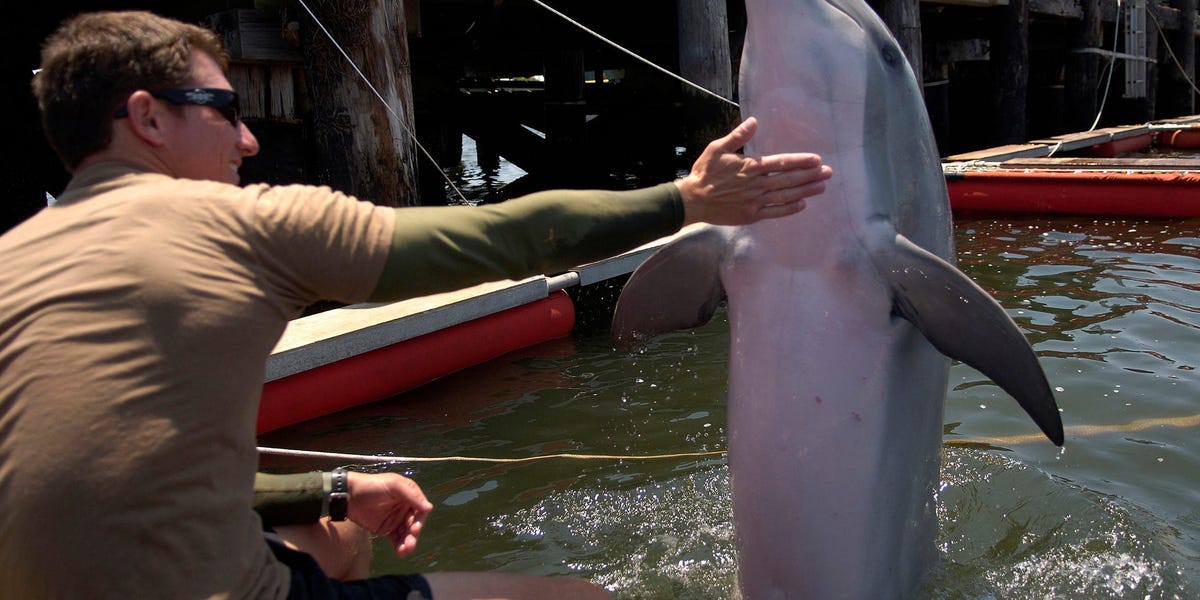
While the Iranian armed forces may not have dolphins in their arsenal of combat capabilities, the US military has a long history with marine mammals, which are well-suited for tasks like locating underwater mines or alerting handlers to enemy swimmers. Dolphins are exceptionally intelligent animals, with a keen internal sonar system that makes them excellent mammalian sensors.
The US has trained bottlenose dolphins to carry out a range of military tasks, from mine detection to harbor defense, and has been using them in a mix of missions since the late 1950s.
A handful of these dolphins, for instance, were used briefly in the early 1970s to guard an Army pier in Vietnam, and others were deployed from a US base in Bahrain during the Tanker War in the 1980s to help protect US Navy vessels.
The 1996 Republican National Convention in San Diego used dolphins for maritime protection, and then they saw service again seven years later in the Persian Gulf clearing mines for US forces before the invasion of Iraq.
In 2015, the Navy’s Marine Mammal Program at the Space and Naval Warfare Systems Command in San Diego, California, told Business Insider that the program oversaw training for 85 dolphins and 50 sea lions. It’s unclear how many are part of the program today.
While the US military has widely acknowledged the value of dolphins as a military working animal for key detection and protection missions, the Navy has challenged reports stating that dolphins have been trained to kill enemy swimmers.
A 1990 New York Times article regarding the US Navy’s decision to halt part of its dolphin program at the time cited former trainers who said that some mammals were being trained to kill with nose-mounted guns and explosives. A Navy spokesperson said at that time that dolphins were only used for surveillance, detecting objects, location, marking, and recovery.
“We don’t train animals to kill people,” the spokesperson said.
There have been other such assertions since the Times article. Famous ocean explorer Robert Ballard, who found the Titanic, wrote in his 2021 memoir that he was approached about “training dolphins to kill enemy divers in Vietnam.” He said that he declined because “it didn’t feel right to put the animals in that position.”
And a former special operator told Business Insider in 2023 that dolphins have played defense against forces like the Navy SEALs in training, attempting to “kill” or capture the “enemy” combat swimmers, preparing them for a potential encounter with an adversary dolphin or other militarized animal.
In 2022, the Navy considered shuttering the Marine Mammal Systems program and ending the mission of using dolphins and sea lions to help find and neutralize underwater mines, with plans to instead rely increasingly on advanced sensors and underwater vehicles.
However, it was determined that the technology had not yet advanced beyond the dolphins’ capabilities. The Navy program is still active today, focused on detection and overseen by the Reconnaissance and Interdiction Division of Naval Information Warfare Center Pacific.
Read the full article here