





Nonfarm Payrolls (NFP) in the United States (US) rose by 115K in April, the US Bureau of Labor Statistics (BLS) reported on Friday. This print followed the 185K increase (revised from 178K) recorded in March and surpassed the market expectation of 62K by a wide margin.
Other details of the report showed that the Unemployment Rate remained unchanged at 4.3% as expected, while the Labor Force Participation Rate edged lower to 61.8% from 61.9%. Finally, annual wage inflation, as measured by the change in the Average Hourly Earnings, rose to 3.6% from 3.4% in March but came in below analysts’ estimate of 3.8%.
“The change in total nonfarm payroll employment for February was revised down by 23,000, from -133,000 to -156,000, and the change for March was revised up by 7,000, from +178,000 to +185,000,” the BLS noted in its press release. “With these revisions, employment in February and March combined is 16,000 lower than previously reported.”
Market reaction to US Nonfarm Payrolls
The US Dollar struggles to attract buyers despite the upbeat employment data. At the time of press, the US Dollar Index was down 0.4% on the day at 97.88.
US Dollar Price Today
The table below shows the percentage change of US Dollar (USD) against listed major currencies today. US Dollar was the weakest against the Australian Dollar.
| USD | EUR | GBP | JPY | CAD | AUD | NZD | CHF | |
|---|---|---|---|---|---|---|---|---|
| USD | -0.44% | -0.49% | -0.23% | 0.09% | -0.52% | -0.49% | -0.41% | |
| EUR | 0.44% | -0.08% | 0.18% | 0.51% | -0.09% | -0.02% | 0.04% | |
| GBP | 0.49% | 0.08% | 0.28% | 0.59% | -0.02% | 0.06% | 0.11% | |
| JPY | 0.23% | -0.18% | -0.28% | 0.33% | -0.31% | -0.24% | -0.17% | |
| CAD | -0.09% | -0.51% | -0.59% | -0.33% | -0.64% | -0.57% | -0.49% | |
| AUD | 0.52% | 0.09% | 0.02% | 0.31% | 0.64% | 0.07% | 0.13% | |
| NZD | 0.49% | 0.02% | -0.06% | 0.24% | 0.57% | -0.07% | 0.06% | |
| CHF | 0.41% | -0.04% | -0.11% | 0.17% | 0.49% | -0.13% | -0.06% |
The heat map shows percentage changes of major currencies against each other. The base currency is picked from the left column, while the quote currency is picked from the top row. For example, if you pick the US Dollar from the left column and move along the horizontal line to the Japanese Yen, the percentage change displayed in the box will represent USD (base)/JPY (quote).
This section below was published as a preview of the US Nonfarm Payrolls data at 04:00 GMT.
- Nonfarm Payrolls are expected to rise by 62K in April.
- The Unemployment Rate is seen holding steady at 4.3%.
- The USD is set to experience heightened volatility heading into the weekend.
The United States (US) Bureau of Labor Statistics (BLS) will release the Nonfarm Payrolls (NFP) data for April on Friday at 12:30 GMT.
Investors will scrutinize the underlying details of the employment report to assess whether the Federal Reserve (Fed) is likely to consider an interest-rate cut later in the year.
What to expect from the next Nonfarm Payrolls report?
Investors expect NFP to rise by 62K following the surprisingly strong 178K increase recorded in March. The Unemployment Rate is expected to remain unchanged at 4.3%, while the annual wage inflation, as measured by the change in the Average Hourly Earnings, is projected to rise to 3.8% from 3.5%.
Previewing the employment report, TD Securities analysts note that they expect to see signs of stabilization in the labor market after three volatile months.
“NFP likely increased 80K, with 85K private gains and 5K government job losses. Healthcare and leisure & hospitality will likely support most of the improvement. The Unemployment Rate rate should continue showing stabilization at 4.3%. We also expect Average Hourly Earnings to stay modest at 0.2% m/m, with the y/y moving up to 3.7%,” they add.
Automatic Data Processing (ADP) reported earlier in the week that employment in the private sector rose by 109K in April. This print followed the 61K (revised from 62K) increase reported in March. Assessing the report’s findings, “small and large employers are hiring, but we’re seeing softness in the middle,” said Dr. Nela Richardson, chief economist at ADP. Meanwhile, the Employment Index of the Institute for Supply Management’s (ISM) Services Purchasing Managers’ Index (PMI) survey improved to 48 in April from 45.2 in March, reflecting an ongoing contraction in the service sector payrolls, albeit at a softening pace.
Economic Indicator
Unemployment Rate
The Unemployment Rate, released by the US Bureau of Labor Statistics (BLS), is the percentage of the total civilian labor force that is not in paid employment but is actively seeking employment. The rate is usually higher in recessionary economies compared to economies that are growing. Generally, a decrease in the Unemployment Rate is seen as bullish for the US Dollar (USD), while an increase is seen as bearish. That said, the number by itself usually can’t determine the direction of the next market move, as this will also depend on the headline Nonfarm Payroll reading, and the other data in the BLS report.
Read more.
Next release:
Fri May 08, 2026 12:30
Frequency:
Monthly
Consensus:
4.3%
Previous:
4.3%
Source:
How will the US March Nonfarm Payrolls affect EUR/USD?
The US Dollar (USD) has been struggling to stay resilient against its rivals since the beginning of May, even though the Federal Reserve’s (Fed) April policy meeting delivered a hawkish surprise, with three policymakers dissenting against the inclusion of an easing bias within the policy statement. Improving risk mood on easing geopolitical tensions in the Middle East and suspected foreign exchange market interventions by Japan emerge as primary drivers behind the USD weakness.
In the post-meeting press conference, Fed Chair Jerome Powell acknowledged that the labor demand has clearly softened but refrained from steering away from a neutral guidance because of inflation risks. “Policy is not a preset course,” Powell added, and reiterated that they are in a good place to move in either direction. In the meantime, Chicago Fed President Austan Goolsbee argued that gains in payrolls are not a good measure of labor slack anymore and noted that the labor market is “stable but not great.”
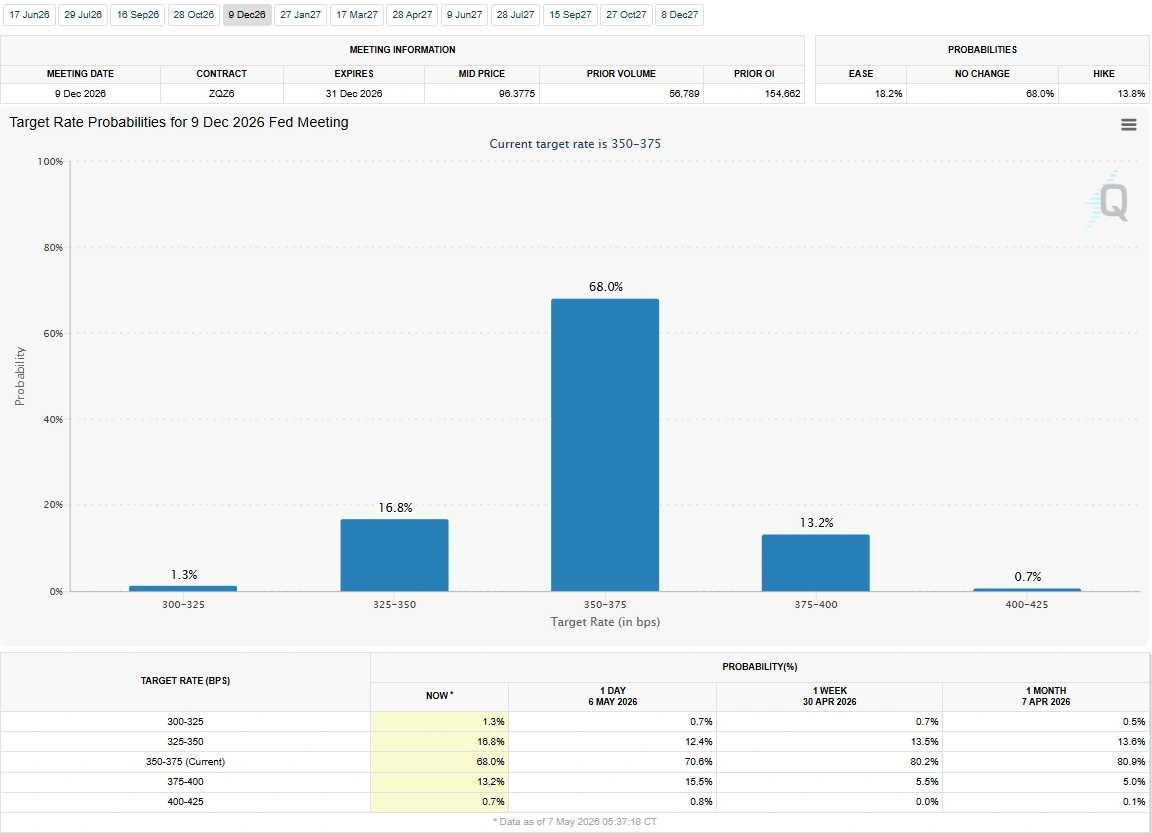
According to the CME FedWatch Tool, markets are currently pricing in about a 70% probability that the Fed policy rate will remain unchanged at the range of 3.5%-3.75% by the end of 2026. They also see a 13% chance of a 25 basis points (bps) hike and a nearly 17% odds of a 25 bps cut.

A significant negative surprise, a reading below 30K, in the headline NFP print, especially if combined with an uptick in the Unemployment Rate, could revive expectations for an interest rate cut by year-end and cause the USD to come under selling pressure with the immediate reaction.
Conversely, an upbeat NFP print, near or above the market expectation, could cause investors to refrain from pricing in policy easing later this year, as healthy labor market conditions are likely to allow Fed policymakers to take their time to assess the inflation dynamics before deciding on the next step. In this scenario, the USD could stay resilient against its peers and limit EUR/USD’s upside. However, even in this case, a strong USD rally could be hard to come by if markets remain risk-positive heading into the weekend.
Eren Sengezer, European Session Lead Analyst at FXStreet, offers a brief technical outlook for EUR/USD:
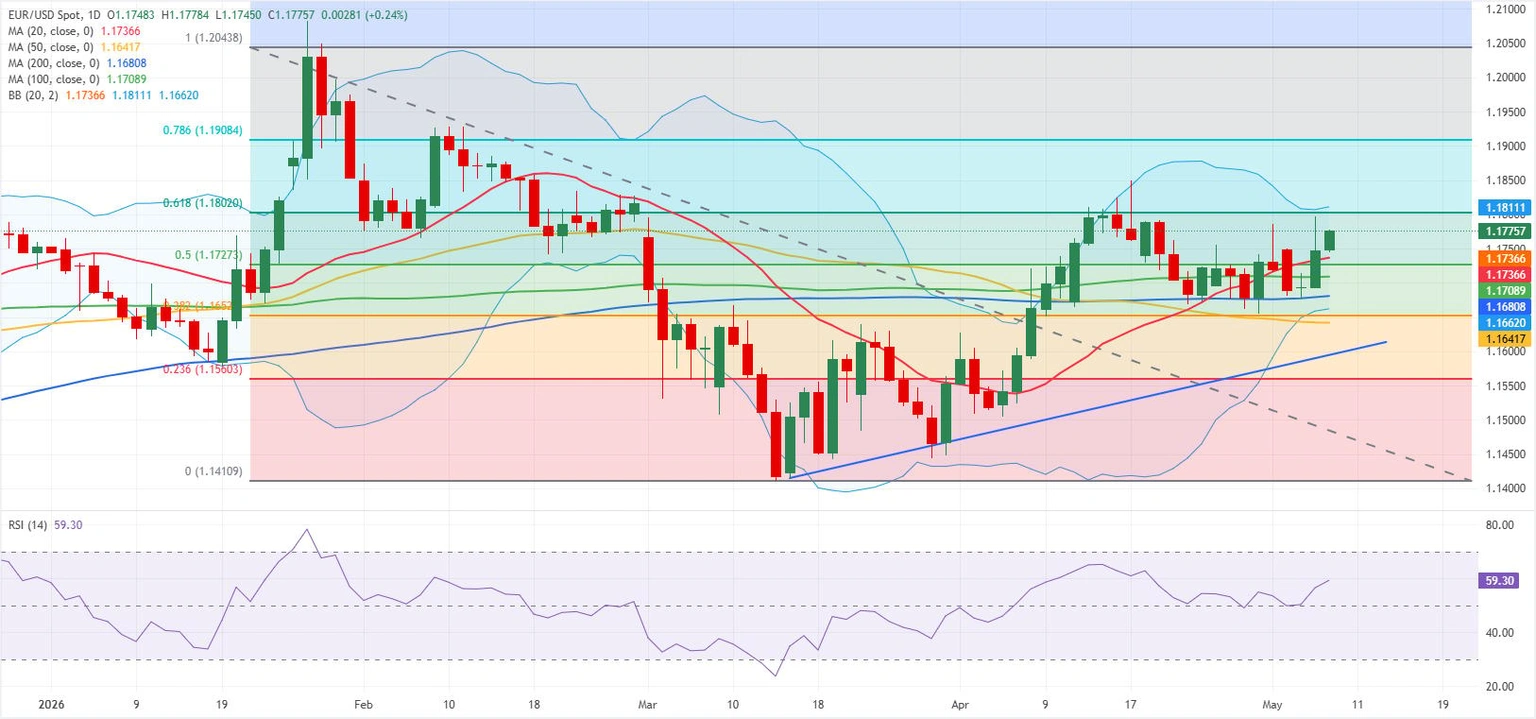
“EUR/USD’s near-term technical outlook points to a bullish tilt. The Relative Strength Index (RSI) indicator on the daily chart rises toward 60 and the pair holds comfortably above the 100-day and the 200-day Simple Moving Averages (SMA).”
“EUR/USD could face the next strong resistance area at 1.1800-1.1810, where the upper hand of the Bollinger Band and the Fibonacci 61.8% retracement of the February-April downtrend align. If the pair manages to clear this level, 1.1900-1.1910 (round level, Fibonacci 78.6% retracement) could be seen as the next hurdle before 1.2000 (psychological level, round level).”
“On the downside, an important support area seems to have formed at 1.1710-1.1680 (100-day SMA, 200-day SMA). In case EUR/USD retreats below this region and starts using it as resistance, 1.1650 (Fibonacci 38.2% retracement) could act as an interim support level before 1.1560 (Fibonacci 23.6% retracement).”

Employment FAQs
Labor market conditions are a key element to assess the health of an economy and thus a key driver for currency valuation. High employment, or low unemployment, has positive implications for consumer spending and thus economic growth, boosting the value of the local currency. Moreover, a very tight labor market – a situation in which there is a shortage of workers to fill open positions – can also have implications on inflation levels and thus monetary policy as low labor supply and high demand leads to higher wages.
The pace at which salaries are growing in an economy is key for policymakers. High wage growth means that households have more money to spend, usually leading to price increases in consumer goods. In contrast to more volatile sources of inflation such as energy prices, wage growth is seen as a key component of underlying and persisting inflation as salary increases are unlikely to be undone. Central banks around the world pay close attention to wage growth data when deciding on monetary policy.
The weight that each central bank assigns to labor market conditions depends on its objectives. Some central banks explicitly have mandates related to the labor market beyond controlling inflation levels. The US Federal Reserve (Fed), for example, has the dual mandate of promoting maximum employment and stable prices. Meanwhile, the European Central Bank’s (ECB) sole mandate is to keep inflation under control. Still, and despite whatever mandates they have, labor market conditions are an important factor for policymakers given its significance as a gauge of the health of the economy and their direct relationship to inflation.
Read the full article here