




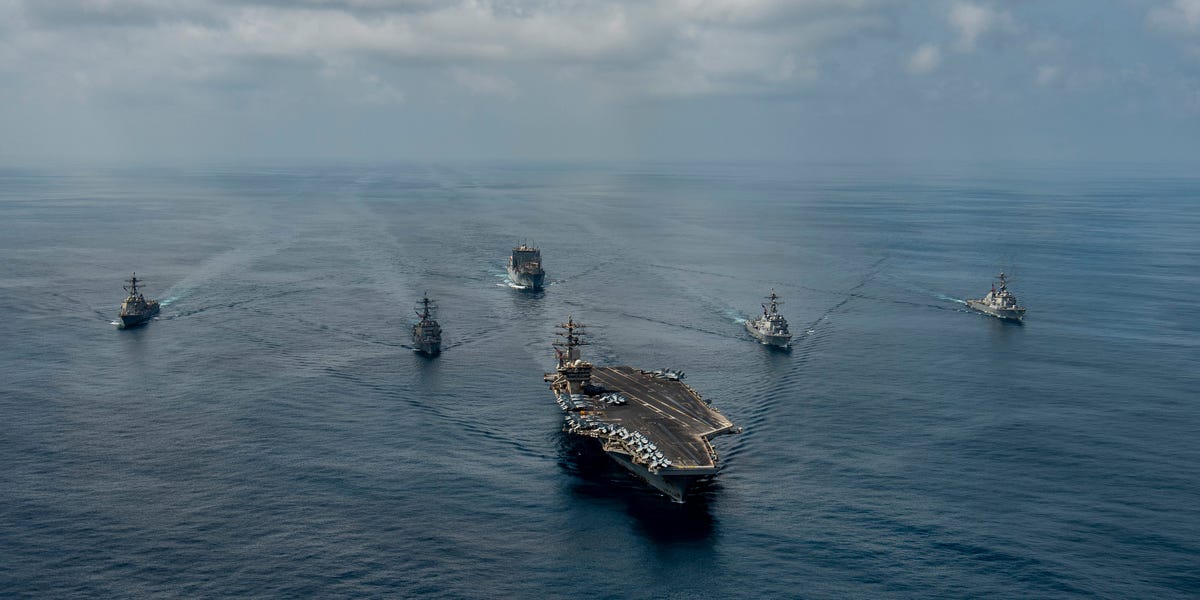
The US Navy faces a number of challenges in its goal of growing the fleet. None are easily or quickly solvable.
A new report from naval and defense policy experts assesses that a number of actions are urgently needed across shipbuilders and the government to fix the Navy’s delays and cost overruns, especially as China’s fleet surpasses the US’ in size and adopts new technologies to become a dominant naval power.
Many of the Navy’s problems, including retiring more ships than it is building, a slowed and expensive shipbuilding process with only a handful of commercial shipyards, and program mismanagement, trace back to the end of the Cold War. They’ve gotten worse in the decades since and are reaching a boiling point as the US military attempts to focus on countering China’s military rise.
“Despite the Navy’s plans for growing the fleet and bipartisan efforts and funding from Congress, the US shipbuilding enterprise — including the Navy, Department of Defense, Congress, and industry — has failed to consistently produce ships at the scale, speed, and cost demanded,” authors of the Center for Strategic and International Studies think tank, or CSIS, report wrote.
Among the failed projects: Two types of littoral combat ships, an advanced stealth destroyer the service will only have three of, and the newly canceled Constellation-class frigate.
No one entity, incident, or program is solely to blame. Washington’s demand signal for building new vessels has been inconsistent, leaving shipbuilders unable to plan long-term projects. And the Navy’s requirement process and ship designs have sometimes resulted in vessels not meeting expectations, being delayed by years, and coming in far over budget.
Right now, Navy Secretary John Phelan, officials in DoD, and shipyards are focused on fixing these problems and avoiding the same mistakes in the future. Shipbuilding is a top priority, and it’s gotten a lot of attention throughout the first year of the second Trump administration.
But, per the report, there is no single solution to arrest the decline in American shipbuilding, “and resolving any one of the underlying issues does not guarantee a drastic improvement of the situation.” Instead, the Navy, Congress, and shipyards will have to find the right way forward through years of work.
The Navy’s battle force, including surface ships, submarines, and aircraft carriers, peaked during the build-up in the second Reagan administration at 568. After the Cold War, the number dwindled, as the US focused on land wars in Iraq and Afghanistan; the fleet hit its low point of 271 in 2015. A year later, the Navy released plans of a 355-ship goal, which increased in 2023 under the Biden administration to 381 and 134 large uncrewed surface and underwater vehicles.
These goals have proven unreachable without an effective small warship whose price tag is well below $13 billion Ford-class aircraft carriers and $2 billion guided-missile destroyers.
Compared to the US, China has amassed a huge fleet over the last 25 years. Thanks to its state-owned shipbuilders and dual-use commercial and military shipyards, equipment, and workforce, China’s fleet reached a height of an estimated 370 battle force ships last year. China’s naval growth has alarmed officials even if they are not all a match for the US’ highly advanced, well-built vessels and weapons.
Navy officials have increasingly looked at uncrewed vessels to rapidly add new capabilities to the fleet. A mix of large, medium, and small drone boats would be useful for a number of intelligence, surveillance, and reconnaissance missions, and could expand the Navy’s reach in regions like the Indo-Pacific while keeping sailors out of harm’s way. Companies can build these autonomous vessels fast but questions remain on how effective drone ships are; the few operational drone boats today largely act as surveillance vessels. It’s still a relatively new field, but it could present short-term answers to fleet problems by reducing the demand for crewed ships.
The Navy’s current fleet has also seen a higher tempo of operations, putting “greater stress on the fleet and its crews as a smaller number of ships must deploy more regularly to mission demands, thereby increasing the need for greater maintenance and sustainment,” the CSIS report noted.
Earlier this year, then-acting Chief of Naval Operations Adm. James Kilby said the Navy was clocking in at a 68% readiness rate for surface ships and 67% for submarines, while aviation stands at 70%. The service aims for 80% by 2027.
Part of the disparity stems from ship maintenance delays. The US’s current capacity to keep its fleet running has been strained across shipyards, resulting in repairs often taking 20% to 100% longer than estimated, according to a new Congressional Budget Office analysis. There are many causes for that: the average age of the Navy’s ships is older than it used to be and require more work and the scope of maintenance is often larger than anticipated.
Keeping older vessels ready is one challenge but the Navy’s goals of building new ones has continued to face hurdles with increased construction times, holdups across major programs, and cost overruns. In a US Government Accountability Office report earlier this year, the government watchdog agency assessed that 37 of the 45 battle force ships under construction were delayed as of fall 2024.
That’s been blamed on several things, including the Navy’s focus on price in contracting rather than speed, rising prices for ships due to purchasing fewer hulls, and changes to ship designs and capabilities during construction. The recently cancelled Constellation-class frigate is a prime example of how design changes can doom a program by causing delays and soaring costs. The frigate was originally supposed to have 80% commonality with its Italian navy version but only ended up with 15%.
On the industry side, the shipbuilding sector has shrunk and largely serves to build ships for the Navy and Coast Guard and a few merchant ships; most commercial shipbuilding has shifted to countries like Japan, South Korea, and China, where they are cheaper to build.
Washington, the Navy, and shipbuilders are pursuing several avenues to address these problems. Billions are being invested in the industrial base, with a major focus on submarines, and broader initiatives are focused on training the next generation of workers. Modernization efforts in shipyards, including automation, artificial intelligence, and robotics, are a priority as well to drive down costs.
Given the vast lead and advantages of competitors like South Korea and China, it’s these could drive down ship production costs. But they are unlikely to revitalize a commercial ship industry that can be converted to war-time use, as occurred in World War II.
But the issues afflicting American shipbuilding are complex. “There is no single policy solution to solve the overall problem,” CSIS authors wrote, “Moreover, resolving any of the underlying issues does not guarantee a drastic improvement of the situation.”
In its conclusion, the report suggests that continuous production of Navy vessels based on multi-year contracting would stabilize projects, budgets, and the workforce.
Another solution could involve more cooperation with US partners and allies, something Washington is already pursuing. South Korean shipyards, some of the most advanced and busiest in the world, are conducting more maintenance on US Navy vessels and major partnerships between these yards and the US are aimed at modernizing American shipbuilding processes and workflows.
Read the full article here