





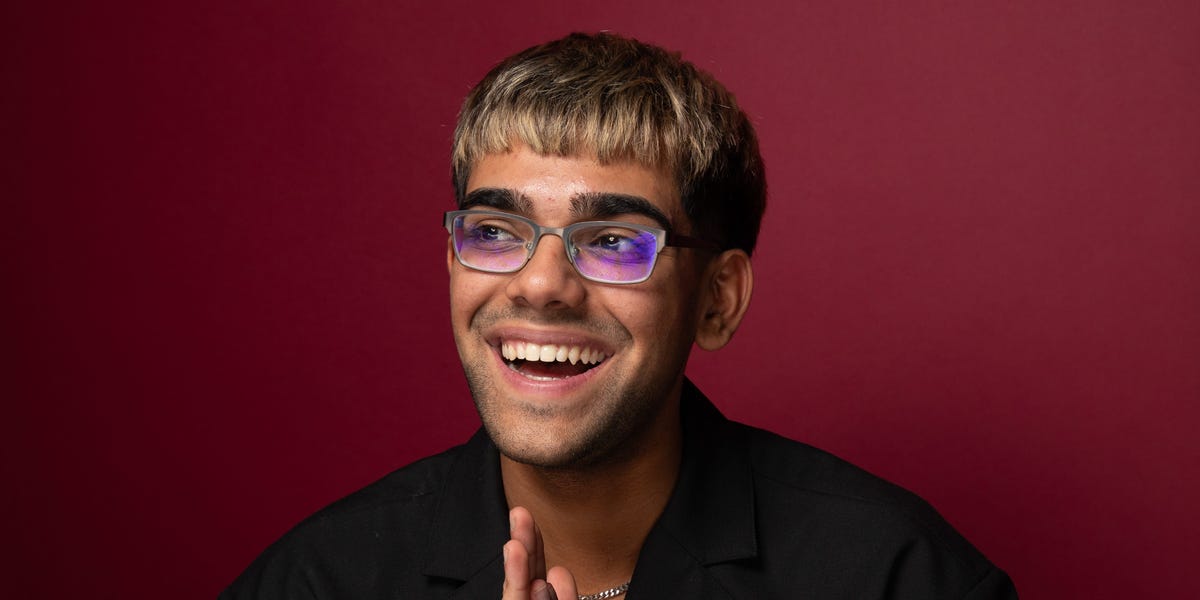
N3on couldn’t believe it.
The famous livestreamer was in Cancún filming himself shopping for jewelry when he realized he’d paid $200 more than he thought. He returned to the store to find it closed.
“Bro, I just got scammed,” he cried out to the fans watching his stream.
In reality, it was a good day. The moment turned into internet gold, with clips of his wide-eyed reaction going viral on social media. Could scam clips be his new thing?
These kinds of episodes have propelled the 21-year-old from a kid gaming in his bedroom to a top livestreamer known for unpolished and dramatic entertainment.
His primary home is Kick, where he streams — often upwards of four hours a day — to some 500,000 followers and is one of its top 10 stars.
N3on said in an interview with Business Insider that he can make several hundred thousand dollars a month from Kick. Some of that revenue comes from the Kick Partner Program, the streamer’s direct-payment effort, which he said pays him up to $3,000 an hour depending on how big and actively engaged his audience is. (Kick said it wouldn’t confirm individual streamers’ financials, and N3on’s team declined to provide supporting documentation.)
He is also paid by Gamdom, an online crypto casino, to help grow the platform, and has struck deals with brands like Telegram and Ch@mobile, a mobile platform geared toward creators.
N3on, whose real name is Rangesh Mutama, is part of a larger group of livestreamers who have gained mainstream attention in recent months. They include the left-wing political influencer Hasan Piker, controversial looksmaxxer Clavicular, and the high-energy streamer Speed, whose trip to China went viral.
Streamers, like podcasters, have been boosted by the rise of “clipping,” where people are paid to post grabby moments from longer videos on social media. Clips of streamers have proliferated on short-form video platforms like TikTok, YouTube shorts, and Instagram reels. Clipping has helped catapult streamers like Mutama into the public discourse, but it can be a huge expense. In a recent five-week period, Mutama paid out over $1.4 million to 303 clippers, according to a document his team shared.
Mutama’s level of success and his audience’s interest in his life have surprised even him.
“They want to tell me what haircut to do,” he said. “They want to see me evolve, like, telling me what clothes to wear, what girl to talk to. I don’t know why people like watching me. At first, I understood because it was a nerd thing. They wanted to see me out and about. But now, my numbers are better than ever.”
Still, his success has come at a cost — and he said he’s trying to moderate his on-camera behavior. Antics like picking fights in public and faking his own death led one YouTuber to label Mutama “The Most Hated Kid On The Internet” for being a “toxic troll.”
“I would do whatever it took to get a view — like, literally, absolutely anything,” Mutama said of his earlier content. “But it’s not genuinely what I wanted to do deep inside. It didn’t make me feel good.”
Controversy as a business model
Mutama was born in Houston to strict, Indian and Pakistani parents. Afflicted by a stomach disease, he spent much of his childhood in and out of hospitals, completing schoolwork online. Cooped up at home, he started playing video games and making YouTube tutorial videos at age 11, sharing a PS4 with his younger brother.
Lacking confidence, Mutama was eventually encouraged to stream in public by the livestreamer Adin Ross. He grew an audience on the Amazon-owned livestreaming platform Twitch before moving to Kick, which he said offered him better financial terms.
Australia-based Kick, founded in 2022 by the owners of the crypto gambling site Stake.com, has become a haven for controversial streamers. It has a 95/5 subscription revenue split with creators, compared to rival Twitch’s default 50/50 split, and also pays certain streamers directly based on viewership and other factors. Kick has lighter content moderation policies than Twitch, which can appeal to creators who like to push boundaries.
To gain views and momentum, Mutama adopted a highly controversial, negative persona.
He used scripted acts and even paid clippers to post bad PR about him just to keep his name relevant. He was temporarily suspended from Kick after a fight broke out on his stream. He was also once arrested in Dubai for filming in a restricted area and spent almost two days in jail.
From IRL streaming to viral clips
Like many top streamers, Mutama has an army of “clippers” posting viral moments on social media. An hours-long stream might only get 40,000 live viewers, while a successful clip can reach 50 million views, leading to partnerships with brands and collaborations with celebrities. Mutama has streamed with athletes like Dennis Rodman and recently appeared on the popular radio show and podcast “The Breakfast Club.”
Mutama prides himself on his clipping operation, which he said consists of a network of about 1,000 people. He estimated that about half belong to a group he and Ross built, spanning from India to Nigeria, and said the rest are paid by Kick.
Mutama said clipping is one of his biggest expenses. He pays on the higher end of the market — $40 per 100,000 views, or $50 if he especially wants to incentivize them. In any given month, he estimated that he’s paying at least one streamer upwards of $100,000.
“I feel like my life is clipping now,” he said.
The clipping economy favors entertaining and inflammatory moments, said Mustafa Aijaz, VP at SoaR Gaming, a digital entertainment company and creative agency. “A lot of it is staged. Audiences will call it out as clip farming. But people will still watch it.”
Once, a stream Mutama and former rapper Iggy Azalea did from a yacht ran into technical problems and didn’t perform well. It still became one of his most-viewed clips.
“The clippers made it seem like it was this insane, crazy stream,” Mutama said. “No one actually watched the stream. They just saw the clips, and they’re like, ‘Wow, N3on and Iggy had a great time on this yacht.'”
Mutama says he wants to move past his negative image
Making a lot of money at an early age came with challenges.
Living in Los Angeles, Mutama said he blew his early earnings, renting three sports cars a day and houses for upwards of $2,000 a night. His dad, who had a business background, stepped in and now controls his money, putting it in areas like real estate.
“My dad handles everything,” he said. “If I overspend, my dad calls me out.”
Mutama said he employs about 10 people, including moderators, editors, and security personnel.
He readily says chasing success led him to engage in obnoxious behavior. Some streamers won’t work with him because of his past antics and because of the stigma Kick carries among some in the industry.
Mutama has adopted a more positive persona over the past year. He’s focused on streaming with NBA and NFL players, living out his childhood love of sports. He talks about being a devout Muslim.
He said he realized his toxic persona was making him unhappy. He’s also trying to do more deals with brands, many of whom are wary of associating with risky content.
Mutama said shifting away from more provocative stunts cost him some viewership initially. He added that he still feels pressure from audiences and platforms to do “crazier and crazier things.”
“There is pressure on you,” he said of streaming. “You’re like, dry for a week, you’re like, what can I do to get it back?”
Extreme content ‘gets views’
Mutama could potentially gain a lot from brand deals if he mellows out. However, it’s an open question whether he can satisfy brands without sacrificing viewers.
Ryan Morrison, the CEO of esports-focused Evolved Talent Agency, whose clients include the prominent Kick streamer xQc, said the top livestreamers seem to have gotten edgier in their content over time, not less so.
“People get pushed to extremes because that’s what gets views,” Morrison said.
Mutama also continues to keep company with controversial streamers. He’s livestreamed with Clavicular, and remains tight with Ross, who has buddied up with self-described misogynist Andrew Tate and streamed with far-right personality Nick Fuentes.
Mutama is unapologetic about his friendship with Ross, saying he was the only person who helped him out at one point when he had stopped streaming and lost all his money trading stocks.
“Whatever he says that’s controversial, I don’t care,” he said of Ross. “He’s the only person who put me in the position to succeed and believed in me. No matter how much people hate him, no matter how many dumb comments he makes, that’s still my friend. He’ll always be my brother.”
Mutama said he believes he can maintain an audience without engaging in outrageous or scripted behavior. A clip of Mutama circulated in March that showed him appearing to be arrested in Chicago. Some commenters speculated it was staged. He insisted the clip was real, saying he was detained by private security but not actually arrested.
“You can still succeed without doing crazy stuff,” he said. “I used to script things — I don’t anymore.”
Mutama said he knows streaming won’t last forever.
He wants to transition to long-form YouTube content, which is both more brand-friendly and less all-consuming. He’s exploring product lines and even the idea of a movie based on his life.
“I’ve had so many eras online, made so many mistakes,” he said. “Now I’m on a good path, thank God. So seeing people change their perspective on me — that’s success.”
Read the full article here