




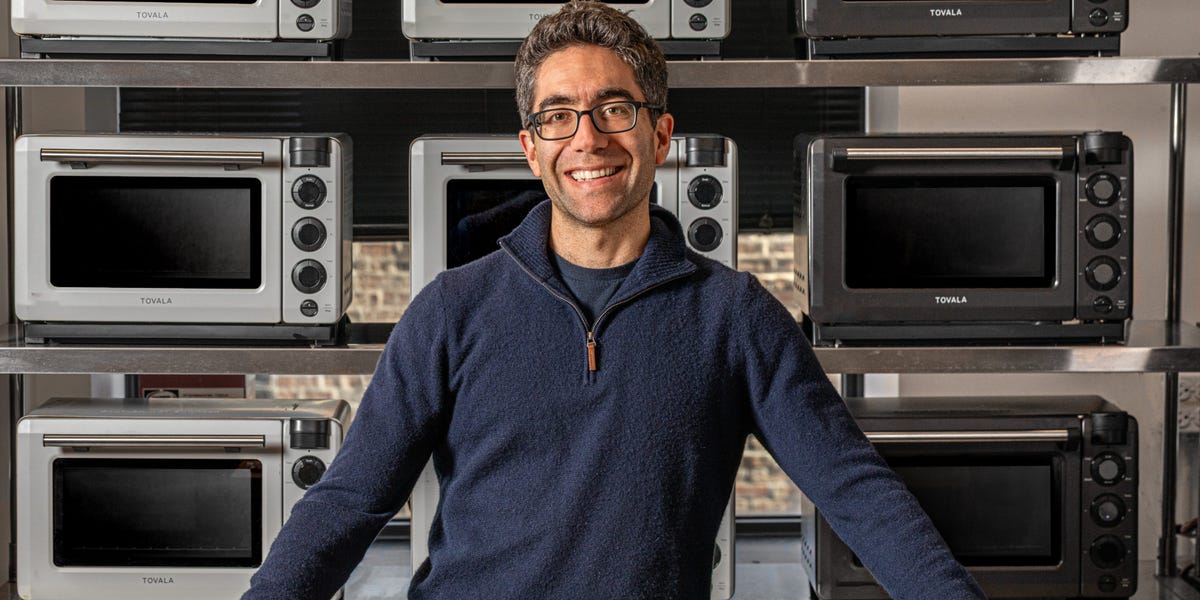
This as-told-to essay is based on a conversation with David Rabie, founder of Tovala. It has been edited for length and clarity.
When I was in business school, I was cooking dinner for myself one day, prepping meals for the week. I was using my oven, the stovetop, and a countertop steam machine, spending hours turning dials and pushing buttons. I thought, couldn’t this be automated?
That was the seed of the idea for my company, Tovala, which launched in 2015. Tovala is a meal service that allows users to cook at home, simply. Once you purchase a Tovala oven, you get fresh meals delivered weekly. You scan a code, and have a home-cooked meal in 20 minutes.
I wanted to provide a solution that lets busy people like me create a home-cooked meal without spending hours in the kitchen. The product evolved over time, but we stuck to that core tenet: a meal made with raw ingredients, but without the fuss.
My family’s immigration story shaped my outlook
Before I created Tovala, I was looking for business opportunities. I knew I wanted to be an entrepreneur; I just didn’t know what my business would be.
My family immigrated from Iran, and almost all of them became entrepreneurs, including my dad, who developed properties. My family — like many immigrants who find success in the US — is a big believer in the American dream.
I was raised on the idea that if you have an idea in this country and the resilience and grit to pursue it, you can achieve success. Since that was instilled in me from a very young age, I always thought I would achieve my goal of being an entrepreneur.
My family’s experience also gave me a higher tolerance for risk. I was colored by the stories I heard growing up. Compared to what my extended family had to go through leaving Iran, figuring out life and business in this country felt easy.
Creating the product with a small team was difficult
I would need that risk tolerance more than I realized. Tovala had early successes, including winning a $70,000 prize in a new venture challenge at the University of Chicago. And yet, even with that funding, launching the company was difficult.
Want more Business Insider in your news feed?
Add BI in Google so our reporting is easier to find when you’re searching for what matters.
I needed money to hire a team and develop the product. And yet, without that team, I didn’t have the tech I needed to prove the concept to investors. I needed one to get the other, and balancing that was difficult and lonely.
I managed to make it work with a small team that took very modest salaries. When we launched a Kickstarter and reached $100,000 in sales, we celebrated wildly. The immediate feedback was that this was a product people wanted to buy.
Overcoming challenges became part of our company lore
That wasn’t the end of the challenges — not even close. In March of 2020, we were slated to close on our Series B fundraise. The deal came apart at the 11th hour, after a conflict of interest surfaced.
I had a newborn at the time, and the pandemic was starting to shut down the global economy. It felt like a confluence of really horrible things. It was a pretty dark time.
However, once we survived, that story became part of company lore. That helped in 2023, when Silicon Valley Bank collapsed. We had almost all our cash tied up there, and we weren’t yet profitable. For a very stressful three days, we weren’t sure we would get our money back. Still, we were fairly assured that we’d take it through, just like we did when the series B collapsed.
The company is successful, and I’ve learned to live with worry
Today, Tovala has done more than $100 million in revenue during the past six months. The business has matured, and the team has grown. We’ve been profitable since 2024, which has taken a huge stressor off me.
And yet, a little part of me is still worried that it will all go back to zero. I think I’ve lived with that risk for so long that it won’t ever fully leave me. Over ten years in business, I’ve learned to continue to grow in spite of it.
Read the full article here