




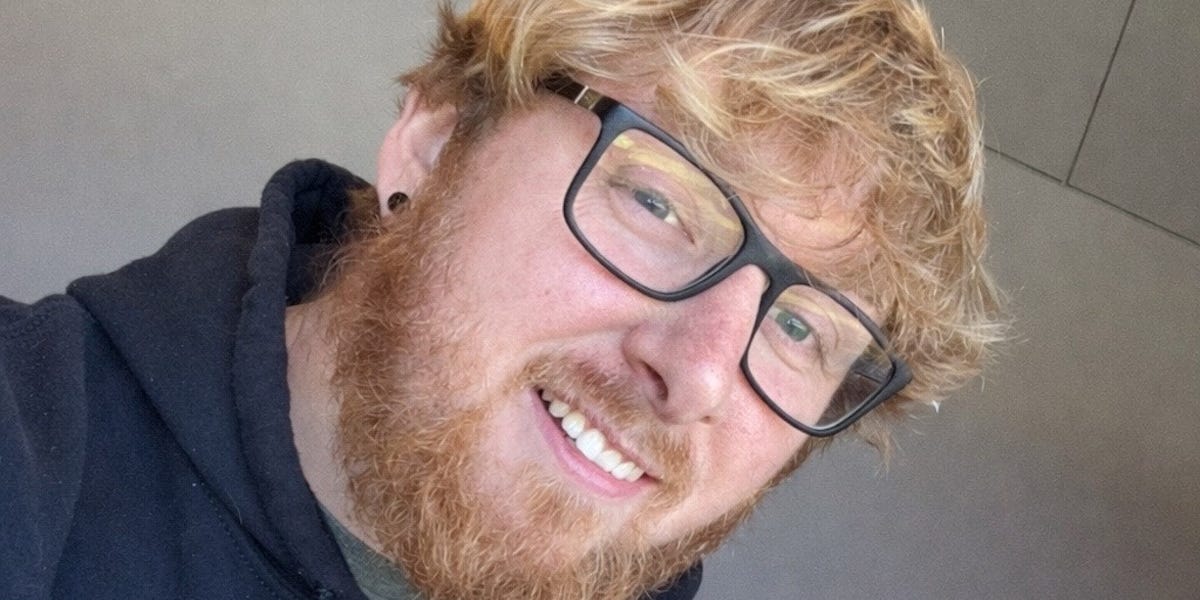
This as-told-to essay is based on a conversation with Kathy Lemoine, 58, who lives in Lawrenceville, Georgia. Her son, Andrew Reaster, died on August 9, 2025, from colon cancer. This story has been edited for length and clarity.
My son Andrew lived life to the fullest every day.
He was a kid at heart, decorating his condo with Pokémon and Legos. He loved his job as a UPS driver, and many of his customers loved him. He would jump around and pet their dogs. It seemed that each friend he had considered him their best friend.
On top of his active job, Andrew was also very regimented about his health. He followed a mostly clean diet and never skipped his dental appointments. He also had perfect school attendance and was rarely sick.
So when he called me in January 2025 about a stomach ache that wouldn’t go away for three days, I immediately called a gastroenterologist in my town. Andrew came in the next day.
The doctor immediately felt something hard during Andrew’s rectal exam and scheduled an emergency colonoscopy. After a major snowstorm, Andrew came in a few days later. I went with him, thinking the procedure would last at least half an hour. Ten minutes later, I was called in. They couldn’t even fit the scope through because of the blockage.
Within a week, we learned he had stage 4 colon cancer, with the cancer spreading to his liver, lungs, and stomach lining.
That’s when our nightmare began.
The hardest decision I ever had to make
We learned from the CT scans that the mass couldn’t be surgically removed and that Andrew would require chemotherapy treatment and a colostomy, a procedure that creates an opening in his abdomen to collect waste through a colostomy bag.
I couldn’t breathe. I felt like there was a hand squeezing my heart. Because Andrew had Asperger’s, now known as autism spectrum disorder, I knew if I focused on the negative, that’s what he would end up doing, too. So I said, “OK, honey, we can do this.”
He went to the front desk to start the paperwork for short-term disability. I called the doctor over and asked for a prognosis. He told me that without treatment, Andrew had about one month to live. With treatment, about six.
After Andrew drove home, I called my mom. I broke down on the phone. I was inconsolable. I said, “I just can’t believe that my son is dying.”
Andrew worked right until the day before his colostomy in February 2025. He was so worried about getting his short-term disability paperwork right so he wouldn’t lose his job. All he talked about was having the colostomy bag removed and going back to work after he kicked cancer’s butt.
The colostomy was supposed to involve a three- to five-day hospital stay. Due to complications, Andrew ended up being there for 48 days. He had fevers, which the hospital staff first thought were infections but later deduced were caused by his cancer.
Because Andrew gave me power of attorney, the doctor pulled me aside and said, “Mom, you have a huge decision to make.” Without chemotherapy, Andrew would only live for about three more weeks, but given how weak he was, there was a chance he wouldn’t make it through the night if we started now.
It was the hardest decision I ever had to make. I knew I would regret not trying chemotherapy. I sat with him throughout the three-day regimen, waiting to see what happened. It was scary because I could have lost him at any point. We ended up watching “Cars,” “Fast & Furious,” and all these different movies.
He made it. The doctor was shocked. I thought, “Oh my God, we’re going to kick this.” Andrew came back for his second round of chemo two weeks later.
Trying to stay positive
Andrew started to feel a little bit better. He still couldn’t work, but he went out with his friends. In the meantime, a new doctor closer to Andrew’s home encouraged me to look into any clinical trials I could find — he really didn’t think Andrew had very long.
The chemo became harsher and harsher on Andrew. His white blood cell count was too low to continue chemo, and he couldn’t go to the bathroom, even with the colostomy bag. Still, he seemed to keep a positive outlook.
By the time he turned 30 in July 2025, he only weighed 140 pounds, down from 210. Toward the end, he didn’t want friends and family visiting him anymore, seeing how skeletal he’d become.
He suffered greatly. He was in constant pain until he died on August 9, 2025.
In hindsight, I say, “Oh my God, I should not have let him suffer that long. We should have just let him go.” But I think if I let him go, then I would be saying, “Oh my gosh, we should have tried harder.” So no matter what, I would have regrets, which I do.
It was heartbreaking, watching him fade away.
I still wonder if we missed early symptoms
We had no idea that colon cancer was something to look out for. Andrew was young, had no family history, and never had any digestive issues other than that stomach ache. I believe that he probably had little signs here and there, but just didn’t know or dismissed them.
Colon cancer is now the deadliest cancer for people under 50. It’s also very treatable if caught early. I want people under 45 to know all the risks, so they can get screened the moment they notice any warning signs, whether they get colonoscopies or at-home colon cancer tests.
I also think people struggle to talk about colon cancer because it has to do with their butts, and I hope to make it less of a taboo topic.
I recently restarted Andrew’s Instagram account to share information about colon cancer. I put up a picture of him that says, “I am 29 with Stage IV Colorectal Cancer in this pic and will be gone in 4 months.” More than 400,000 people viewed his profile in that month.
My son didn’t have a snowball’s chance in hell. I hope, with more awareness, young people — and their parents — will realize how serious colon cancer is.
Read the full article here