




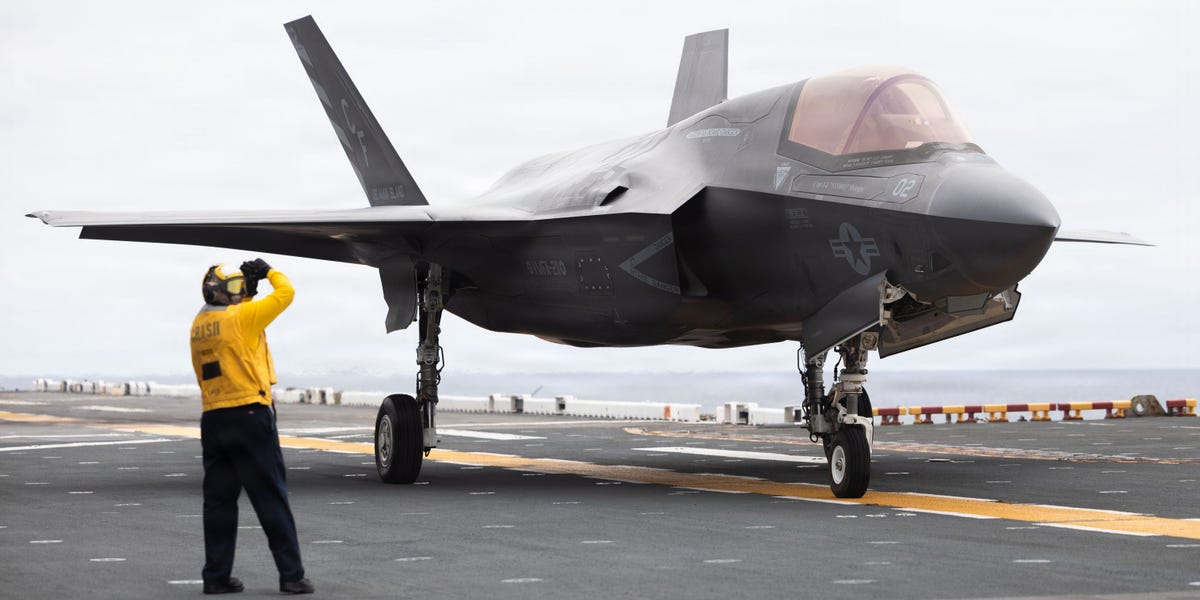
The first time a former Marine Harrier pilot brings an F-35 fighter jet in to land on the deck of an amphibious warship, skills honed by hundreds of hours in the old jet might work against them in the new Lightning II.
The AV-8B Harrier, the Marine Corps’ short take-off and vertical-landing fighter, saw its pilots carefully manage three different controls — one to control direction, an engine throttle, and a nozzle lever that directed engine thrust, allowing the aircraft to hover.
The combination of controls allowed Harriers to stay level while hovering above a moving ship, but it meant constant small corrections from pilots, who trained to land on ships by delicately hovering around a landing pad in a box pattern of precise movements — left, backward, right, forward — halting after each one.
The fifth-generation F-35 stealth fighter flies differently.
On their first approaches to land in the newer jet, former Harrier pilots may feel that they are moving too quickly, instinctively making corrections that worked in the Harrier, such as pulling back and adding power. In the F-35, those same movements can make the aircraft accelerate and climb, said Maj. Travis Theimer, the executive officer for Marine Fighter Attack Squadron 211, who logged nearly 700 hours in the Harrier before transitioning to the F-35.
Business Insider spoke with pilots aboard the amphibious assault ship USS Makin Island last month during a trip to observe deployment training for the Marines assigned to the 13th Marine Expeditionary Unit.
“I would bet that every Harrier pilot on his first [deceleration] to the [landing] pad has gone faster and climbed over,” he said, noting the tough transition to the F-35.
The Corps retired its final operational Harrier squadron this year, ending decades of flying the distinctive jump jet. Many of those Harrier pilots have been reassigned to the F-35, meaning they must unlearn some of the skills that once kept them safely in the air.
Harrier pilots had to devote significantly more attention simply to flying the aircraft, without an auto-throttle to control airspeed, though it did have an altitude-hold system, Theimer said. The jet was primarily an air-to-ground attack aircraft, supporting ground troops throughout the post-9/11 wars in Iraq and Afghanistan with missions like offensive strikes and armed reconnaissance.
Want more Business Insider in your news feed?
Add BI in Google so our reporting is easier to find when you’re searching for what matters.
The F-35 stealth fighter can do those jobs, too, but it also performs missions the Harrier typically could not, he said, including air-to-air fighting, locating and striking enemy air defenses, and sharing information with nearby aircraft and troops on the ground.
The F-35B, a variant used by the Marine Corps for operations aboard amphibious assault ships, can also take off and land vertically like the Harrier, but most of that complex work is handled by its onboard computers. Its sophisticated flight-control system can maintain a hover and even allows the aircraft to match the speed of a warship it’s landing on, aiding pilots much more than Harriers could.
Such assistance, however, doesn’t mean the F-35 is easier to master.
It’s a major change for aviators, said Lt. Col. Michael Jones, the commanding officer of Marine Fighter Attack Squadron 211, a former F/A-18 Hornet pilot.
“They were probably riding a unicycle, and now they’re transitioning to a bike,” Jones said.
The F-35 is “not simple to utilize tactically,” Jones said. But its automation, flight controls, and speed-control systems allow pilots to focus less on “stick and rudder” work and more on the tactical fight.
For pilots used to flying the Harrier, the change can feel like going “from watching on your phone a movie to going to an IMAX,” Theimer said. The new jet is equal parts weapons platform and sensing tool. The biggest learning curve, he said, is figuring out how to absorb and apply all of that information.
The F-35 combines data from its own sensors and other connected aircraft and systems into a single battlefield picture. That gives pilots more options during combat operations, but also much more information to process and act on. “I’m one person with one human brain,” Theimer said. When pilots try to manage air-to-air, air-to-ground, escort, and mission-command duties at once, “things start to fall out of your skin; you start to lose track of things,” he said.
Even after hours in an F-35 simulator, Theimer said his Harrier career had left him with instincts that did not easily translate to the F-35 and had to be unlearned.
“When you get on brainstem power, you just go to muscle memory, and the muscle memory was counterintuitive to what the F-35 actually did,” he said. The answer, he said, has been “just practice, just lots of reps” focused on approaching a hover and “breaking my muscle memory.”
Read the full article here